
By: Cavar (University of Maine: Augusta)
I am a writer—a Mad [1] one. I live with a number of syndromes that, variously, name the contours of that insanity—at least, as they appear to medical and psychiatric observers. Among them, diagnoses which would discredit and have discredited me, my political and ideological orientation, and my approach to the craft of storytelling. As a Mad writer and scholar whose interests are oriented toward the epistemological and rhetorical practices deemed “sane” and “insane,” and how these boundaries of un/reasonability are created and negotiated, I find myself particularly drawn to narratives deemed “speculative”—that is, “deliberately depart[ing] from imitating ‘consensus reality’ of everyday experience” (Oziewicz). A large, capacious meta-genre, “speculative fiction” typically includes science fiction, fantasy, Weird fiction, horror, dystopian fiction, and more approaches to storytelling and categories of narrative occurring somewhere not-quite-here and not-quite-now.
In 2024, my debut science fiction novel, Failure to Comply, was published. Drafted during my undergraduate years, which coincided almost completely with the first trump [2] administration, Failure to Comply follows a nameless narrator who rejects and is rejected by a medico-fascist governing entity known only as “RSCH,” the high-tech grips of whose authoritarianism are quite literally impossible to evade. The pursuit of this impossibility—and what potentialities exist beyond it, beyond what can be conceptualized within white supremacist, cisheteropatriarchal, and sanist/ableist frameworks of reason and truth—is the book’s primary organizing principle, even as pages with bizarre layouts; unconventional bolded, indented, and italicized text; and spontaneous time-skips defy linear, logical thought. Failure to Comply is a product of, and a tribute to, the speculative potentialities of Madness and particularly Mad opacities—practices of ambiguity that challenge psychiatric impulses to define and confine non-normative psychological experiences. Here, “speculative” operates less as a literary genre, and more as a site in which multiple realities may collide, or, to use a Zapatista aphorism, in which many worlds fit. [3]
This essay looks to the linkages between my novel, whose fractality and opacity may initially suggest distance from the “real world,” and lived experiences of Madness, institutionalization, and psychiatric violence. Indeed, the fractality present within this essay is meant to mimic the epistemic unfolding within Failure to Comply, a result not only of some fundamental, ontological Mad ambiguity (if such a thing exists) but also of the enduring psychological fracturing resulting from prolonged medical abuse. Such incursions on our access, as Mad people, to bodily integrity and personal autonomy, are across speculative forms presented as fantastical, and yet, proliferate within the lives and worlds sealed off from sane interpretation. We exist behind locked doors and plexiglass windows, beneath straitjackets, folded into black boxes [4] , whose violent opacity conceals harms in excess of reason, in excess of language.

The beginning of Failure to Comply’s chapter 6 (Cavar, Failure to Comply 99) situates us in a deceptively simple scene: a waiting room which has haunted the narrative until this moment, but has refused until this moment to present itself clearly. Image courtesy of Cavar / featherproof books.
Indeed there is an opacity to Madness, an opacity that both harms us (in the case of the black box) and which may heal and conceal us. Certainly, I can (and will) speak at length about the former version, the kind of opacity which permits violence against those denied personhood and thus expelled from public space—the violence of the institution, the concentration camp, the jail. But Madness also offers another, more generative kind of opacity. Here, I am drawing both on Edouard Glissant’s classic understanding of opacity as a response by the subaltern to their subjugator, a defense of particularity (as opposed to the universalizing, hypervisibilizing impulses of Eurocentrism) and non-assimilation as critical to our collective wellbeing (Davis 60). In short, those marginalized by a certain cultural, political, and epistemic system have the right to epistemic forms all our own, which may be difficult or impossible for the dominant group to perceive. This right to opacity is not a right to hegemonic violence, but rather, a grassroots method of anti-hegemonic evasion.
The right to opacity is not merely a defense of “human rights,” a framework with imperialist (Wendy Brown) and ableist roots (Nguyen) that understands “protection” as legibility to state power. My own formulations of transMad (a portmanteau of “transgender” and “Mad”) present opacity as a practice of resistance against the clinical demand for transparency and confession in pursuit of “cure” (Cavar, “Access Fictions” 163). These are practices that refuse the clinical/state confessional, against sanity, and against the very call to sense-making and interpretive conquest that readers of novels and peer-reviewed texts are asked to heed, at least by Eurocentric frameworks of interpretation and discourse. Implicit and explicit associations of humanness with whiteness and with sanity are inescapable within a tangled history of carceral sanism, defined by Liat Ben-Moshe as “forms of carcerality that contribute to the oppression of mad or ‘mentally ill’ populations under the guise of treatment” (“Decarcerating Disability” 58) in lock-step with chattel slavery and imperial expansion (Waggoner).
Inasmuch as Eurocentric commitments demand the suppression of alternative, subaltern subjectivities and epistemologies, they equally demand the strategic appropriation of these subjectivities and epistemologies as a point of contrast against a modern, reasonable, and indeed sane Eurocolonial world—what Walter Mignolo calls “colonial difference” (Alcoff). Mignolo identifies a profound myopia resulting from Europe’s teleological, enlightened self-understanding, rendering points of view outside of its specific historical genealogy “unthinkable” (Mignolo 90). What results is not only a system of appropriation and erasure but also one of rhetorical ownership [5] , epistemic possession, and the infinite extraction, not to mention plagiarism of marginalized knowledges and narratives. This status enables the transmogrification of collective myth-making, storytelling traditions, and cultural/spiritual gifts and care practices into clinicized symptoms made transparent and legible to medico-legal interlocutors (Malott, Barraclough, and Yes). What Catherine Prendergast calls the rhetorical “black hole” of supposed cognitive unfitness renders objection to these conditions crazy, absurd, and worthy of dismissal, until and unless the Maddened objector—an objector not victimized by commonsense but merely clinically “maladjusted,” [6] to it—is cured.
Transparency, enacted upon penalty of extreme harm and even death, is not only a practice of personal edification but one of destruction, one which practices of opacity have attempted to subvert. This is the case within Mad fictions and Mad realities. After all, the practices of fugitivity I chronicle in Failure—the deliberate destruction of surveillance technologies, including augmented reality contacts which transmit sensory input to data centers for harvesting; flight to and hiding in physical spaces associated with filth, poison, and other “civilizational” risk; and personal renaming in order to disrupt dominant logics of identification and circumscription—are all indebted to Black queer, trans, feminist, and Mad scholarship on fugitivity, particularly fugitivity from neoliberal academic institutions (Moten and Harney) and from the carceral demands of sex/gender (Snorton). In many ways, these fugitive practices reveal the radical potentiality of sowing chaos, wreaking havoc and willfully destroying reason, linearity, and civility—including those wielded within the context of canonical literature and literary analysis—as weapons of subjugation.

I decided to include an extensive note on the book’s intellectual genealogy as part of my citational practice (Cavar, Failure to Comply 292-293). Images courtesy of Cavar / featherproof books.
The, non-linear, rhizomatic [7] arrangement of ideas in Failure to Comply, whose closest analogue in form and content, as far as I have seen, is Samuel R. Delany’s Dhalgren (1975), turns Madness from a mere part of a book’s content or attribute of its character(s) to a constituen element of its form and politic. It is an experiment with the things that Madness could do and say beyond merely describing, for example, what it means to be confined by walls and by a discourse steeped in sanity.
For what it’s worth, I think that the completed novel is situatable within a broader discourse of science fiction, but in the process of getting there, raised more questions for me about the nature of “speculation” in speculative fiction, particularly as it relates to Mad and Maddened realities: I am writing about things that have really happened, albeit bookended by fantastical bodies and unfamiliar technologies. I am not alone in this quandary; speculative fiction is filled with contemporary political anxieties and observations. But the particular anxieties and observations of Mad people are confined and consigned to the unreal, the speculative, even when we report our lived experiences within the black box of the institution. What do we do, as Mad writers of speculative fiction, when our own lives are treated as fictions themselves?
So, yes: I wrote a work of science fiction, nominally taking place in an ambiguous future. An ambiguous future where, perhaps, what is happening now to Mad people happens to everyone, and they know it. As I wrote and then revised the manuscript, I found myself increasingly prone to half-joking that Failure, whose main motifs include “uncitizens”—made so by the mere performative utterance of the seat of state power—being hunted by vigilantes with axes as well as illicit surgeries performed by a being with eyes in its hands, is actually, in a way, a memoir told slant [8].

RSCH (indicated by boldface font) speaks directly to the narrator and to the reader, repeating demands for compliance that reduplicate and entangle with contemporary medical/psychiatric demands for wellness and recovery (Cavar, Failure to Comply 134). Image Courtesy of Cavar / featherproof books.
Within popular and oftentimes academic discourse in science fiction there exists an unspoken tendency to assume that texts within the genre describe a “not-yet” scenario, albeit one inevitably informed by the social and ideological conditions of its creation. It seems at first natural and sensible to envision the speculative as that which is not-yet, a “beyond” that provokes our imaginations and yet reifies the concreteness of the world as it is. A better framing, I suggest, might be “not-here,” or more specifically, “not now, not to me,” with language and story not so much offering a peek into a potential future but a bridge toward alternative presents, particularly those offered by people in positions of what Gayatri Spivak famously called subalternity, what Johanna Hedva calls “de-personhood,” and what Mel Baggs referred to as having been “Xed.” While many speculative texts address state violence, repression, and (correct or incorrect) assignments of Madness, fewer address the material realities of embodied and enminded experiences of subaltern, Xed [9] de-personhood and exile from reality and truth.
In both my peer-reviewed writing and my creative work, my primary objects of analysis are medicine, psychiatry, and critiques thereof. These topics receive similarly significant attention within speculative fiction both classic and contemporary: H.G. Wells’s novel The Island of Dr. Moreau (1896) is perhaps the ur-example of an approach to medicalized capacities for violence and torture which emerge momentarily in 20th century science fiction entries: the chemical mood management in Philip K. Dick’s (1968) Do Androids Dream of Electric Sheep?’s [10] and Room 101, the site of torture and brainwashing for political dissidents in George Orwell’s (1949) 1984. Some 21st century science fictional entries have addressed contemporary systems of medical and psychiatric violence with more specificity, constructing markedly dystopian scenarios with contemporary mirrors—Jessamine Chan’s The School for Good Mothers (2022), Leila Lalami’s The Dream Hotel (2025) and Bothayna Al-Essa’s The Book Censor’s Library (2024) come to mind. Notably, none of the above listed texts are concerned specifically with psychiatry or medicine per se—rather, they take up these institutions as extensions of, and often, metaphors for, a state concerned with exacting exceptional violence on undeserving (sane, everyday) populations—parents, neighbors, workers, and bureaucrats.
In these texts, we, as readers, enter through the lens of a narrator presumed to be reasonable and capable (if not at first, then eventually) of discerning the rational from the irrational, the just from the unjust. Indeed, we face highly racialized expectations to empathize with those characters afforded rational personhood, often through concomitant racialization as a (white) human (Rearick; Young). If it is at some point threatened, a narrator’s departure from rationality and descent into Madness is just that, a descent, signifying not only a loss of selfhood but a loss of credibility from the presumed-sane reader. Madness, here, is something either a) falsely assigned to a reasonable narrator by a power-hungry authority, and/or b) a status attained by a once-reasonable narrator once pushed into its grasp by the aforementioned authority. That is to say that “Madness” is routinely depicted as an injustice done to a hero whose humanity should be clear to readers; exploration of what it means to be a hero who whose sanity is meaningfully, materially compromised is significantly rarer. [11]
By this logic, Failure to Comply’s “i” could be characterized as an ontologically sane individual Maddened by unjust social conditions, without critical interrogation of our own readerly assumptions around in/sanity, in/justice, and in/appropriate reactions to said conditions. Readers of speculative fiction that contends with Madness often sit with the experiences of heroes forcibly Maddened by despots, rhetorically, materially, or both. We speculate: what if this gratuitous suffering happened to real people, people like me? What if it was not, in fact, consigned to the “not yet,” but instead to the “not here”—a fugitive reality just far enough for comfort from the sane person’s line of sight?
*
I was seventeen when I began writing Failure to Comply, having spent the majority of my life until that point consuming literature for younger readers. I clung to a particular form of fictional suffering, a particular—and, to me, familiar—kind of story. This type of story was usually oriented around some form of extraordinary medical incarceration and torture, preoccupied with the lived experience of powerlessness shared among many demographics of children. While largely marked as exaggerated and unrealistic in degree, the basic denial of bodily autonomy in many of these texts was recognizable in kind: Children’s and young adult series like Animorphs (1996-2001) by K.A. Applegate, Maximum Ride (2005-2010) by James Patterson, Virals (2010-2016) by Kathy Reichs, Unwind (2007-2015) by Neal Shusterman, and The Program (2013-2018) by Suzanne Young combine familiar motifs of carceral eugenics, literal and figurative dehumanization, and ominous demands for compliance, transparency, sanity, and purity.
These books do not necessarily take a deliberately crip, Mad [12] lens to the experience of childhood. They don’t need to. The subjugation of children to the whims of authority figures—parents, medical practitioners, teachers, and more—is real, and children notice, gravitating toward speculative books that dispense with adult authority and depict scenes of resistance against injustice. Yet here, we see the lines between the now and the not-quite blur, for a child might read of a protagonist denied food and then emerge from their book to a locked cupboard, emerge from a story of solitary confinement to the threat of grounding, with the removal of electronic devices that connect them to the world outside a likely-nuclear home. What I mean to say here is that science fiction for young readers often has fewer barriers to overcome in its links to “real life” violence, simply because for young people, a profound and legislatively mandated denial of autonomy is an unavoidable part of daily existence.
What does this tell us about Madness in speculative fiction more broadly, and in particular, about the distancing of science fictional Madnesses from their potential present day analogues? Children, along with many disabled adults in need of caregivers, live carceral lives, even institutional ones, if one is to define institutionalization based on Dave Hingsburger’s famous “burrito test” of bodily autonomy: whether one is in an institution depends on their ability to microwave a burrito in the middle of the night (Cavar, “Burrito Texts” 17). When I was growing up, my childhood home did not pass the burrito test. Imagine a world where you cannot control what you eat, when you eat it, when you are satisfied. Imagine a world where you were not permitted to cook and consume a meal in your own home. Imagine a world in which you are publicly force-fed for a lack of appetite, as happened in Failure to Comply, my novel, which is also, in a way, a memoir. Often, works of science fiction ask us to imagine a world in which, if this goes on, such violations will be visited upon real people, even as the Maddened and depersoned face them today.
*
I grew up watching Blade Runner (dir. Ridley Scott 1982), and it remains one of my favorite films, albeit complicatedly so. As a child, my father had a habit of pausing Rachel (Sean Young), a highly advanced replicant (android) who appears flawlessly human-passing, during her first onscreen appearance. He paused the film in order to give me the same test replicant-hunter protagonist, Deckard (Harrison Ford), must give rogue androids before he executes them. It is called the Voight-Kampff Indicator, a fictional test designed to distinguish the android (who, no matter how advanced, will inevitably, at some point, be clocked as subhuman and thus fail) from the human (each of whom is uniquely endowed with a soul, theory of mind, and cultural knowledge necessary to pass).
I failed. The first time, I asked him what it meant, that failure.
He said, it means you don’t think like a human. Grinning.
After that, it became a joke, albeit one I rarely found funny.
He would give me a question I had forgotten about: the calfskin wallet; butterflies and the killing jar. I would give my answer. Failed again, you’re a replicant!
I watched Rachel, poised and beautiful in a cloud of cigarette smoke, admitting inadvertently that she was not the human she claimed to be. Dismissed offscreen post-test by her father-creator Dr. Tyrell (Joe Turkel), a scientific marvel and a prisoner at once. A creature neither entirely human nor entirely non-, uncanny in its mimicry of human language and cultural mores.
Over the years, I’ve gathered my syndromes. Perhaps the most obvious—or, at least, most foundational to the architecture of my life—has been autism, with which I was professionally diagnosed in 2017, the same year I began earnestly working on Failure to Comply. That, alongside what is currently called “gender dysphoria,” were the first two professional diagnoses I sought out and received consensually. I knew both of these parts of myself, knew them like my organs, like my flesh. I needed things—accommodations, surgeries, documentation—that were available, but for a price. Strategically, I allowed these pieces of myself to be hollowed-out, honed, archived, and thus made real by the small, simpering women who held my autonomy in their hands.

RSCH’s discourse overwhelms and swallows alternative ways to conceptualize otherness: Deviance unseats queerness, alienation outpaces solidarity (Cavar, Failure to Comply 56). Image courtesy of Cavar / featherproof books.
Indeed I felt the holes already inside me growing. Disabled and Mad people are no strangers to things put inside of us without consent. This happens materially with very literal technologies that render disabled subjects into cyborgs, throwing a wrench, a pacemaker, or a prosthetic into Donna Haraway’s famous call for feminist collectives to embrace partiality over wholeness, mess over purity, in “A Cyborg Manifesto.” Even as it addresses the subjugation of (feminized, racialized) bodies to (white, masculinized) minds, the Manifesto comes with its own holes, namely, its foundational presumptions of ablebodiedness. What does this call—or, for that matter, the dystopian tactics of cyberpunk fiction—mean to those for whom physiological and neurochemical reliance on patented, exorbitantly expensive and often ethically dubious technologies is a reality? Jillian Wiese, a writer with a prosthetic leg, famously disrupted Haraway’s cyborgian vision in “Common Cyborg.” Wiese’s prosthetic was, after all, not a metaphor, nor was it the result of mere scholarly speculation. Rather, the prosthetic is a material means of access to the wider world and, inasmuch as it disrupts ableist expectations of comportment and public space, a source of social and physiological friction. There was, put simply, a hole in the futuristic imaginary in which Haraway and many others play: an opacity, a hole the size of a disabled (un)person, relegated to abstraction rather than material existence.
The rhetorical implications of these holes, particularly as they entangle with the above mentioned material concerns, also demand attention. Firstly, in literatures on disability, Madness, and other bodymind difference, the study of said difference, or, in some cases, the recovery from it (or better yet, administration of a definitive cure), is considered more trustworthy than the testimony of the currently, actively disabled. Diagnosis, often the sole means of institutional validation and accommodation, is less a practice of identifying existing problems than a performative act of transformation— turning, via a billing code, a sane subject to a Mad patient, a cognitively present interlocutor to a simple-minded, and indeed, child- or animal-like object. Not only does this idea guarantee the epistemic undermining of those marked as “crazy” or “stupid,” it also undermines the lived expertise of those who conditionally pass as sane, abled, and neurotypical.
This double-edged denial of both autonomy and expertise structures what M. Remi Yergeau calls “demi-rhetoricity,” a strategy by which parents, medical professionals, and other non-autistic actors seek to deprive both “high-functioning” (not autistic enough/conditionally neurotypical-passing) and “low-functioning” (too autistic, with too many needs) advocates of epistemic parity (46-47). The material implications of demi-rhetoricity are catastrophic and, for many autistic people, all too real: parents commit filicide against “low-functioning” children and are cast with sympathy, not horror [13] ; “therapeutic” institutions like the Judge Rotenberg Center torture (in the words of two UN Special Rapporteurs [Lydia Brown 31]) disabled children of color with beatings, starvation, and electric shocks with impunity (Davies). [14]

Violent institutions require the bodies of the subjugated in order to remain profitable. Here, the narrator realizes that they are not only powerless in the face of RSCH; they are indispensable (Cavar, Failure to Comply 123). Image courtesy of Cavar / featherproof books.
Certainly, my own denial of access to an autism diagnosis relied in part on the assumption that a functional, capable student—regardless of emotional or social distress—simply had no need for recognition: the sufficiently “high-functioning” autistic is, in the framing Yergeau critiques, hardly autistic at all—certainly not autistic enough to reflect meaningfully on their lived experience of neurodivergence. The material implications of demi-rhetoricity on me have been, and continue to be, growing suspicion as to the veracity of my claims both as an autistic person and as a scholar; as a Mad person and as a scholar. My coherence, in limited and highly curated locations such as the peer-reviewed journal, are both my salvation and my undoing.
*
Let’s go, for a moment, someplace less coherent, more opaque, where some version of me has also existed.
Here is who began writing Failure to Comply: a teenager in a coffee shop across from their college campus, anxiously awaiting their eighteenth birthday, which would, if they performed well enough, render them eligible for what the Diagnostic and Statistical Manual of Mental Disorders, Fifth Edition, (DSM-V) calls gender dysphoria; render them trans-enough in terms sufficiently legible to the medical industry (they prayed) which, in determining their eligibility for top surgery, was also determining whether they would live or die.
They had played this game before. Two years prior, another person, a creature whose survival until that point several orderlies found remarkable, was placed in institutions where bathroom doors could not be shut, and where their nude, shaking, adolescent body received a routine cavity search. I have always hated being told what to do, ever since an eight-year-old me called out the “tyranny” of mandatory bed-making, mispronouncing, of course, the word tyranny, which I had in my precocity read only in books. But, in hindsight, it was at that moment, the long moment of psychiatric incarceration, that [I, she, they] became an anti-fascist.
I isolate that moment in particular because it was then that several elements of power became abundantly clear, though I would not quite have names for these elements until that first semester of college. That power, understood generally, not only has but is the ability to conceal and reveal at will; to demand and extract confessions from bodyminds; to extract and materialize transparent bodies of knowledge from those who can’t help but submit. To make live and let die, and in so doing, to make fake and let real. I cried in my freshman dorm room, reading Michel Foucault for a philosophy course I barely understood. But I didn’t cry because I did not understand Madness and Civilization or Discipline and Punish. I cried because I understood them too well, feeling their arguments in my marrow.

recovery, here, is a process of violent erasure, one in which the Deviant body assimilates RSCH doctrine until it loses something of itself. In the text, this process of assimilation is signaled by physical immobilization (Cavar, Failure to Comply 135). Image courtesy of Cavar / featherproof books.
An incomplete list of what I learned during my teenage institutionalized summer:
Maximum Ride [15] and its science fictional kin are fake, and they are also real.
I know this because it happened to someone who shares this body, someone I trust implicitly because they are as me as I.
Being Mad is seeing, breathing, being, doing things that are not real, and at the same time, are absolutely true. Or perhaps it is the opposite.
The Asylum does not exist anymore, and it also does, and it also rests on the horizon—the not-yet, the yet-to-come—ahead of those with no choice but to see it (“The Institution Yet to Come”).
The Asylum exists because it does not exist. Because you’d be Mad to bring it up.
Bentham [16] believed in his own benevolence, his own rightness. With his belief, he made Truth, despite our knowledge of its falsehood.
Here is something that I have been learning continuously since:
These principles will be the rest of my life.
There is a word for this process, and that word is disillusionment. I certainly agree with the dis- if only to pun on my ongoing relationship to disability, crip, Mad community and culture. I even somewhat agree with illusion, which include the absolute Truths demanded by my RSCH and i’s and yours, too; the ideologies of gender, of sanity, of sex, of independence, of capitalism, of democracy, of freedom, of health, of safety, of nonsense terms like past and present and future. While I can easily cite the event concurrent with my beginning to write this novel (the 2016 Presidential Election) as inaugurating, as it were, an increased distance between “fact” and “fiction,” this does an immense disservice to all of us who have been subjugated at the hand of sane, settler, cisheteropatriarchal narrative domination. If coerced consensus makes what is real, then dissent must always and already be Mad.
*
That science fiction mirrors, fractures, twists, estranges, and comments upon contemporary and historical events is not a new assertion, yet direct connections between the lived realities of disabled and Mad people physically and epistemically isolated from the “real world” and the “unimaginable” practices of science fictional medical abuse are seldom made. Yet, when we strip the pages of their accouterments, nominally speculative works tend to depict existing practices of medical, carceral violence—kidnapping, forced institutionalization, denial of food and water, filicide and its enablement, and more—visited upon predominantly disabled and Mad (or Maddened) people, yet done largely behind closed doors, within segregated environments, or within situational locations in which there exists unique justification for said violence: they are lab rats, genetic freaks, alien races, hardened criminals. They become narrators whose perspectives, however committed to justice, are a priori unreliable, whether as a result of pre-existing pathology or via the paradoxical assertion that the long event of institutionalization itself has rendered them worthy of confinement.
In Failure to Comply, the relentless “unreliability” of the narration—not to mention, the unreliability of genre—creates a sense of claustrophobia that it is difficult to escape. Both create a confusion of place which mirrors the carcerality of those institutions which conceal, condemn, and (in so doing) create the Mad. If genre is a ward, whose fluorescents beat steadily, routinely, in eventing my path, then anti-genre is no-place. It is the no-place where non-things are felt by non-people in a series of non-moments. Silence is a powerful tool within what Smilges (Queer Silence 26) names as a rhetorical matrix of words, gestures, expressions, and other modes of communication, including refusals to do so. And yet silence, when mandated, disappears: The asylum is a great silencer, performing a disappearing act, the first and most primary being the disappearance of itself. The asylum, itself a partner and microcosm of the settler colony (Coleborne; Whitt), invents the real by removing contradiction, squeezing steadily until the plate of possible realities has been thinned to one great, terrible event.

Insert page 213 picture here. Caption: at first glance, those marked as Deviant do have one avenue for escape, or perhaps rehabilitation: the ability to identify and betray those less compliant than themselves by attacking them with an axe. It quickly becomes apparent, though, that the axe does not bestow the freedom that it promises (Cavar, Failure to Comply 213). Image courtesy of Cavar / featherproof books.
Not only is Failure to Comply’s nameless protagonist actively experiencing the deleterious a/effects of fascist propaganda—most obviously, with bolded statements meant to internally reprise RSCH commands, a Foucauldian internalization of medico-legal authority—they are also quickly revealed to be rife with their own insecurities. They experience a desperate obsession with bodily mastery whose impacts (including self-injury and starvation) mimic both contemporary coping mechanisms in those deprived of autonomy and the very techniques of discipline and punishment carceral forces mete out against us. Failure to Comply—and, arguably, any work that attempts to imagine itself outside the language of its writing—bears witness to wildly imperfect, even harmful bids for narrative and physiological control. And yet it is these bids, from the hunger strike to the political self-immolation, that generate Mad flashes, gritty f(r)ictions, in the face of sane hegemony.
A Maddened rhetorical imagination, a Maddened literary imagination, and a Mad poetic imagination, are necessary to fighting sane hegemony. These imaginative practices, I have argued, not only allow us to see and believe in the lived realities we have been taught to call “not yet,” but also to discern in them practices of resistance usable here and now. Failure to Comply may bear similarities to texts within the dystopian genre, but the practices of resistance it offers are less dramatic (and frankly, less exciting) than those of its shelfmates. This is not a story of a singular, scrappy hero against a designated “bad guy,” but instead a largely cerebral and often difficult-to-grasp negotiation of freedom, risk, and reason. If i—still nameless, still embattled—“wins” at anything throughout the course of Failure, they win at demonstrating that power is nebulous and truth is contextual, no matter how totalizing either may seem.
Yet this “win,” it seems, raises more questions than it answers: what is a win against hegemonic power, when even the most straightforwardly successful resistance movements leave their members with permanent scars, dead friends, and broken relationships? Fear, even paranoia, that someday, the bad guy will come back?
The revolutionary is seldom sane. The sane person is seldom, if ever, a revolutionary.
*
In “SF: Science Fiction, Speculative Fabulation, String Figures, So Far,” a transcription of an acceptance speech for the Science Fiction Research Association, Donna Haraway reflects generously upon the speculative practices and practitioners “of all genders and genres” that have influenced her work. This is a phrase I’ve used, too, though it feels a bit hollow, its acknowledgement of genre- and gender-nonconforming people tantamount to a “hybrid” listing on a literary magazine submission platform. A nod, a consignment space.
I wonder if there might be a sub-genre for us, for Mad people. By sub-genre, I don’t mean a smaller genre within an existing one, but instead something below, behind, outside. An undercommons, to use Moten and Harney’s term, and an undercommoning and Maddening of genre, not because nonconformity is inherently radical in and of itself, but because it can and has facilitated alternative ways of thinking about knowledge and communication. These are alternative ways that can, just maybe, break down the border between worlds, between conceptual frameworks. I can see its contours and its corners now, sometimes in the books I grew up with. Not necessarily because these books intend to do the Mad work I read in them, but because a Mad reading lets me link Animal Farm to the patients’ rights notice posted on the wall of the inpatient unit—too high for us patients to read.
The Maddened imagination I have, in this text, advocated for, allows us to link Mad and Maddened experiences such as these to speculative “fictions,” not as metaphor but as literal representations of real lives that sane publics rarely see. This approach views Madness capaciously: as a set of struggles befalling those suffering at the hands of the state, yes, but also a gateway to “impossible” and opaque practices of resistance and reimagining. We have the raw materials in existing speculative fictions, even those whose connection to Madness is neither explicit nor intentional. We have our hands, too, capable of rescuing our narratives from epistemic and material black sites (prisons, asylums, hospitals, group homes, detention centers) and re-presenting them in the service of community and collective consciousness.
Science fictional texts will always be limited by the realities and the discourses they take as given. Representations of Madness therein are likewise limited by preconceptions about who is, and is not, capable of relaying Elsewheres to an audience. Yet from our present positionalities, with the texts in which we’ve scavenged Madness, readers and writers can identify echoes of the “untruths” we live and embody in fictional happenings deemed too violent, too frightening, and too outlandish to be true. From my desk today, I watch civilians murdered, children kidnapped, immigrants tortured in trump’s latest fascist spectacle. I reach backward within my own experience—my institution, my confinement, my abuse, my opacity (chosen and unchosen)—and I meet this Mad reality with a grim understanding. All who have been incarcerated by a colonial, white supremacist, sane-itizing state are my kin; we have lived the inside the exception, the violence, and the unreal, together. The fictions we build from these shared experiences of violence and survival can be an invitation to reimagine what is “real” and, in the process, challenge a system of sane hegemony that violates Mad personhood and deems those violations speculative, deems them fictions.
Yes, we speculate. We speculate by abandoning tenses: then, now, will, was. We speculate by understanding the past and present as a construct propped up by demands for legibility, an insatiable hunger for knowledge and with that knowledge, domination. This is a colonial and sanitizing, sane-itizing impulse—the impulse to strip, to reveal, and in that revelation, destroy (to pin the butterfly for study is to assume that it is dead)—that dominates sane/settler fields of vision, from medicine, to history, to literature, to technology. We embrace, instead, that we live in the negative, in the forest, stealing and transforming like crazy. Emerging (in) a new language that, by necessity, makes nonsense.
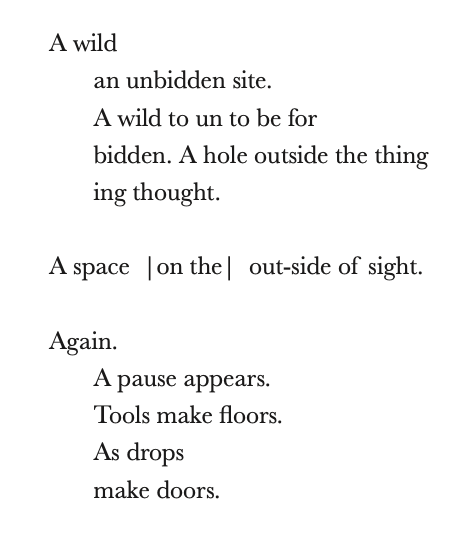
In this poetic section, we glimpse fragmented, gestural, and imaginative possibilities beyond RSCH, written in an English inevitably inadequate for addressing their true potential (Cavar, Failure to Comply 196). Image courtesy of Cavar / featherproof books.
Notes
[1] I capitalize Mad to denote its political implications as a reclaimed term with ties to a decades-old movement. For an introductory article on the Mad Pride movement, see Lewis, Bradley. “A Mad Fight: Psychiatry and Disability Activism.” The Disability Studies Reader 3, Lennard J. Davis, ed, Routledge, 2006, pp. 115-131.
[2] I choose not to capitalize his name here to signal my belief that his claim to authority –– as a political agent and a cultural influence –– as illegitimate.
[3] For an extensive discussion on Zapatista philosophy and calls to action, see Eraña, A., and Axel Barceló. “A World Where Many Worlds Fit.” The Oxford Handbook of Applied Philosophy of Language. Luvell Anderson, Ernie Lepore, eds., Oxford University Press, 2024, pp. 59-78.
[4] “Black box” is defined by Merriam-Webster as “a usually complicated electronic device whose internal mechanism is usually hidden from or mysterious to the user.” Within Science & Technology Studies, the term has expanded from its roots in midcentury military computing to encompass material and rhetorical technologies of opacity in modern life (Von Hilgers).
[5] See Hidalgo, Alexandra, Catheryn Jennings, and Ana Milena Ribero. “Constellating Stories and Counterstories: Cultural Rhetorics Scholarship Principles.” Constellations: A Cultural Rhetorics Publishing Space, 4, 2021, https://constell8cr.com/conversations/cultural-rhetorics-scholarship/.
[6] Cameron Awkward-Rich speaks extensively about trans/Mad “maladjustment” in The Terrible We, suggesting readers “[think] with, rather than against” the constitutive “insanity, tragedy, and absurdity” present in trans/Mad literatures (59).
[7] Deleuze, Gilles., and Félix Guattari. A Thousand Plateaus: Capitalism and Schizophrenia. Bloomsbury Publishing, 1988.
[8] With love to Emily Dickinson.
[9] Baggs uses “X’ed,” following Madeline L’Engle, as a shorthand for removal from the realm of the human-person, worthy of empathy and community. See Cavar, “Burrito Texts: Mel Baggs and the Language of Crip Life.”
[10] Adapted into Ridley Scott’s film Blade Runner (1982), which will be discussed later in this essay.
[11] There are real-life analogues to this issue, too: Rosenhan’s (1973) field-altering article, “On Being Sane in Insane Places,” illustrates the propensity of psychiatric institutions to assign pathology to those marked as patients, regardless of internal experience of psychiatric distress. By sending “sane” students into a psychiatric hospital, only to have them pathologized along with the Mad masses, we see that Madness is less the result of objective observation and more the result of circumstance and interpretation.
[12] I use “crip” and “Mad” in accordance with the reclamatory practices of crip/Mad scholar-activist communities.
[13] In January 2026, Australian parents Jarrod Clune and Maiwenna Goasdoue killed themselves and their two autistic children in an act of filicide-suicide, with news media turning its sympathies not toward the children victimized but rather to their parents (Wu). The notion that disabled children may be disposed of for the good of their caregivers is also present in fictional narratives: Lois Lowry’s (1993) The Giver and Neal Shusterman’s Unwind series offer speculative critiques of this impulse.
[14] James Patterson’s Maximum Ride series and John Singleton’s (2006) Angel’s Blood offer estranged analogues to this phenomenon.
[15] A young adult book series by James Patterson following young human-avian hybrid victims of medical experimentation. It ran from 2005-2020.
[16] Jeremy Bentham, creator of the Panopticon approach to carceral architecture, counted among a group of then-“reform”-minded thinkers seeking to replace unhygienic and chaotic prisons deemed not conducive to the development of (Christian) moral values (Steadman 5-6).
Works Cited
Alcoff, Linda Martín. “Mignolo’s Epistemology of Coloniality.” CR: The New Centennial Review, vol. 7, no. 3, 2007, pp.79-101.
Awkward-Rich, Cameron. The Terrible We: Thinking with Trans Maladjustment. Duke University Press, 2022.
Ben-Moshe, Liat. Decarcerating Disability: Deinstitutionalization and Prison Abolition. U of Minnesota Press, 2020.
Ben-Moshe, Liat. “‘The Institution Yet to Come’: Analyzing Incarceration through a Disability Lens.” The Disability Studies Reader 4, Lennard J. Davis, ed., Routledge, 2013, pp. 132-145.
“Black box.” Merriam-Webster.com Dictionary, Merriam-Webster, https://www.merriam-webster.com/dictionary/black%20box. Accessed 30 May. 2026.
Brown, Lydia. “The Crisis of Disability Is Violence: Ableism, Torture, and Murder.” Tikkun, vol. 29.4, 2014, pp. 31-32.
Brown, Wendy. “‘The Most We Can Hope For…’: Human Rights and the Politics of Fatalism.” The South Atlantic Quarterly, vol. 103.2, 2004, pp. 451-463.
Cavar, Sarah. “Access Fictions: Clarity, Violence, and the Promise of transMad Opacity.” TSQ Transgender Studies Quarterly, vol. 12.2, 2025, pp. 162-177.
Cavar, Sarah. “Burrito Texts: Mel Baggs and the Language of Crip Life.” Review of Disability Studies: An International Journal, vol. 18.4, pp. 2024, pp. 1-29.
Cavar, Sarah. Failure to Comply. featherproof books, 2024.
Coleborne, Catharine. “Making ‘Mad’ Populations in Settler Colonies: The Work of Law and Medicine in the Creation of the Colonial Asylum.” Law, History, Colonialism. Diane Kirkby and Catharine Coleborne, eds., Manchester University Press, 2017, pp. 106-122.
Davies, Quentin. “‘Prisoners of the Apparatus’: The Judge Rotenberg Center.” Autistic Self Advocacy Network (2014). https://autisticadvocacy.org/2014/08/prisoners-of-the-apparatus/.
Davis, Benjamin P. “The Politics of Édouard Glissant’s Right to Opacity.” The CLR James Journal, vol.25.1/2, 2019, pp.59-70.
Delany, Samuel R. Dhalgren. Bantam Books, 1975.
Deleuze, Gilles., and Félix Guattari. A Thousand Plateaus: Capitalism and Schizophrenia. Bloomsbury Publishing, 1988.
Dick, Phillip. K. Do Androids Dream of Electric Sheep? Doubleday, 1968.
Eraña, A., and Axel Barceló. “A World Where Many Worlds Fit.” The Oxford Handbook of Applied Philosophy of Language, Luvell Anderson, Ernie Lepore, eds., Oxford University Press, 2024, pp. 59-78.
Haraway, Donna. “A Cyborg Manifesto: Science, Technology, and Socialist-Feminism in the Late Twentieth Century.” The Transgender Studies Reader, Susan Stryker and Stephen Whittle, eds. Routledge, 2013, pp. 103-118.
Haraway, Donna. “SF: Science Fiction, Speculative Fabulation, String Figures, So Far.” Ada: A Journal of Gender, New Media, and Technology, vol. 3.1, 2013. https://hdl.handle.net/1794/26308.
Harney, Stefano, and Fred Moten. The Undercommons: Fugitive Planning and Black Study. Minor Compositions, 2013.
Hedva, Johanna. “In Defense of De-Persons.” GUTS, vol. 6, 2016. https://gutsmagazine.ca/in.
Hidalgo, Alexandra, Catheryn Jennings, and Ana Milena Ribero. “Constellating Stories and Counterstories: Cultural Rhetorics Scholarship Principles.” Constellations: A Cultural Rhetorics Publishing Space, 4, 2021). https://constell8cr.com/conversations/cultural-rhetorics-scholarship/.
Lewis, Bradley. “A Mad Fight: Psychiatry and Disability Activism.” The Disability Studies Reader 3, Lennard J. Davis, editor, Routledge, pp. 115-131.
Malott, Krista M., Shanee Barraclough, and Terrence Yee. “Towards Decolonizing Diagnosis: A Critical Review and Suggested Alternatives.” International Journal for the Advancement of Counselling, vol. 45.1, 2023, pp. 1-17.
Mignolo, Walter D. “Epistemic Disobedience, Independent Thought and Decolonial Freedom.” Theory, Culture & Society, vol. 26.7-8, 2009, pp. 159-181.
Moten, Fred, and Stefano Harney. “The University and the Undercommons: Seven Theses.” Social Text, vol.22.2, 2004, pp. 101-115.
Nguyen, Xuan-Thuy. “Genealogies of Disability in Global Governance: A Foucauldian Critique of Disability and Development.” Foucault Studies, vol. 19, 2015, pp. 67-83.
Oziewicz, Marek. “Speculative Fiction.” Oxford Research Encyclopedia of Literature, Deidre Shauna Lynch, ed, Oxford University Press, 2017. https://academic.oup.com/edited-volume/61883/chapter/547841578.
Prendergast, Catherine. “On the Rhetorics of Mental Disability.” Embodied Rhetorics: Disability in Language and Culture, James C. Wilson and Cynthia Lewiecki-Wilson, eds. SIU Press, 2001, pp. 45-60.
Ramírez, Alejandra I., and Ruben Zecena. “The Dirt Under My Mom’s Fingernails”: Queer Retellings and Migrant Sensualities.” Constellations: A Cultural Rhetorics Publishing Space, 2, 2019. https://constell8cr.com/issue-2/the-dirt-under-my-moms-fingernails-queer-retellings-and-migrant-sensualities.
Rearick, Anderson. “Why Is the Only Good Orc a Dead Orc? The Dark Face of Racism Examined in Tolkien’s World.” MFS: Modern Fiction Studies, vol. 50.4, 2004, pp. 861-874.
Rosenhan, David L. “On Being Sane in Insane Places.” Science, vol. 179.4070, 1973, pp. 250-258.
Scott, Ridley. Blade Runner. Warner Bros., 1982.
Smilges, J. Logan. Queer Silence: On Disability and Rhetorical Absence. U of Minnesota Press, 2022.
Spivak, Gayatri Chakravorty. “Can the Subaltern Speak?.” Imperialism, Peter H. Cain and Mark Harrison, eds. Routledge, 2023, pp. 171-219.
Steadman, Philip. “The Contradictions of Jeremy Bentham’s Panopticon Penitentiary.” Journal of Bentham Studies, vol. 9, 2007, pp. 1-31.
Von Hilgers, Philipp. “The History of the Black Box: The Clash of a Thing and its Concept.” Cultural Politics, vol. 7.1, 2011, pp. 41-58.
Waggoner, Jess. “Race, Gender, and Sanism: Remapping Mad Feminist Genealogies.” Signs: Journal of Women in Culture and Society, vol. 47.4, 2022, pp. 885-904.
Whitt, Sarah. “‘Care and Maintenance’: Indigeneity, Disability and Settler Colonialism at the Canton Asylum for Insane Indians, 1902-1934.” Disability Studies Quarterly, vol. 41.4, 2021. https://dsq-sds.org/article/id/753//
Wiese, Jillian. “Common Cyborg.” Granta, 24 Sept. 2018. https://granta.com/common-cyborg.
Wu, David. “Mosman Park Suspected Murder-Suicide Family ‘Failed’ by NDIS, Former Carer Claims.” News.com.au, 3 Feb. 2026. https://www.news.com.au/lifestyle/real-life/news-life/mosman-park-suspected-murdersuicide-family-failed-by-ndis-former-carer-claims/news-story/dcf219807c3cd92a4e53a69160060aa1.
Yergeau, M. Remi. Authoring Autism: On Rhetoric and Neurological Queerness. Duke University Press, 2018.
Young, Helen. Race and Popular Fantasy Literature: Habits of Whiteness. Routledge, 2015.
About the Author
[sarah] Cavar is a writer, editor, and educator interested in queercrip/transMad knowledge production. They hold a PhD in Cultural Studies with an emphasis in Science & Technology Studies from the University of California, Davis, and are the author of the novel Failure to Comply (featherproof books) and the poetry collection Differential Diagnosis (Northwestern University Press). A Lecturer of Interdisciplinary Studies at Grand Valley State University, their peer-reviewed research has appeared in Transgender Studies Quarterly, Kairos, the Journal of Literary and Cultural Disability Studies, and elsewhere. Cavar lives online at www.cavar.club.
Production Credits
Copy Editors: Gissell Del Castillo and Alexandra Hidalgo
Posted by: Gissell Del Castillo
Editorial Assistants: Gissell Del Castillo and Natalie Cohen
Managing Editor: Megan Simmermeyer
Social Media Manager: Sasha Jason
Editor-in-Chief: Alexandra Hidalgo
Related posts:
 Cultivating Solidarity through Radical Subjectivity: A Review of Noor Ghazal Aswad’s Searching for Solidarity: Revolutionary Dreams and Radical Social Movements
 Reproductive Liberation Requires Dismantling the Gender Binary: A Review of Doing Gender Justice: Queering Reproduction, Kin and Care by Shui-yin Sharon Yam and Natalie Fixmer- Oraiz
 Constellating Stories and Counterstories: Cultural Rhetorics Scholarship Principles
 Countering Racial Enthymemes: What We Can Learn About Race from Donald J. Trump
 A Dance of Joy, Distress, and Tenderness: An Introduction to Our Fourth Issue
 Constellating Jewish Rhetorics: A Call for New Directions from an Iraqi Jew