
Kimberly Williams, University of Florida
T. Allen Thomas, University of Southern Mississippi
Alexander Slotkin, University of Florida
Ivette Rodrigues, University of Florida
Claudia Mitchell, University of Florida
Nicole Green, University of Florida
Laken Brooks, University of Florida
Laura Gonzales, University of Florida
Abstract
Drawing on current conversations regarding the connections between digital and cultural rhetorics, as well as on current cultural events taking place during multiple current pandemics, this article presents four pedagogical examples stemming from a digital writing and cultural rhetorics graduate seminar. These examples are contextualized within interdisciplinary conversations related to digital writing and cultural rhetorics, providing readers with opportunities to see how digital and cultural rhetorics can be threaded together in pedagogical practice.
Introduction
Recently, there has been increased interest in rhetoric programs to make more intentional connections between digital and cultural rhetoric conversations. These connections are necessitated not only by academic interests, but also by current events that shed light on the importance of threading together digital/cultural conversations to make sense of, and intervene in, ongoing injustices. Concurrently, in 2021, there is the Black Lives Matter movement (BLM), a second Civil Rights Movement that is battling for a new world decentralizing white supremacy. Marginalized populations are overwhelmingly dying from COVID-19 due to medical racism, resource allocation, and comorbidity problems (also influenced by systemic oppression).
At a time of so much chaos and change, we posit that bridging digital writing and cultural rhetorics pedagogies can help teachers and students alike envision new futures and interventions within and beyond the university, as pedagogy can help bring healing and reflection in both classroom and community contexts. In this article, we present activities that connect digital writing and cultural rhetorics pedagogies through mediums that can foster community action and intervention, including poetry, drawing, storytelling, and translation. We hope this positions the following pedagogy as centered in community and intended to expand on curiosity, meaning-making, and digital, cultural communication.
In “Interfacing Cultural Rhetorics: A History and a Call,” Casie Cobos, Gabriela Raquel Ríos, Donnie Johnson Sackey, Jennifer Sano-Franchini, and Angela Haas provide a historical overview of how cultural rhetorics scholarship has developed and evolved since around 1990, highlighting the many ways through which scholars consider “how culture, rhetoric, and composition come together” (140). Cobos et al. illustrate the history and broaden the scope of cultural rhetorics scholarship, inviting “future work on the stakes and scope of cultural rhetorics as a term and as an analytic,” specifically by seeking interdisciplinary approaches to cultural rhetorics and “its history and convergence in relation to other areas of rhetoric and composition, writing, technical communication, and community literacy studies” (150).
In her section within this article, Ríos references the often-cited tension between cultural rhetorics scholarship and practice and the conversations related to digital writing and digital technologies. As Ríos explains, “recent scholarship on the rise of new media and digital humanities has often deployed the trope of colonization to articulate a variety of frustrations stemming from the ‘invisibility’ and marginalization of rhetoric and composition as a discipline in these trends to more internal frustrations over the imposition as the one and only valued mode of composing” (146). Indeed, for several years now, cultural rhetorics scholars have been inviting digital rhetoric and writing researchers to further interrogate the connections between technologies and cultural material, digital, and visual practices, pushing conversations about digital technologies away from positivist orientations that position digital media as the most effective and “progressive” form of communication (Haas, “Wampum as Hypertext”; Ríos, “Land-Based Literacies”). As Angela Haas explains in “Wampum as Hypertext,” “American Indians have a long-standing intellectual tradition of multimediated, digital rhetoric theories and practices—or theories and practices of communicating via the encoding of information with our fingers and toes, our original digits, using a variety of media.” (94). Haas urges digital writing and rhetoric scholars to avoid misconceptions about the tools and technologies they position as “new” or “innovative” at the expense of long-established cultural practices that get erased and/or fetishized through these arguments.
Drawing on emerging work that threads together cultural rhetorics and digital writing scholarship in order to counter “the shorthand that ignores the media produced by people of color, further erasing the rhetorical, oral, and aural traditions of these communities,” this article provides grounded activities and pedagogical examples that seek to position digital writing pedagogies through cultural rhetorics perspectives (Medina and Pimentel). We follow Christina V. Cedillo, Victor Del Hierro, Candace Epps-Robertson, Lisa Michelle King, Jessie Male, Staci Perryman-Clark, Andrea Riley-Mukavetz, and Amy Vidali’s example by “constellating stories that were told about how to practice a cultural rhetorics pedagogy” (n. pag.).
About our Digital Writing and Cultural Rhetorics Course
In this article, we share pedagogical examples, stories, and reflections stemming from a graduate seminar that we all participated in, both as students and the instructor, in the Fall of 2019. Following cultural rhetoric’s long history of centralizing stories as data (Cobos et al.), this article is not structured as a formal study, but is instead built around a constellated set of experiences shared with the goal of fostering further dialogue (Cedillo et al.). To compile these stories, all of the authors, which include students in a single course as well as the instructor, traced our experiences defining and adapting definitions of and orientations to digital writing and cultural rhetorics pedagogies through the course of the semester. We spent the beginning of each class period discussing how our definitions of digital writing and cultural rhetorics shifted through each week’s readings, and we took collaborative notes about these definitions on a shared google doc throughout the course of the semester. Following the conclusion of our course, we continued to meet together and discuss our shifting definitions and experiences with digital writing and cultural rhetorics throughout the course of a year, as current events taking place both in our city and in the world at large impacted our pedagogical practices and research agendas. By sharing pedagogical examples of activities developed in a digital writing and cultural rhetorics graduate seminar, we seek to continue expanding conversations about how digital writing and cultural rhetorics conversations can be threaded together and applied in pedagogical spaces across fields and disciplines.
The course that we introduce in this article was titled “Digital Writing and Cultural Rhetorics,” and it included MA and PhD students in multiple specialization areas within English studies. Given the interdisciplinary nature of digital writing and cultural rhetorics, as well as Cobos et al.’s recent call to leverage cultural rhetorics’ broad disciplinary history and potential in an effort to expand the scope of what “counts” as cultural rhetorics work, we used our class to both read interdisciplinary research in rhetoric and composition, technical communication, and English Education (among other fields) and to translate our readings and conversations into pedagogical examples that we both practiced and unpacked in class as a group. In particular, we sought to thread together conversations in cultural and digital rhetorics to further understand how cultural ideologies are embedded in all tools and technologies, while also developing methodologies and practices to help us design tools and technologies that are culturally-sustaining (Alim & Paris) and justice-driven (Jones).
It’s important to note that while this article is written by one instructor and seven students who worked together in a graduate seminar, the students in the course are also instructors who were teaching and implementing the pedagogical activities from the course in their own writing courses. The reflections we share in this piece come from our graduate seminar, where we all participated in each other’s activities. We also recognize that each of us as authors of this text have different positionalities that orient us to digital and cultural rhetorics praxis, which is why we provide brief positionality statements for each author in Table 1. We also note that we all contributed to this article equally and are listed in backwards alphabetical order with the course instructor listed last.
Author Positionality Statements
| Kimberly Williams is a Black, queer Ph.D. student studying healing, apocalypse, and sound studies |
| T. Allen Thomas is a Ph.D. candidate in English with Creative Writing concentration at the University of Southern Mississippi |
| Alexander Slotkin is a Jewish PhD student interested in cultural rhetorics, technical communication, public writing, and non-Western methods/ologies. |
| Ivette Rodriguez is a Cuban immigrant who grew up in Miami and is currently pursuing a PhD in English at UF with a concentration on Caribbean Literature. |
| Claudia Mitchell is a graduate student in English interested in addiction rhetorics, technical communication, and feminist criticism |
| Nicole Green is a white, queer, chronically ill/disabled Ph.D. student in English who studies children’s literature, pedagogy, and the history of education |
| Laken Brooks is a chronically ill, LGBTQ+, Appalachian PhD student who studies the intersections between folklore, wellness, and digital rhetoric. |
| Laura Gonzales is a Latina Assistant Professor of Digital Writing and Cultural Rhetorics at the University of Florida |
Course Structure and Assignments
According to the syllabus, our Digital Writing and Cultural Rhetorics course was “intended to help guide you [students] as you interrogate the connections and intersections between digital and cultural rhetorics. Coming into this work with an understanding that all technologies are inherently culturally and rhetorically situated, we [students and the instructor] will discuss and build on contemporary emerging frameworks for understanding how humans design and use technologies to make meaning in and across rhetorical and cultural contexts.”
Course assignments were intended to help students make connections between their own interests and current research within digital writing and cultural rhetorics. For example, instead of traditional reading response essays, students were asked to keep track of their reactions to course readings in a collaborative Google doc, called our “Notebook of Relations,” where students were asked to trace connections across readings and to also connect course readings to students’ interests and research outside of a single class. Students posted their reflections and connections in this open Google doc every week, where they were also asked to comment on each other’s responses and extend the conversation. In addition to this collaborative document, each week, one student in the course was assigned to facilitate a pedagogical activity that was intended to synthesize course readings through practical application. Rather than being a formal academic presentation, the pedagogical activities were intended to put course concepts and ideas into practice, as a way to build a digital writing and cultural rhetorics pedagogical repertoire.
Course Readings
Our course readings helped us develop ongoing and constantly evolving definitions of “digital writing,” “cultural rhetorics,” and their intersections. For example, early research from the subfield of computers and composition, such as Selfe & Selfe’s “Politics of the Interface,” helped us see one early intersection between digital writing and cultural rhetorics as disciplinary conversations. Selfe & Selfe introduce the idea that technical fields require humanist perspectives to be inclusive and accessible, rather than perpetuating the dominance of white, middle-class, largely male perspectives. Moving from computers and composition to technical communication, Natasha Jones’ “The Technical Communicator as Advocate” touches on the idea of oppression as structural; less a single, tyrannical force pushing people down intentionally and consistently than it is a swath of systems in place which, often because of the historical origins of these systems, marginalize groups of people as part of “everyday practices.” Technical and professional communication is simply a set of these systems in place, and particularly because of its history as arising as a part of the industrial revolution, the field at large has historically misunderstood or even ignored the human experience of marginalized people. Jones, in identifying these structures and raising the idea of their relevance to technical communication, calls for the integration of social justice advocacy into the field, specifically at the level of pedagogy.
We paired these readings in computers and composition and technical communication with articles in other fields like English Education, including Tamara T. Butler’s “Say[ing]HerName as Critical Demand: English Education in the Age of Erasure.” In this piece, Butler brings together Black and Decolonial Feminisms in a “plurilogue”—a theoretical space “to explore the points of divergence among women scholars of color” that helps recognize how Black feminist and decolonial feminist theories “both extend from intersecting, yet different, geographical and historical traditions” (157-58). Butler’s intentional move toward dialogue, we argue, is critical to a digital writing and cultural rhetorics pedagogy.
In “Interfacing Cultural Rhetorics,” Sackey’s section describes cultural rhetoric as a “verb, or a recursive way of inhabiting and engaging space” rather than a “static, totalizing, orienting position” (147). This push for fluidity and emergency is a point of connection between cultural rhetorics and digital writing—concepts that are fluid, constantly changing, and material. When we say digital “writing,” drawing on the work of scholars like Gabriela Raquel Ríos, we mean writing that honors and sustains cultural praxis, and that centralizes community needs and desires, and that actively works to redress white supremacy. This connection between communication, culture, and emergent practice is how we define, and consistently extend and redefine, digital writing and cultural rhetorics.
Pedagogical Examples
In this section, we share pedagogical examples that illustrate our practical approaches to defining, theorizing, and practicing digital writing and cultural rhetorics. These pedagogical activities we practiced in class came to be a grounding point for us—a place where we could thread together our individual perspectives and impressions of course concepts into a tapestry that came to represent what we, as a classroom community, understood to be digital writing and cultural rhetorics. We share pedagogical examples as a way to illustrate how pedagogy can serve as a point of connection between digital writing and cultural rhetorics conversations. We provide both reflections of how we practiced the activities in our class and advice for others who may want to try out these activities in their own courses.
Alexander’s Pedagogical Example: Black Out Poetry as an Accessible Mode of Cultural Writing
If we understand rhetoric as any symbolic meaning-making process, we might, to use Raúl Sánchez’s language, “see writing as any consequential mark-making” (88). That is to say, spraying graffiti on the side of a building or even making footprints in a pile of mud are rhetorical acts of writing so long as they are made with the desire to communicate. When we as writing instructors view writing and rhetoric through this terministic screen (Burke 50), it becomes clear that our students are veteran communicators, actively creating and circulating meaning outside the classroom by producing symbolic cultural objects or events (i.e., texts).
Forms of writing that disrupt or remix privileged alphabetic, pictorial, or auditory texts are interesting to me because they put cultural rhetorics and technical communication scholarship into practice in ways that are meaningful for and accessible to specific cultural communities. Whether these acts of writing take the form of “Chopped and Screwed” mixtapes (Del Hierro) or moving captions on platforms like Youtube (Zdenek), our students are recognizing and repurposing the textured world around them to write for audiences that are disconnected from hegemonic university classrooms.
Privileging culturally diverse forms of writing in the college can be kick-started with this blackout poetry activity. Blackout poetry is composed through the redaction of already composed texts in ways that are linguistically and visually significant. Figure 1 contains examples of blackout poetry created in our Digital Writing and Cultural Rhetorics graduate seminar. Our goal was to use blackout poetry as a pedagogical tool for honoring the “‘everyday writing practices of specific cultural groups’” (qtd. in Cobos et al. 144) and combating traditional understandings of composition.
Unlike normative notions of writing that ground “authenticity” in sole authorship or total originality, blackout poetry asks writers to create layers of meaning atop an already “finished” text, framed by the author’s cultural, emotional, and physical response to the original text. Just as my peers and I created a Google Document over the course of the semester by responding, in a non-linear and nontemporal manner, to one another’s thoughts on any given week’s readings, so too does blackout poetry frame writing as a collaborative meaning-making process. Blackout poetry as a pedagogical exercise then begins when students are assigned a text to redact or respond to. When adapting this activity to our Digital Writing and Cultural Rhetorics classroom to reinforce how Hip Hop rhetorics “transform information across media, languages, spaces, and physical locations” (Del Hierro 28), I printed out a page from that day’s reading—Victor Del Hierro’s article, “DJs, Playlists, and Community: Imagining Communication Design through Hip Hop.”

An example of blackout poetry written during my pedagogical activity.
An accessible and adaptable learning tool, blackout poetry can begin anywhere at any time, making itself amenable to non-normative bodies and/or non-neurotypical brains. For my peers, blackout poetry served as a counter-hegemonic way to “make sense” of an academic text through its pictorial and linguistic reordering (see Figure 2).
An otherwise technical, academic text was made accessible for different audiences through symbols (e.g., a raised fist and purposeful blotting) and spatially disjointed text, framed by the cultural knowledge they carry with them every day and everywhere. Each of us were fully engaged in creating a culturally diverse network of responses to that week’s reading, a friendly reminder that digital writing—produced in this case with bodily “digits” (Haas, “Wampum as Hypertext”)—is an inherently cultural act. Although the downfall of most pedagogical activities (blackout poetry included) is that they occur outside the cultural communities students belong to, (re)interpreting an otherwise academic text through non-academic ways of writing highlighted for us the intimate connection(s) between digital writing and cultural rhetorics (see Figure 2). When adapting this activity to your own courses, keep in mind that redaction has a long, painful history for some communities, stemming from oppressive actions such as the Federal Bureau of Investigation’s surveillance of Black activists. Depending on the rhetorical context, you might choose to preface this activity with some discussion of government redaction and power dynamics.
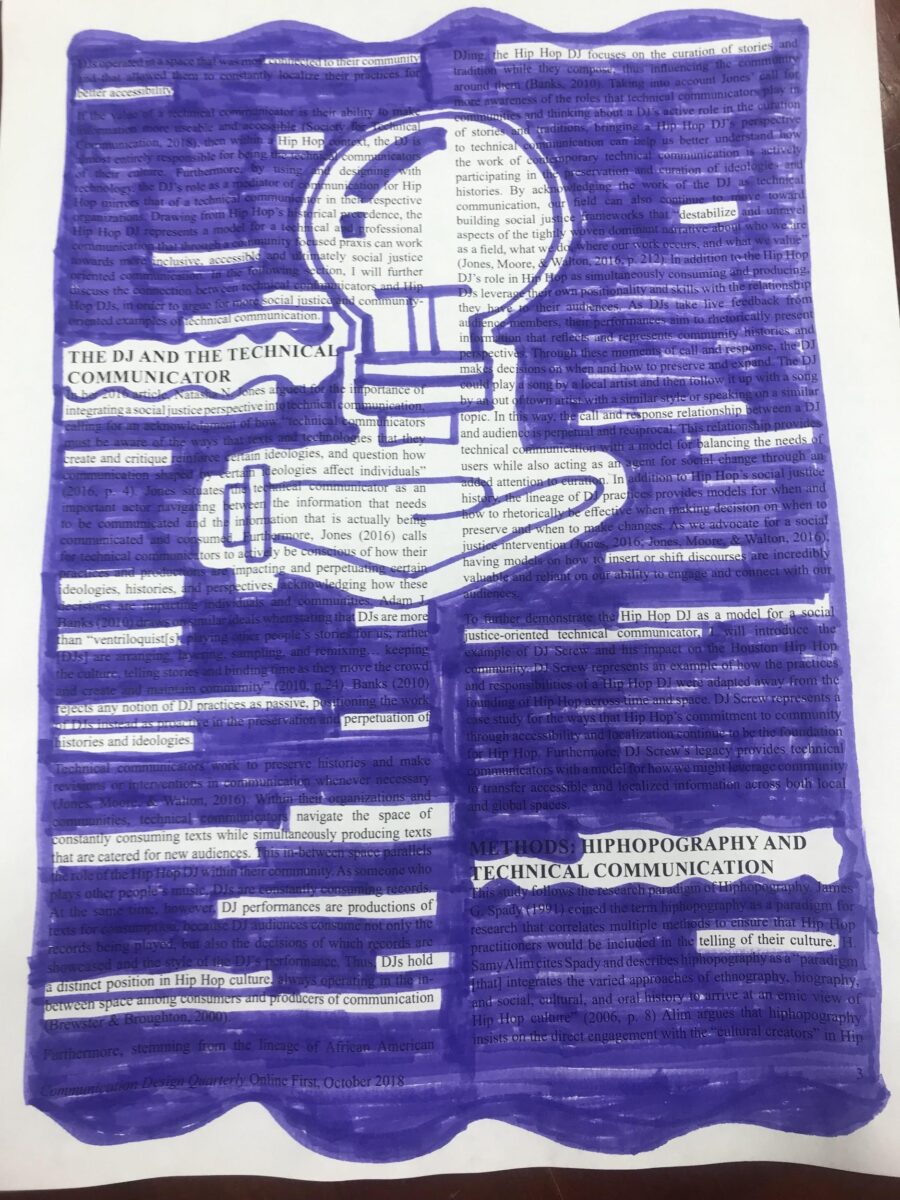
Another example of blackout poetry produced during class.
Ivette’s Pedagogical Example: Supporting Ambiguity in the English Composition Classroom
Borders are an especially sinister construct for immigrants from Latin America. Our bodies and voices mark us as trespassers who threaten the idea that the US is and should remain a white, English-speaking nation. In the 80s, Chicana rhetorician Gloria Anzaldúa published Borderlands/La Frontera, responding to the “open wound” that was, and continues to be, the Mexico-US border. She described her feelings of illegitimacy on either side of the historical power struggle between these two nations and proposed a healing tolerance for ambiguity. With this understanding of borders as constructs intended to exclude for the purpose of wielding power and drawing on the notion of digital writing and cultural rhetorics as two areas of scholarship that should be brought into further dialogue, for my pedagogical activity, I asked students in our class to think about two aspects of their identity and represent each through drawings and illustrations using separate sheets of see-through paper. I then asked them to superimpose one sheet onto the other, and to discuss how their illustrations change and expand when bringing various elements of their identities together.
Figure 3 is an example of two images drawn on projector slides, and Figure 4 shows how the two images come together when the projector slides are superimposed on one another. The student creating this project wanted to illustrate the challenge of balancing the desire for personal achievement with the need to remain grounded.
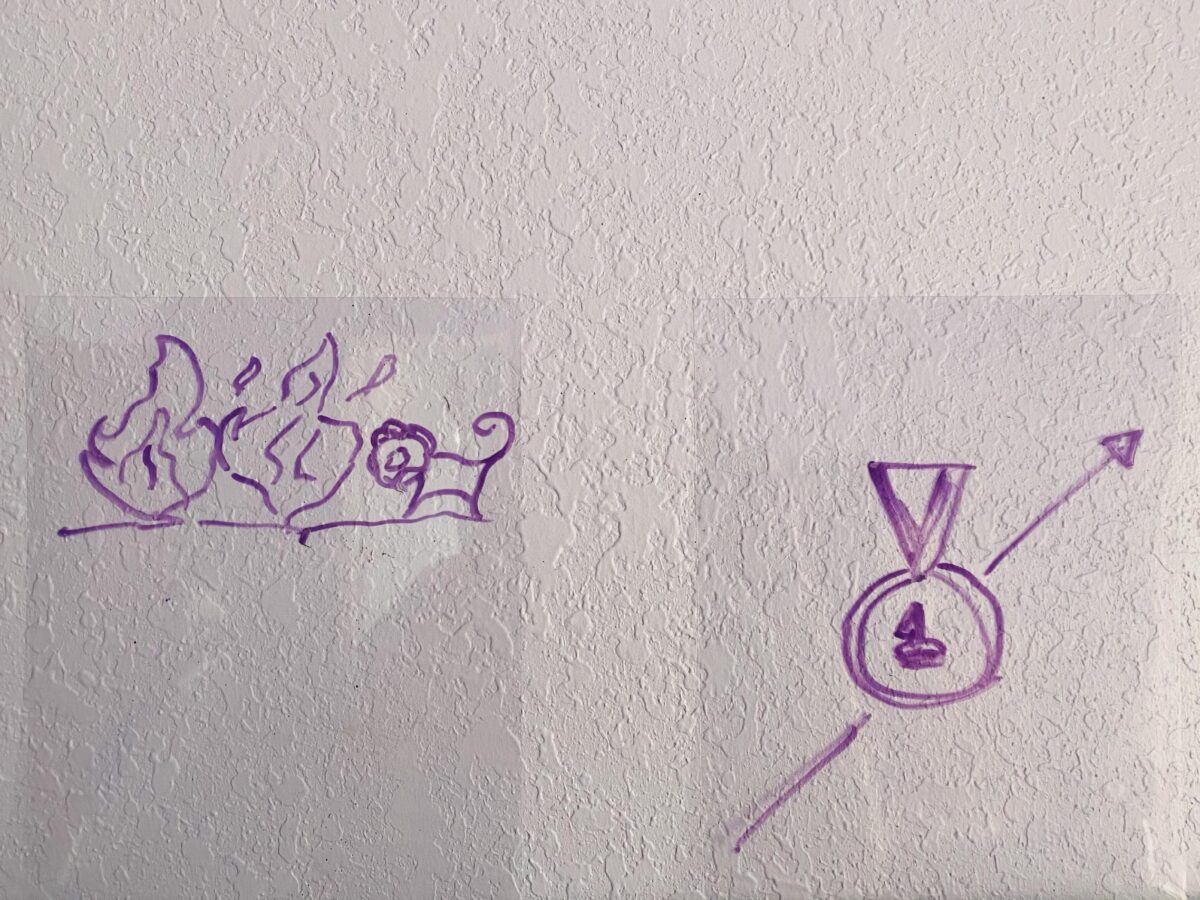
Two projector slides containing one image each. One shows a lion standing by flames; the other a first-place medal cut across by an arrow.
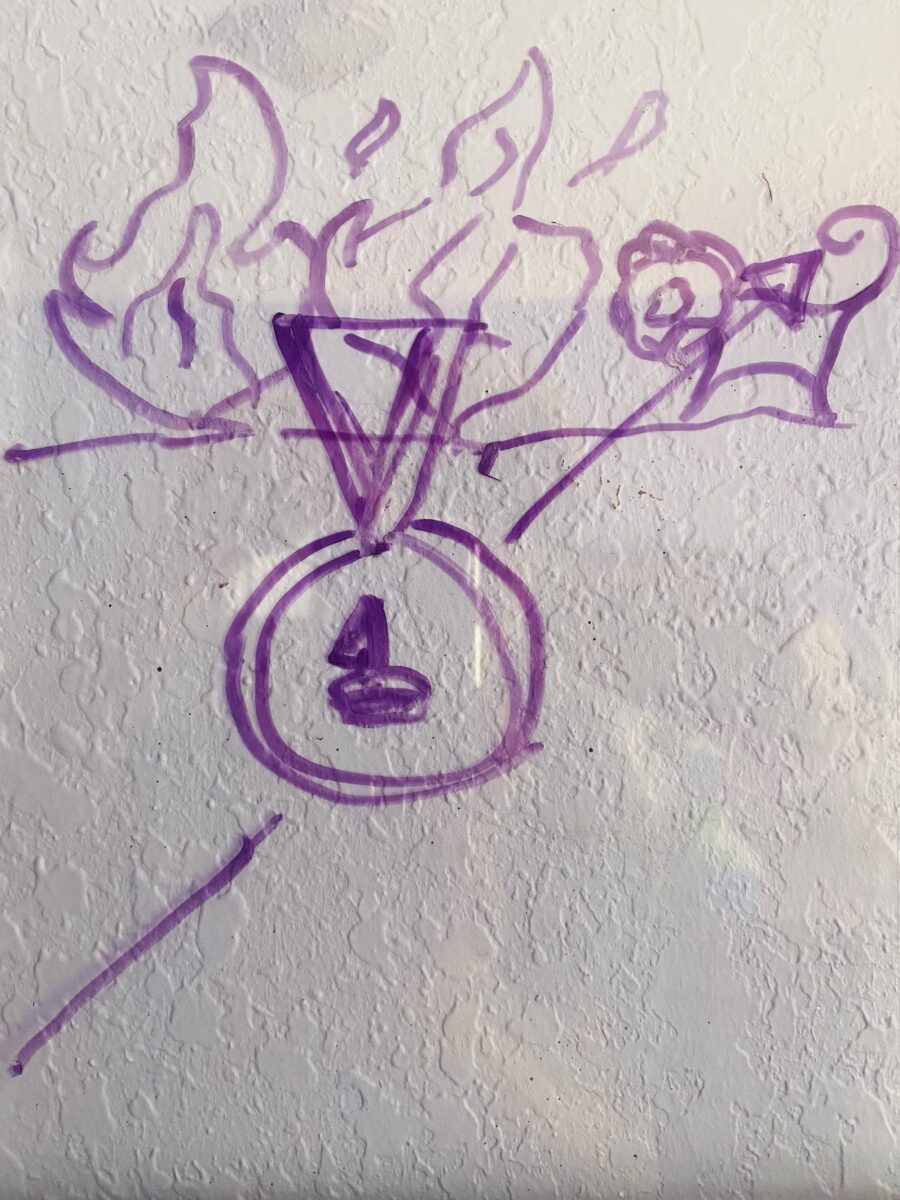
The juxtaposition of the two images in Figure 3 as one is laid over the other.
As students created these images and superimposed them, we highlighted the fact that bridging cultures and identities is never as easy as putting two sheets of paper together, but the material act of drawing and combining images helped us enter into important conversations of identity.
In another example, another peer shared his experience of being Jewish-American. On one of the see-through slides, he illustrated the rural, mountainous world where his ancestors had lived, and in the other, the metropolitan city where he resided now. As he placed each sheet on top of the other, a new image appeared that combined both worlds and more accurately represented who he was. Using these juxtaposed images, he was able to communicate his identity beyond his current reality to include an ancestry that, though we can’t see with our eyes, has shaped who he is today. Conveying the nuances of human identity, the multitude of factors that form it, is one of the purposes of writing. In this case, through a pictorial juxtaposition that expanded our understanding of what can constitute writing, my classmate was able to represent his cross-cultural, geo-relational history.
In this activity, by using transparent sheets of construction that we could manipulate and hold with our own hands, we could see in front of us that it was impossible to isolate one of our experiences from the other, as they all figured in the final image of who we were—revealing the hybrid (as opposed to pure) reality of human identity. Anzaldúa shows us this idea through multimodal writing in Borderlands/La Frontera, where she fluctuates between languages and genres without solid borders. Likewise, my activity invites students to move beyond the strict concept of alphabetic writing to other forms of mark-making, as well as beyond the idea of an essential and static cultural identity towards one that is ever-changing and fluid. Walter Mignolo’s The Darker Side of the Renaissance: Literacy, Territoriality, & Colonization and Raúl Sanchez’s chapter “Writing,” published in the book he co-edited, Decolonizing Rhetoric and Composition Studies, New Latinx Keywords for Theory and Pedagogy, can serve as references to further understand how alphabetical writing has historically been used to form cultural hierarchies and justify the colonization of one people by a another that is deemed superior based on the alphabetic literacy they have themselves established as the standard. With this activity, the idea that writing is the only and best way to communicate is blurred as different kinds of representative marks blend to narrate each person’s story of who they are, while at the same time, my classmates’ juxtaposed representations of their various identities resisted the hybridization that a compartmentalized form of illustration might have created. Finally, the indistinguishable meshing together of both identities illustrates how new cultures form through contact between peoples and situations over time.
Allen’s Pedagogical Example: Decolonizing Language through Key Words in Translation
Given the teaching environment we find ourselves in in a Covid-19 reality, our goal, now more than ever, should be to build assignments that engage both intellect and curiosity. We should invite our students to actively recognize that White-European-centered practices are as much about erasure as learning. As Medina and Pimentel remind us, the same shorthand that creates English speakers and “Good Americans” also ignores people of color and “eras[es] the rhetorical, oral, and aural traditions” of non-Anglo-European communities. Now, for most of us, we do not enter the classroom to oppress our students. In “The Technical Communicator as Advocate,” Natasha Jones suggests that marginalization stems from not just one single act or artifact, but a compendium. I believe this is true.
Most of us can agree that the shift to online teaching has left more and more of our learning community ungrounded. In “Chicana Feminism,” Candace de León-Zepeda speaks of “non-traditional places” as a sort of “Third Space” (Ruiz and Sánchez 137). To borrow the inspiration Zepeda took from Sonia Saldivar-Hull, Chela, Sandoval, Emma Pérez, and Gloria Anzaldúa; we must redefine and reclaim the classroom. Zepeda claims we empower our students by contesting historical dehumanization and marginalization as we reinterpret our “normative…theories, pedagogies, and practices” (138). The work we do matters if we are to achieve justice and healing. It is in this context that this activity was designed.
In my pedagogical activity, I provided students in our seminar with a sampling of multi-colored index cards. Once each participant selected a few cards, I asked them to write down a series of keywords or phrases related to the course readings. I invited students to be impulsive, to follow their instincts, write in whatever language(s) first came to mind, and write keywords that represented parts of the readings that resonated with them or that were confusing and hard to understand. Figure 5 includes some of the keywords that students in our course wrote on their index cards.

Multi-colored index cards from our activity.
I asked students to find commonalities in the keywords they wrote and to combine cards that were similar. I gave them time to make as many combinations as possible and asked students to then arrange the remaining cards so that they were visible to everyone. Students then took turns selecting a card from the “leftover” pile and placing it on top of an existing keyword or phrase while defining and making a connection between the two keywords displayed. Finally, I asked the class to select a language, Spanish versus English, for instance, and to translate and transcribe one keyword or phrase individually. For the students who were not bilingual, I asked them to translate an unfamiliar term or phrase into their own words. For some, this also meant taking a technical term from the course readings and redefining it into more colloquial terms. I also asked students to look up the remaining keywords in digital dictionaries and online translators, and to discuss how the multiple meanings provided by these tools differed or resembled how the course readings represented the keywords. After going through these translations and definitions, I asked students to discuss the process of translating keywords, reflecting on the questions: What do we gain in these translations? What do we leave behind? How was the process helpful in negotiating various meanings? Through this discussion, students can reflect on how meaning shifts across audiences, and how what we may first think of appropriate, well-managed, or easily understood may not be the same for every user.
Kimberly’s Pedagogical Example: The Afterlife in Counter-monuments
In the introduction to their special issue of English Education, “The Pain and Wounds: A Call for Critical Race English Education in the Wake of Racial Violence,” editors and teacher-scholars April Baker-Bell, Tamara Butler, and Lamar Johnson detail how storytelling and therapeutic curriculum is essential for this current bloodied, sociological climate. Towards the end of their article, Baker-Bell, Butler, and Johnson present three principles to integrate for healing literacy that include self-reflection, re(imagining), and discussion (125). These recommendations engage therapeutic and cultural practices into secondary education. In “The Stories They Tell: Mainstream Media, Pedagogies of Healing, and Critical Media Literacy,” Baker-Bell, Raven Jones Stanbrough, and Sakeena Everett interpret the pedagogy of healing through two sets of tools: “(1) tools to heal: acknowledging that the wound exists and (2) tools to transform: responding to the wound using a tool that works to transform the conditions” (139). Drawing on this work, which we read in our graduate seminar, the impetus for my digital writing and cultural rhetorics pedagogical activity was to integrate the aforementioned elements presented by Baker-Bell, Butler, and Johnson as well as Baker-Bell, Stanbrough, and Everett, and consider the elective nature of architecture, culture, and ancestry into design and meaning-making. I wanted to examine and discuss how we breathe into creation and define whose lungs we are using for propulsion and remembrance. This is how I define the nexus of digital writing and cultural rhetorics with the discussion of allegory, construction, and visual studies. What are the social and cultural influences that inform our consciousness to memorialize—what and how are students tethered to oppression, and how can students process and create alternative realities?
For this digital writing and cultural rhetorics pedagogy activity, then, I combined my interest of Black radical imagination, Black feminist studies, and technical communication for a project on alternative memorialization. More specifically, I designed an activity where students reimagine and create counter-monuments. First, I gave my classmates a brief presentation on contemporary discourse involving monuments, race, and confederacy. This included the discussion of Kehinde Wiley’s Rumors of War —a 27 foot countermonument against the confederate statues brooding on the street of Monument Avenue in Virginia. Wiley discusses his encounter with the memorials during a trip to Richmond (and moreover catalyzed this work): “They’re designed to terrorize and menace. They’re designed to remind the Black citizenry of Richmond that they have a place in society and that they need to stay within those confined spaces.” In the same presentation, I also discussed Simone Leigh’s statue After Anarcha that is in place of the previous Bronx’s Dr. J Marion Sims statue. J Marion Sims, the bestowed pioneer of gynecology, was also known for his brutal experiments, treatments, and dehumanization on enslaved Black women. Sims has memorial sites remaining in South Carolina and Alabama.
After the presentation, I gave my colleagues a prompt that included conceptualizing a countermonument utilizing collaging, drawing, and coloring. This included the consideration of sensory, placement, and community engagement. Figure 6 is an image of some of the materials that students used for this activity.
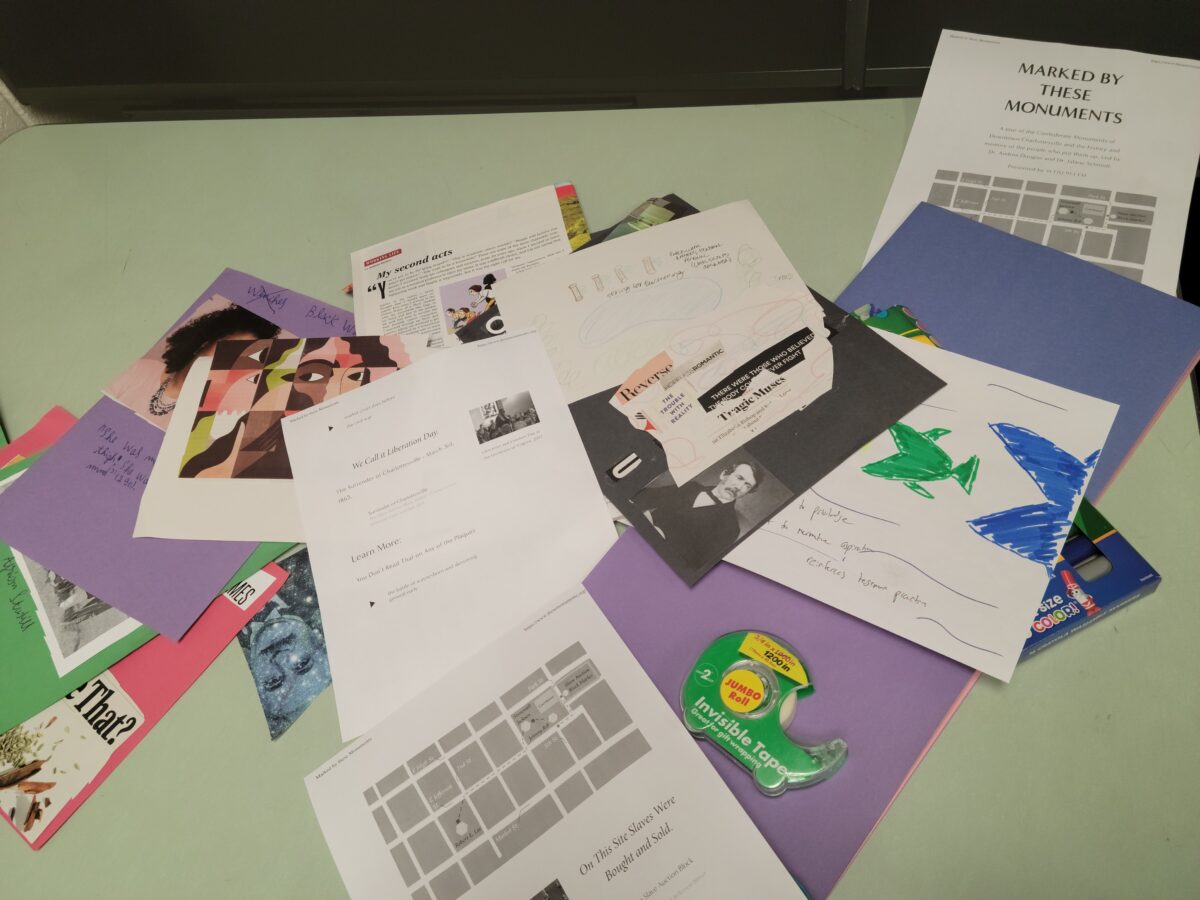
Some of the materials that students used in our graduate course to recreate monuments.
Students were given about 30 minutes to craft their blueprint design based on alternative or otherworldly artifacts against systemic oppression. After designing, students presented their materials, which culminated in examining and remembering issues regarding religion, gender, and ethnicity. Some monuments had gardens while others were fixed on an imagined person. What does healing sound like? What is the texture of care? What does love look like in architecture? They discussed their process, the metaphor, and geography of their enacted memorial. We talked about their artistic and scholarly influences and how these creations led them into the Third space of imagination and safety.
The genesis of this proposal was a culmination of the April 2019 ruling regarding Charlottesville’s statue and recent artists’ counter monuments. Futuristically, I will design an enhanced pedagogy with additional technology integration and gallery collaboration space where students can formulate grief, safety, lineage, and other concepts through visual construction. Moreover, I hope this particular curriculum redefines how the interiority of Blackness can travel through interdisciplinary vessels.
Reflections
The pedagogical examples that we shared are undoubtedly imperfect and represent just a few approaches to translating disciplinary conversations in digital writing and cultural rhetorics into classroom praxis. Our activities also privilege low-tech options and approaches to digital writing, which would require some adaptation when teaching in online environments. For example, the “blackout poetry” activity can be adapted online through Google Docs, the “supporting ambiguity” activity can be completed in Adobe Photoshop or the comparable open-access software Paint.NET. The “decolonizing language through translation activity” can be recreated through Google Jamboard, and the “counter-monument” activity can also be recreated through software like Tinkercad or Vectary. While the intricacies of each tool are expansive and stem beyond the scope of this article, it’s also important to consider issues of usability, design, and privacy (see Beck and Hutchinson Campos) when asking students to engage in digital writing through various online platforms.
While each student in the course developed their own activities, there are also theoretical through lines that connect our pedagogies. For example, the counter-monuments and ambiguity activities tap into students’ abilities to communicate creatively, through reinterpretative visual design. Both of these activities allow students to practice visual modes of communication, and re-work an existing piece of expression to form new rhetorical possibilities. The translation activity encourages students to deeply consider the meanings behind the importance of individual words by exploring their translingual definitions, as the blackout poetry activity does by having students confront the choice to remove or remix individual words; each reveals the malleability of language, and the layers of potential interpretation in each single word, impressing the significance of word choice upon future digital writing and cultural rhetorics practitioners. By prompting students to question existing structures and forms of expression, both the counter-monuments activity and the blackout poetry activity expose how pushing up directly against existing designs through reimagining them can create new modes of communication. Each pedagogical exercise engages in a multimodal form of teaching that requires creative expression and reimagination; a guiding force throughout these activities that confronts students with their responsibility to engage critically with existing uses of language and design and provides them with the freedom to re-work what seems immutable: written published work, monuments of oppression, classroom boundaries, and the tools of language itself.
Conclusion
Digital writing and cultural rhetorics pedagogies are imperative in this current moment, especially as we collectively live and teach through a pandemic and late-stage capitalism. We have seen how entertainment technology, like TikTok and Instagram, for example, are being repurposed to educate and radicalize youth as well as to serve as a site for social justice and community organizing. Footage of protests, community members explaining how to perform street medic tasks, protesters sharing their tips on how to keep safe, and theory made accessible for the revolution has multiplied in response to the pandemic and ongoing anti-Blackness around the world. The pedagogical activities that we shared in this article, while in some ways connected to digitally-mediated technologies, also bring discussions of digital writing to the material—to drawing and sketching and creating with our bodies as we sit in community together.
Decolonizing digital classrooms and syllabi cannot be done without drawing upon digital and cultural rhetorics for help, especially as we watch the state fail us in regard to technology. For example, in our state, the governor recently cut 30 million dollars from virtual learning software. If we were to think through the digital implications of these decisions during the pandemic without also addressing them from a cultural lens, we leave those most impacted by the decisions out of the conversation. Digital pedagogy is a reality for most educators right now, and given the unexpected transition, many are simply teaching to survive. Now, though, teaching online may be the norm, and we must adapt our pedagogy to reflect our most marginalized students’ (and teachers’) needs with culturally-reflective technology. Using these technologies as a form of protest does not need to live within a vacuum. Teaching with digital and cultural rhetorics pedagogies brings these collective efforts for justice to the digital classroom.
Works Cited
Anzaldúa, Gloria. Borderlands/La Frontera: The New Mestiza. Aunt Lute Books, 1987.
Baker-Bell, April, et al. “The Pain and the Wounds: A Call for Critical Race English Education in the Wake of Racial Violence.” English Education, vol. 49, no. 2, 2017, pp. 116-128.
Banks, Adam J. Digital Griots: African American Rhetoric in a Multimedia Age. SIU Press, 2010.
Beck, Estee, and Les Hutchinson Campos, eds. Privacy Matters: Conversations about Surveillance within and beyond the Classroom. University Press of Colorado, 2021.
Butler, Tamara T. “# Say [ing] hername as critical demand: English education in the age of erasure.” English Education49.2 (2017): 153.
Burke, Kenneth. Language As Symbolic Action: Essays On Life, Literature, and Method. University of California Press, 1966.
Cedillo, et al. “Listening to Stories: Practicing Cultural Rhetorics Pedagogy.” Constellations: A Cultural Rhetorics Publishing Space, vol. 1, no. 1, 2018. https://constell8cr.com/issue-1/listening-to-stories-practicing-cultural-rhetoricspedagogy/
Cobos, Casie, et al. “Interfacing Cultural Rhetorics: A History and a Call.” Rhetoric Review, vol. 37, no. 2, 2018, pp. 139-154.
Cornish, Audie. “Artist Kehinde Wiley’s ‘Rumors of War’ Now Stands in Former Capital of the Confederacy.” NPR, 11 Dec. 2019. https://www.npr.org/2019/12/11/787192628/artist-kehinde-wileys-rumors-of-war-now-stands-in-former-capital-of-the-confeder
Curran, Colleen. “Meet the Muse for Kehinde Wiley’s ‘Rumors of War.’” Richmond Times-Dispatch, 6 Dec. 2019. https://richmond.com/entertainment/meet-the-muse-for-kehinde-wiley-s-rumors-of-war/article_f12d1f46-f110-55e3-b49a-fddeaaef0623.html
Del Hierro, Victor. “DJs, Playlists, and Community: Imagining Communication Design through Hip Hop.” Communication Design Quarterly, vol. 7, no. 2, 2018, pp. 28-39.
DePasquale, John. “Blackout Poetry.” Scholastic, https://www.scholastic.com/teachers/blog-posts/john-depasquale/blackout-poetry/
“Electromagnetism.” Wikipedia, https://en.wikipedia.org/wiki/Electromagnetism
Farkas, JM. “Taking blackout poetry to the next level.” NCTE, https://www2.ncte.org/blog/2019/04/blackout-poetry/
Haas, Angela M., and Michelle F. Eble. Key Theoretical Frameworks: Teaching Technical Communication in the Twenty-First Century. Utah State University Press, 2018.
Haas, Angela M. “Race, Rhetoric, and Technology: A Case Study of Decolonial Technical Communication Theory, Methodology, and Pedagogy.” Journal of Business and Technical Communication, vol. 26, no. 3, 2012, pp. 277-310.
——. “Wampum as Hypertext: An American Indian Intellectual Tradition of Multimedia Theory and Practice.” Studies in American Indian Literatures, vol. 19, no. 4, 2008, pp. 77-100.
Hammel, Tyler. “Charlottesville Judge Says Confederate Statues Cannot be Removed, Will Award Attorneys Fees.” The Daily Progress, 14 Sept. 2019. https://docs.google.com/document/d/1o_UX8JMw7x1IY9RSBUeUwHBpFBsctfGJssNLpZAAR4s/edit?ts=5f888077&pli=1#
Jones, Natasha N. “The Technical Communicator as Advocate: Integrating A Social Justice Approach in Technical Communication.” Journal of Technical Writing and Communication, vol. 46, no. 5, pp. 342-361.
Johnson, Jessica Marie. “Xroads Praxis: Black Diasporic Technologies for Remaking the New World.” sx archipelagos 3 (2019).
Kersch, Dorotea Frank, and Mellinee Lesley. “Hosting and Healing: A Framework for Critical Media Literacy Pedagogy.” Journal of Media Literacy Education, vol. 1, no. 3, 2019, pp. 37-48.
Lahiri, Jhumpa. Hell-Heaven. Knopf Canada, 2015.
Medina, Cruz, and Octovio Pimentel, editors. Racial Shorthand: Coded Discrimination Contested in Social Media, Computers and Composition Digital Press, 2018.
Mignolo, Walter. The Darker Side of the Renaissance. University of Michigan Press, 1995.
Noble, Safiya Umoja. Algorithms of oppression: How search engines reinforce racism. nyu Press, 2018.
Paris, Django, and H. Samy Alim, editors. Culturally Sustaining Pedagogies: Teaching and Learning for Justice in a Changing World. Teachers College Press, 2017.
Pratt, Mary Louise. “Arts of the Contact Zone.” Modern Language Association, 1991, pp. 33-40.
Ríos, Gabriela Raquel. “Cultivating Land-Based Literacies and Rhetorics.” Literacy in Composition Studies, vol. 3, no. 1, pp. 60-70.
Sánchez, Raúl. “Writing.” In Decolonizing Rhetoric and Composition Studies: New Latinx Keywords for Theory and Pedagogy, edited by Iris D. Ruiz and Raúl Sánchez, Palgrave Macmillan US, 2016.
Sayej, Nadja. “J Marion Sims: Controversial Statue Taken Down But Debate Still Rages.” The Guardian, 21 Apr. 2018. https://www.theguardian.com/artanddesign/2018/apr/21/j-marion-sims-statue-removed-new-york-city-black-women
“Sculpture by Vinnie Bagwell to Replace Controversial Public Monument in New York’s Central Park.” Artforum, 10 Oct. 2019. https://www.artforum.com/news/sculpture-by-vinnie-bagwell-to-replace-controversial-public-monument-in-New-York-s-Central-Park-81002
Selfe, Cynthia L., and Richard J. Selfe, Jr. “The Politics of the Interface: Power and Its Exercise in Electronic Contact Zones.” College Composition and Communication, vol. 45, no. 4, 1994, pp. 480-504.
Zdenek, Sean. “Designing Captions: Disruptive Experiments with Typography, Color, Icons, and Effects.” Kairos, vol. 23, no. 1, 2018. http://kairos.technorhetoric.net/23.1/topoi/zdenek/
Production Credits
Managing Editor: Sonia Arellano
Copy Editor: Iliana Cosme-Brooks
Editorial Assistant: Jeanetta Mohlke-Hill
Social Media Manager: C. Widmann
Reviewers: Earl Brooks and Anonymous
Related posts:
 Countering Racial Enthymemes: What We Can Learn About Race from Donald J. Trump
 Community, Voice, Identity: The Principles of Cultural Rhetorics Pedagogies
 Dancing with the Devil Revisited
 A Response to Cushman, Baca, and García’s College English Introduction
 Wanaragua: An Embodied Performance of Resistance, Recognition and Resilience Among The Garinagu of Belize
 Storytelling and Relationality: Faculty Experiences During the Texas Winter Storm