
Jenny Bay, Purdue University
Huiling Ding, North Carolina State University
Tarez Graban, Florida State University
Emily Legg, Miami University of Ohio
Laurie A. Pinkert, University of Central Florida
Moderated by Alexandra Hidalgo, University of Pittsburgh
Introduction
On January 22, I got an email from my dear friend and PhD committee member Jenny Bay. The subject was: “Pat Sullivan has retired.” I glanced at the screen, taking in the magnitude of those four words. Pat’s retirement wasn’t shocking. Patricia Sullivan (we all call her Pat) received her PhD from Carnegie Mellon in 1986, so we knew the day was coming. It’s not like I see Pat often either. The last time was at the Conference on College Composition and Communication in 2017. And yet, her retirement felt like a monumental loss. For me, but also for the students who would never get to study with and be mentored by her. The five years I spent as her PhD student at Purdue University changed my life, and I liked thinking of her still changing other students’ lives.
Jenny’s email invited a dozen of Pat’s former students to brainstorm ways to honor her legacy, and this conversation emerged as a way of doing that. It features Huiling Ding, Tarez Graban, Emily Legg, and Laurie A. Pinkert, who (like me) all worked with Pat as their dissertation chair, as well as Jenny, who has been Pat’s colleague at Purdue since 2002. As we commiserated over how Pat had changed us on a Google Doc, long forgotten moments of my time with Pat flooded my mind. We tend to remember the greatest hits of our relationships, and—like algorithmically driven Spotify suggestions—greatest hits vary from person to person.
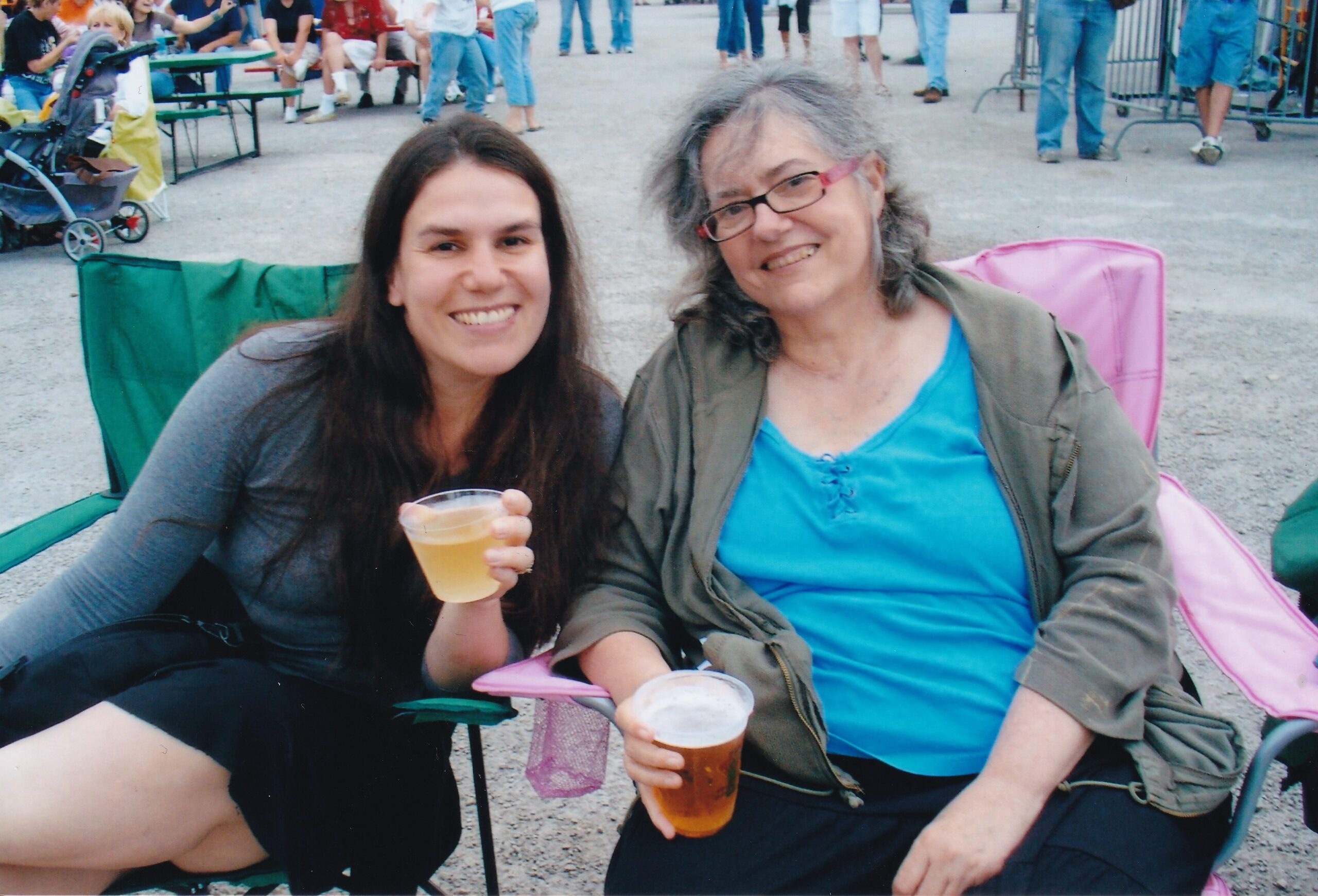
Alexandra Hidalgo and Pat Sullivan at the Carbondale State Fair (Photo by Peter Fadde).
In one of my favorite Pat Playlist memories, we’re exploring a house in Carbondale, Illinois that she and her husband Peter Fadde were thinking of buying. The backyard was a fenced-in forest. No grass, no paths. Just forest. There was an old-timey laundry shoot that went all the way to the basement. I was charmed by the home’s quirkiness, as were Pat and Peter, but the charm wasn’t enough for them to buy it. As we left, Pat told me they’d found the perfect house but wouldn’t bid on it. When I asked why, she said it had built-in bookshelves everywhere but no books. The lack of books was bad enough, but the previous owner had been a professor—and Pat was not about to buy a house from a professor who didn’t read.
I thought of Pat as my husband Nate and I toured the two houses we have bought over the years. We could afford these houses because I was a professor, first at Michigan State University and now at the University of Pittsburgh. I’ve loved my jobs, and you could argue I wouldn’t have them if I hadn’t told Pat about my desire to learn to make films during my first semester as a PhD student. No, I wasn’t studying filmmaking. I was studying rhetoric, but she understood that the detour would nourish my artistic spirit and make me a better scholar to boot. A week later, she told me her husband was a faculty member at Southern Illinois University, and he was teaching a two-week video production course in the summer that I could audit. Not content with letting me take a free course in a subject I wasn’t technically studying, Pat and Peter also found me free housing with Jorge Arévalo and his daughter Susana. Jorge was one of Peter’s graduate students and in their infinite generosity, he and Susana let me stay at their apartment so I could spend my days learning to shoot and edit footage with Peter and his wonderful students.
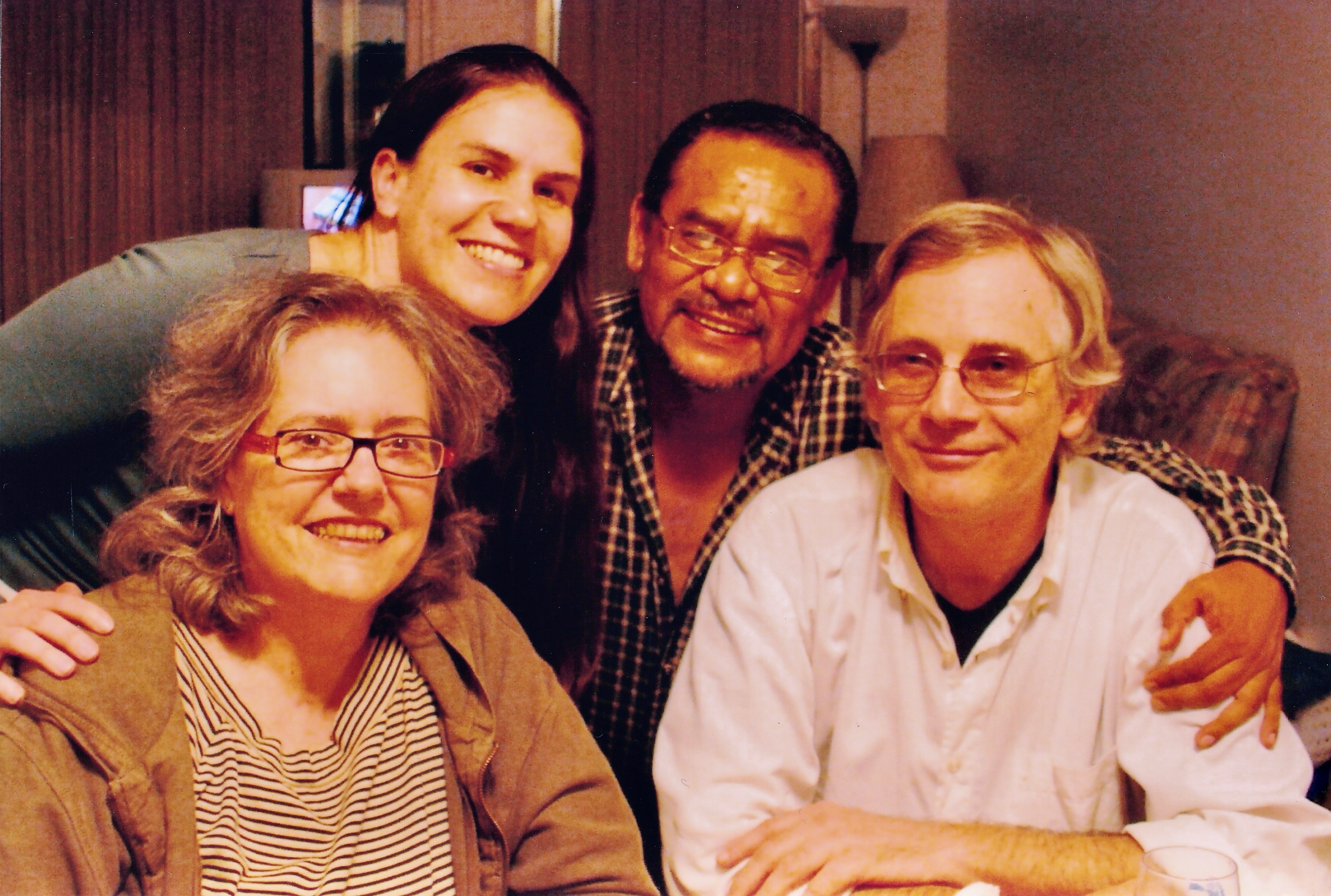
Pat Sullivan, Alexandra Hidalgo, Jorge Arévalo, and Peter Fadde (Photo by Susana Arávelo).
After class ended in the late afternoon, I’d find Pat lost in her research at the library or in Peter’s office, and we’d go on an adventure. We’d look at houses, we’d buy skirts, we’d listen to the western swing band Sleep at the Wheel at the county fair. I couldn’t have asked for a more magical two weeks—and the blend of filmmaking and rhetoric I learned that summer became my dissertation, which became my video book Cámara Retórica (dedicated to Pat, of course), which led me to tenure and to my YouTube channel and… the (play)list goes on. I told you Pat changed my life. Mine and so many others.
Pat met people where they were at individually, but she also knew how to bring them together. It started at the beginning of our PhD journey when Pat handed us gift bags filled with grad school necessities, like staplers and highlighters. Tarez says, “I still use the yellow and white polka-dotted mug I found in my own gift bag. This combination of planning, forethought, understated compassion, generosity, and practicality would define Pat’s relationship with me.” Pat mentored us all the way through the academic job market with that same level of care. Huiling writes, “the job search became less intimidating because we had a community and someone who was really caring and shared success stories, and coping strategies with us. That made the job search process less lonely and much more tolerable.”
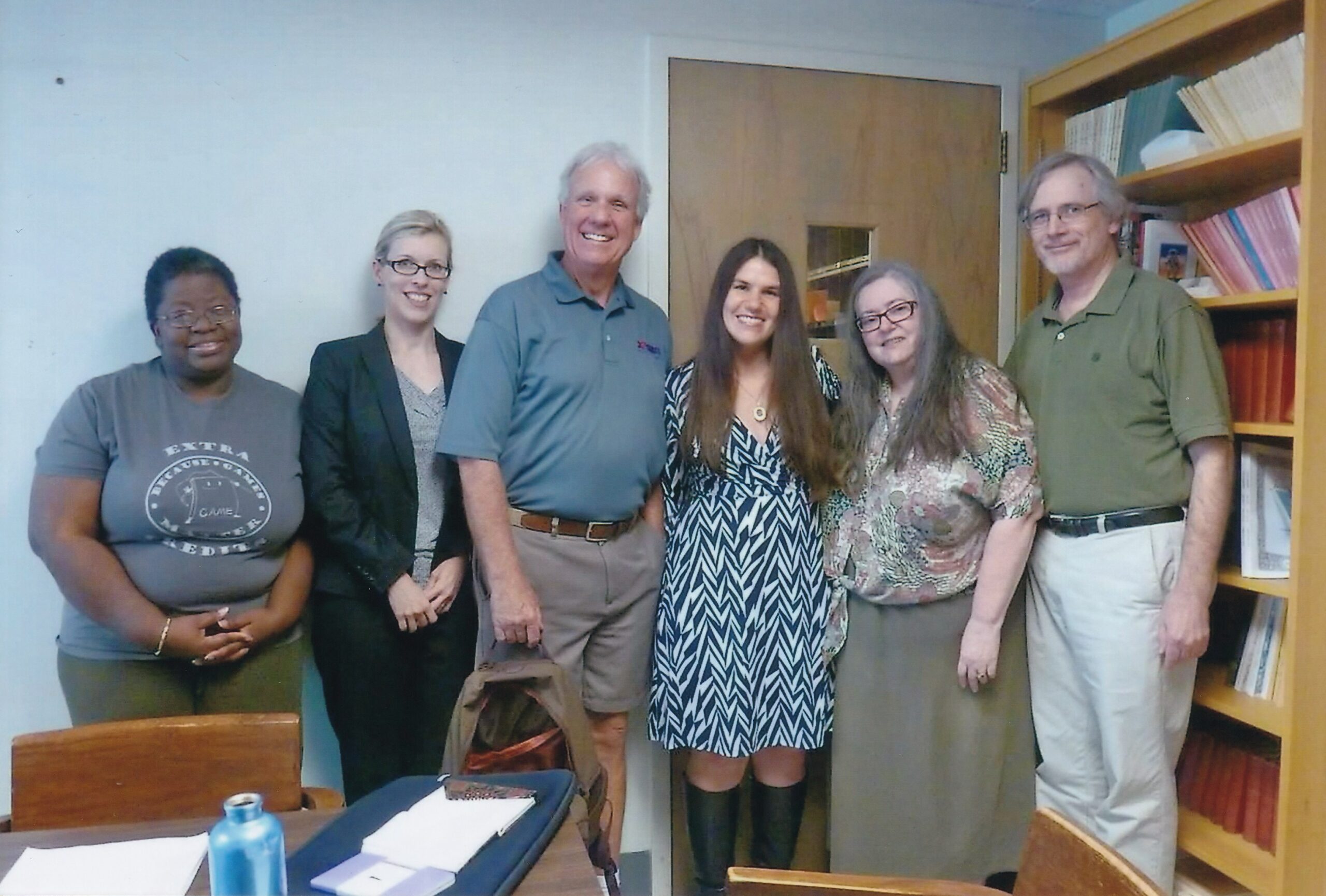
Samantha Blackmon, Jenny Bay, Joe Palmer, Alexandra Hidalgo, Pat Sullivan, and Peter Fadde after Alex’s dissertation defense (Photo by Antonieta Aagaard).
Pat believed her students could change the world, that as Laurie puts it, “Rhetoric changes things because it cannot help but do so. And as responsible change-makers we see the possibility in the new, the changing, the evolving.” Those words ring vital at times like the ones we’re living through, but they’re also heavy. Changing the world is a weighty proposition. Which is perhaps why Emily mentions that Pat “taught me that as a scholar, teacher, and researcher it’s okay to be a human and to feel deeply.” There’s immense joy and satisfaction to be had in academic work, but there are plenty of tears too, and you have to let yourself feel all of it, which can be exhausting. Pat was often exhausted. How could she not be?
I don’t want this conversation to turn Pat into a superhuman being we can’t strive to emulate. She wouldn’t like that, and it wouldn’t be useful, anyway. Being overworked and on too high a demand with grad students, Pat had to set boundaries. Even if she was your dissertation chair, you had to stand (or sit) in line for a chance to talk to her for 20 minutes or so. That’s all she could give you, but 20 minutes with Pat were invaluable, if you knew how to make use of them. Now that I have my own students and mentees, I try to emulate her generosity but also her boundaries. It’s not an easy balance to strike, but I still try, and I often think of her as I do.
Jenny reminded us “we tend to talk in past tense. Pat is still with us! And that is an important point. Not only is she still alive, but she is alive in us every day.” My hope is that she’ll be alive in you too after you read our conversation—whether you had the chance to study and work with her or not. Here’s what Pat’s students and colleagues learned from her. It changed our lives. It might change yours too.
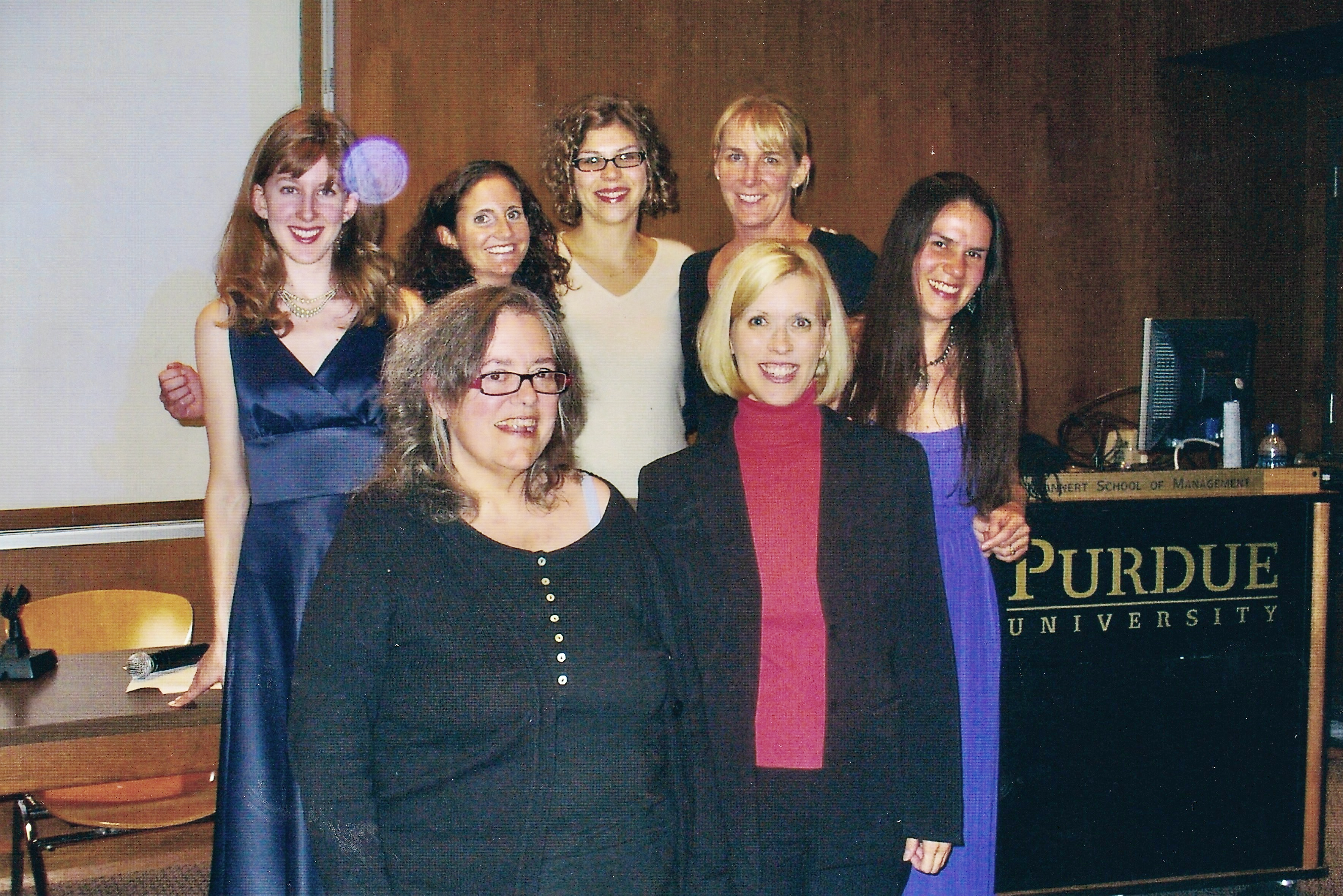
Caitlan Spronk, Megan Schoen, Liz Angeli, Cristyn Elder, Alexandra Hidalgo, Pat Sullivan, and Jenny Bay at the screening for Alex’s documentary Perfect at Purdue in 2009 (Photo by Nathaniel Bowler).
Let’s start at the beginning. What do you remember about meeting Pat for the first time?
Emily Legg: So, I applied to Purdue somewhat out of the blue and didn’t exactly do my research about who was there. I went on the advice of professors I had in undergrad who knew folks connected to Rhet/Comp programs. I distinctly remember walking into one of the 3rd floor seminar rooms in Heavilon Hall (where the English department used to be housed) and sitting with my cohort, who I hadn’t really met with yet. I was bright eyed and so very naive. But Pat walked in, and it was clear to me that everyone seemed to know who she was. She settled down, and we all got quiet. Then, without any context, Pat said: “So, what is Rhetoric?” No laughs, no smiles—she was met with the widest eyes from around the room. In my head, I immediately thought, “Crap, I should have studied before I came to this meeting.”
I was a new MA student who picked Rhetoric and Composition because I liked words. I don’t remember exactly how the conversation went after that, but I’m pretty sure some of the PhD folks in my cohort gave really great answers. I muddled through something, trying to connect it to the “big words” I learned in undergrad, like “semiotics” and “postmodernism.” The whole time, Pat just sat back, smiled, and engaged with everyone’s thoughts, muddled as they may be. She built on our ideas and somehow made this an introduction to the program. She ended by telling us not to worry if we didn’t know the answer. She told us that we were all there for a reason and had been chosen specifically because we brought new and exciting ideas to the program and that we were an amazing fit. Then, she gave us a mug (that I still have, ha), pens, Post-it notes, and candy, and sent us on our way.
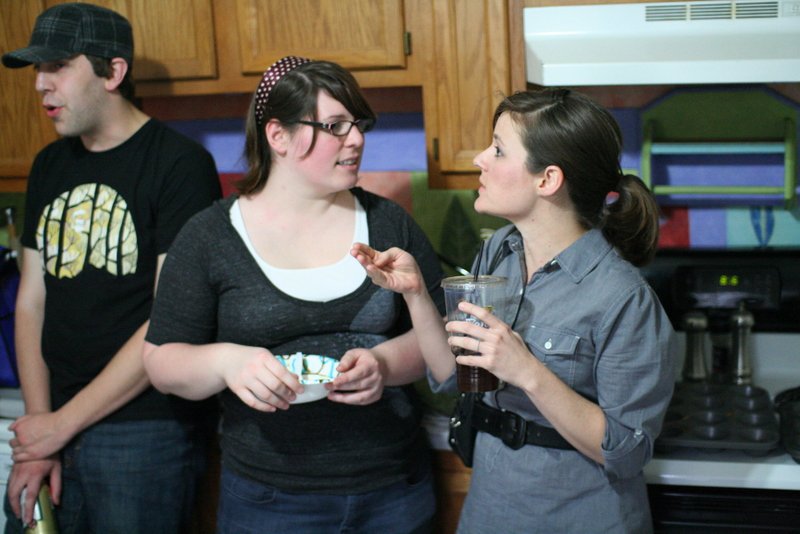
Laurie A. Pinkert and Emily Legg talk at grad a student gathering (Photo by Kristen Moore).
Laurie A. Pinkert: I was a master’s student, like Emily, when I first met Pat. But I wasn’t a Purdue student yet. I was an MA student at the University of Maine, and I’d been accepted to the doctoral program at Purdue but hadn’t finalized my decision about where I would attend. I was scheduled to meet Pat at the Conference on College Composition and Communication (CCCC) in New Orleans, and I have a distinct image of Pat, sitting in the lobby of a hotel, surrounded by a gaggle of folks. Honestly, I don’t remember much about what we discussed that day, but I remember the queue of people waiting for her time and feeling grateful for her making time to meet with me.
Tarez Graban: I first met Pat during the pre-semester orientation she held for the incoming Rhetoric and Composition cohort. We convened around a table at the Student Union. Characteristically, Pat was already seated, having arrived early to reflect on the agenda and anticipate our questions. Also characteristically, she was surrounded by a series of gift bags she had assembled for us. To this day, I still use the yellow and white polka-dotted mug I found in my own gift bag. This combination of planning, forethought, understated compassion, generosity, and practicality would define Pat’s relationship with me and her advisees during the time I was at Purdue. Our collective and individual advising meetings—from this initial meeting all the way through the program—would end up being marked by a combination of intellectual insights, field predictions, and therapy. They were these gifts that spoke to me in the moment, and then continued to resonate (and still resonate) at pivotal moments through my graduate and post-graduate careers.
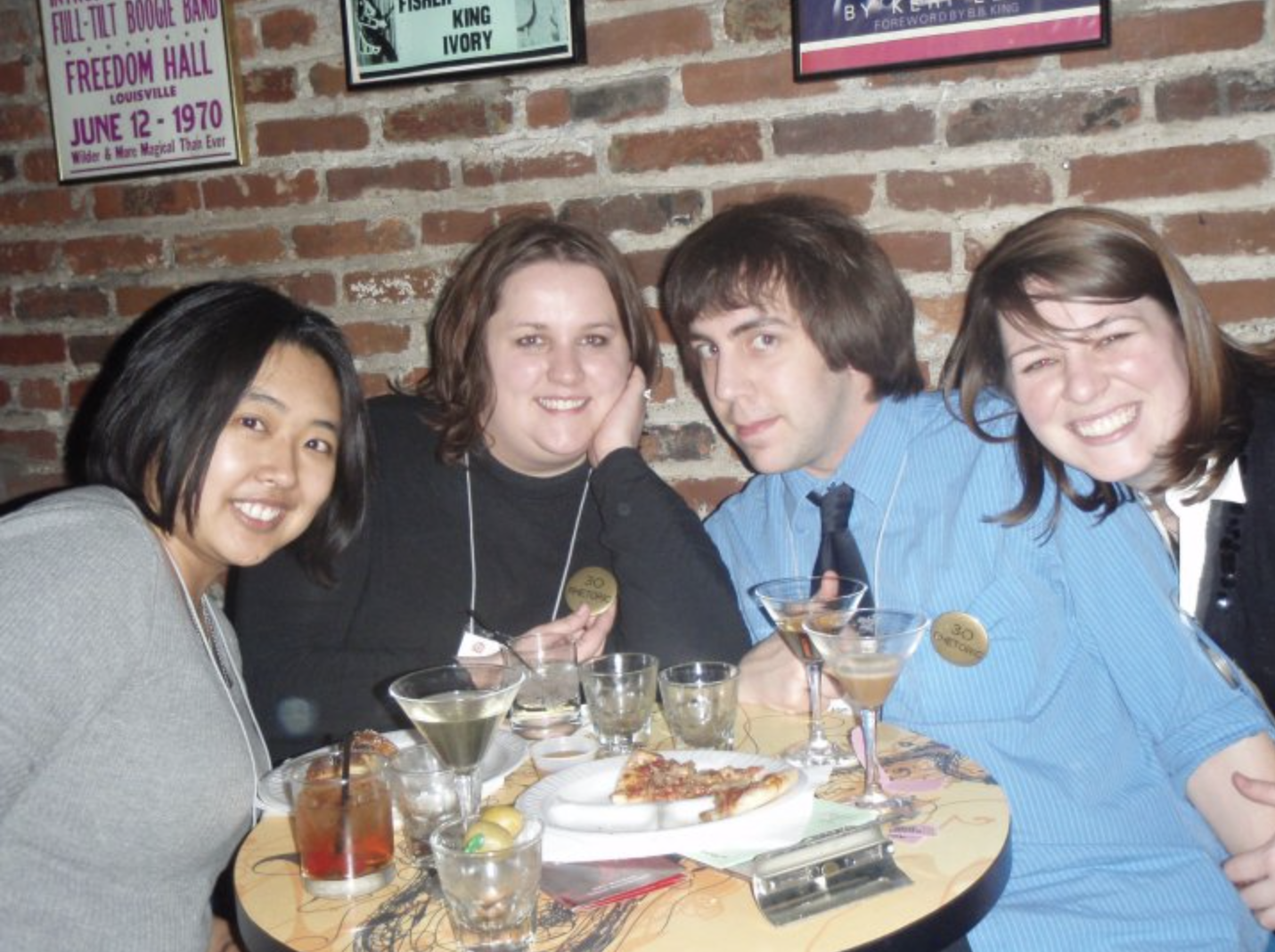
Patti Poblete, Alex Layne, Adam Strantz, and Emily Legg wearing “30 Rhetoric” buttons made by Pat at the 2010 Purdue CCCCs Reunion (Photo courtesy of Emily Legg).
Emily Legg: She was/is always so thoughtful about gifts and making people feel truly welcomed and appreciated! Throughout the years I was at Purdue, she passed on pottery and art to me. I cherish those, of course, but that first gift of mugs and pens still means so much! 🙂
Laurie A. Pinkert: I still have the tiny tape dispenser, tiny stapler, and purple modeling clay that she gave me in my gift bag. Those tokens have traveled with me from institution to institution to every single desk I’ve called my own as a professor.
Emily Legg: The stapler! Oh my goodness, I’m looking at mine right now, ha. I just realized that I’ve had this stapler since 2009. It’s practically an antique now, but the only one I have ever needed.
Jenny Bay: She always brought back gifts for faculty too. I still have this beautiful mug she brought back from Cape Cod one summer. And she gave my husband Thomas and me a large fish platter for our wedding that we still use all the time.
Emily Legg: I don’t know if she knows this, Jenny, but after my dissertation defense, she gave me this lovely painting of an iris. I had just had my son Oliver, of course, but I don’t think she knew that “Iris” was always a name I had picked out if we had a daughter. Then, in 2022, after our daughter Iris was born, the picture has a whole new meaning.
I know we have all felt Pat’s love (for it truly is love) through her gifts, and while they are just “things,” I’m reminded how deeply she cared for all of her graduate students, even before she met us in person. She really knows how little acts can create a supportive, lifelong network of colleagues, mentors, and chosen families. She modeled it so well for us that I only hope that I can do the same in my career for others. But it does remind me that I should get more staplers for my grad students. Or at least buttons, like the ones she always gave out at the Purdue reunion at CCCC.
Huiling Ding: I met Pat before my first semester started at Janice Lauer’s welcome party. We chatted a little bit, and I started to tell her about my interest in SARS and health risk communication about the emergent epidemic and asked her whether that could be a dissertation topic. She said right there right then that it would be a good dissertation topic and she would be happy to direct that project for me. In my second year, I was thinking about moving to a different topic and I talked with Pat briefly about that. She still remembered our conversation about risk communication about SARS as an emergent epidemic and asked, “What happens to your SARS project?” So that brought me back to intercultural health risk communication about SARS. Pat was a wonderful mentor and helped me to choose my dissertation project right at the very beginning.
Jenny Bay: My first semester as a faculty member at Purdue in 2002, I sat in on Pat’s Professional Writing Theory course. I learned so much about Professional Writing theory by sitting in with her. It was at that moment I realized Pat’s broader impact. I had Pat’s former student, Pam Takayoshi, as a professor for a class when I was in grad school, and I saw the ways that Pam channeled much of Pat’s thinking.
I don’t know if I have a specific memory of meeting Pat for the first time, but I do remember meeting her at Einstein’s Bagels where she would “hold court” in the early 2000s. I don’t know if any of you met her there. She was always at the big table in the back, and she would meet her grad students there. Michael Salvo, Thomas Rickert, Sam Blackmon, and I were all young Assistant Professors, and she told us where she’d be, so we just got in line. Pat was trying to establish a culture of collaboration and collegiality. We were all learning together.
Alexandra Hidalgo: We did meet Pat at Einstein’s. I remember going there with my son William when he was still a baby and working through my dissertation blues with her.
Emily Legg: Jenny—that’s such a great way to explain her presence: She had a way of “holding court” that just brought people together.
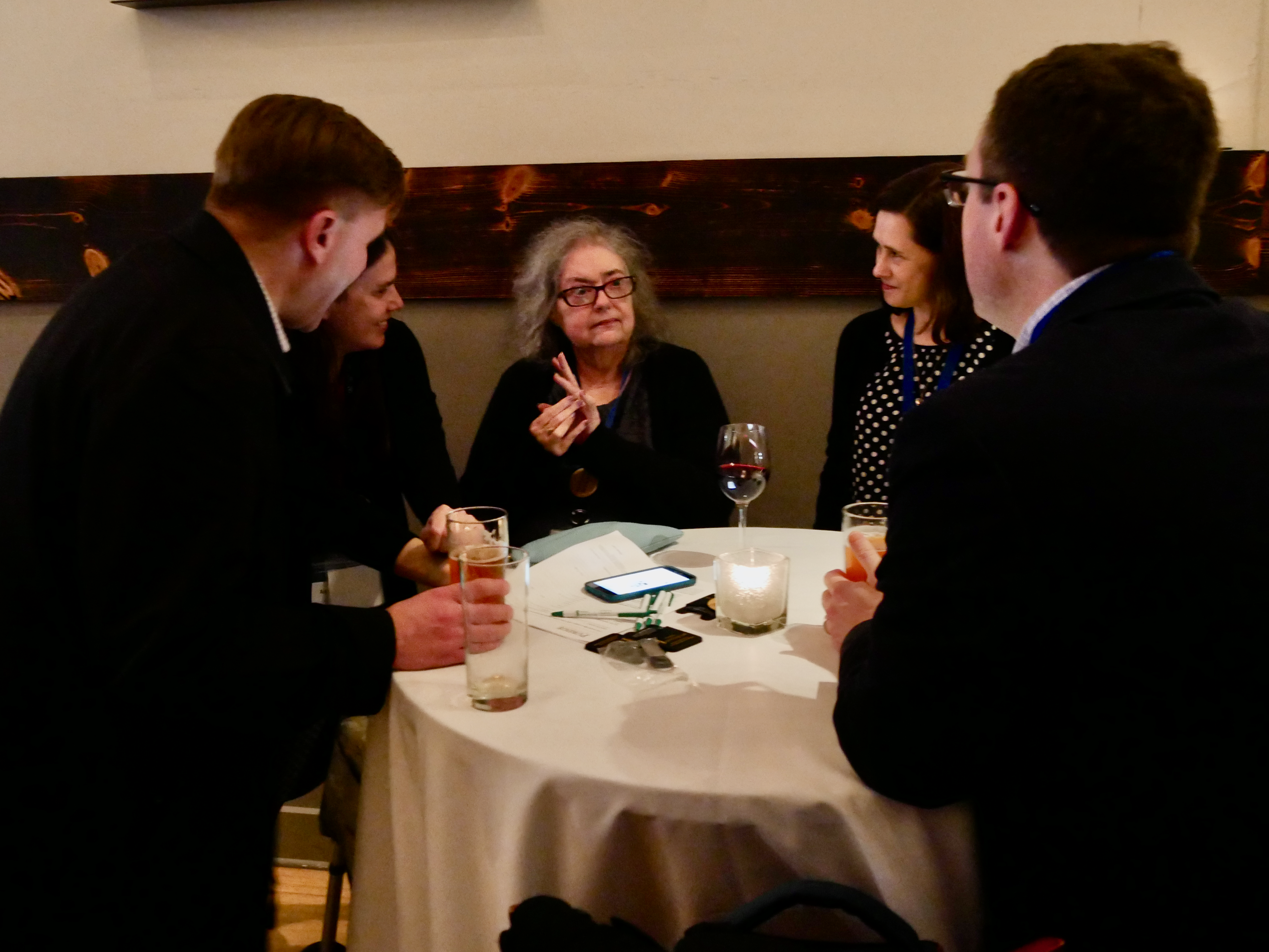
Pat Sullivan “holding court” with Jeff Grabill, Alexandra Hidalgo, Michelle Simmons, and Bill Hart-Davidson at the 2017 CCCC Purdue Party (Photo courtesy of Alexandra Hidalgo).
Tarez Graban: I remember those meetings at Einstein’s. I remember one year when Pat’s advising load was so heavy we had to wait in line for an audience. But then, 5 or 10 minutes with Pat and all my problems were solved. She listened to the whole person, spoke with quiet authority, and had a deep institutional knowledge.
Emily Legg: I have to share a quick story that my husband Adam, whom I met while we were both Purdue students, has about Pat because I feel like it’s related. Adam was shopping at Marsh right at the start of grad school and he ran into Pat. She asked him how things were going, how he liked grad school so far, and then after mentoring him in the chip aisle, she offered to buy his groceries. So, mentoring never ended for Pat, even at the small Marsh in West Lafayette, ha.
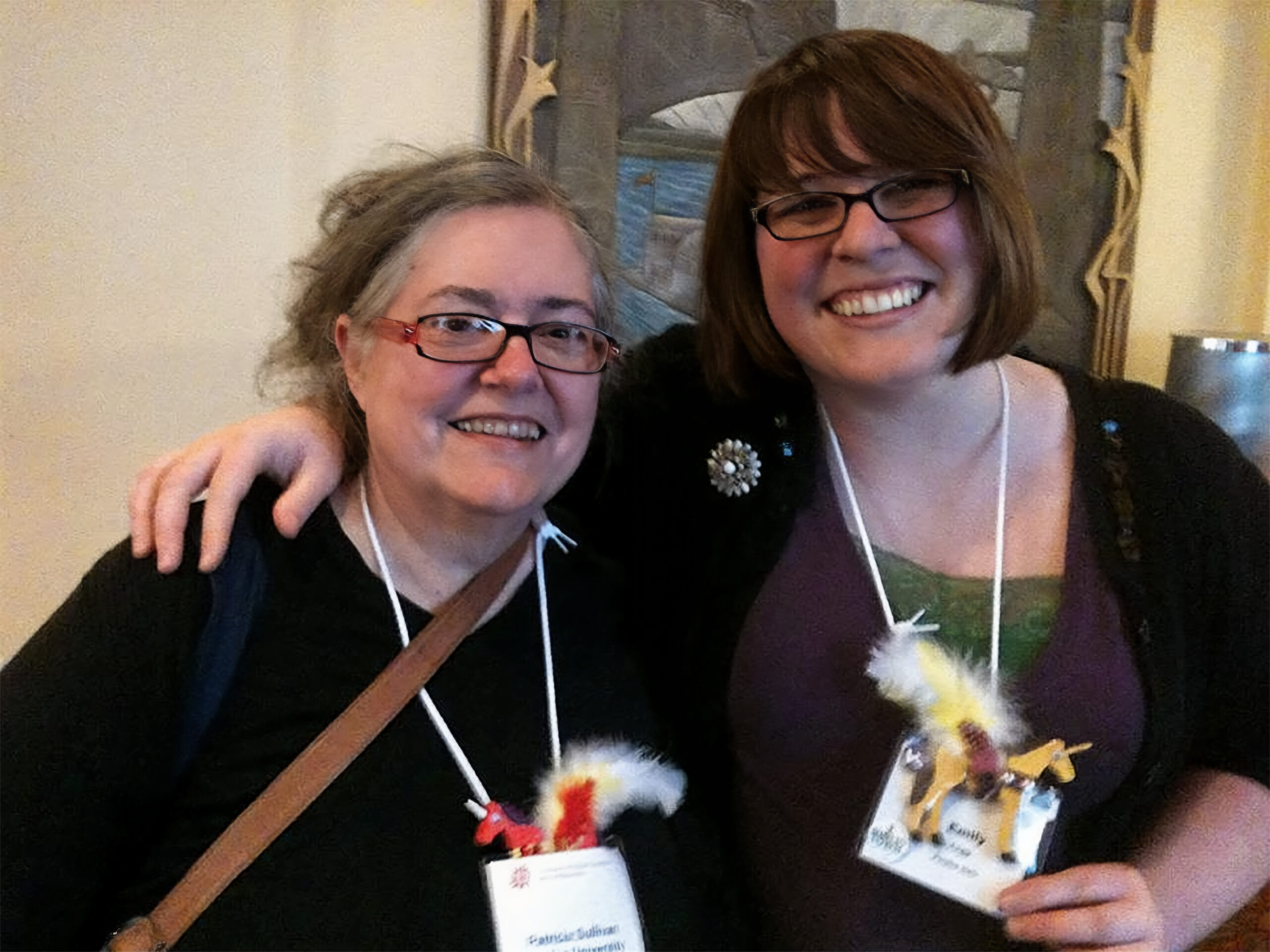
Pat Sullivan and Emily Legg at CCCC (Photo courtesy of Emily Legg).
Laurie A. Pinkert: What I remember most about those meetings with her was her way of describing the relevance of my work to the field in ways that made me feel like I had a contribution to make, and an important one at that. For emerging scholars—and perhaps even more so for those who don’t always feel like they belong in the academy—this kind of re-situating and re-telling can be incredibly powerful. My ideas seemed mostly obvious and pretty straightforward to me, but to hear Pat explain them back to me, I felt like I had something to contribute. She could see the ways that my ideas fit into the ongoing conversations in the field because her perspective was wide and deep and capacious, the kind of perspective that a newcomer is working to build but just doesn’t have yet.
Jenny Bay: Laurie, YES, Pat knows how to listen. She always makes you feel important and valued. Now, we do know she would tell you whether an idea had merit or not. She was not pandering to students, but she did recognize genuine thoughts and ideas that could make a difference in the field and in the lives of others.
Laurie A. Pinkert: So true, Jenny! She didn’t tell me that all my ideas were new or innovative, but she had a way of focusing my attention on the ones that had merit and helping me to see and expand their potential!
Tarez Graban: Laurie, I agree. I valued this about Pat’s mentoring style. She saw no need to inflate our egos or our ideas but was willing to help us extract a core idea, or promising nugget, from the morass, and then put us on the path to discovery. I remember the day I “discovered” tagmemics—a system for linguistically categorizing communicative phenomena—after reading excerpts from Young, Becker, and Pike’s Rhetoric: Discovery and Change. I rushed into Pat’s office and asked how I could shape a dissertation around it. I was still figuring out what was what in the field, and every heuristic I read about seemed just as fresh as any other. It was lost on me that this one was decades old. Without breaking face, Pat gently redirected me to something that ended up being far more salient. It couldn’t have been easy for her to rein me in, and that wasn’t the first time I asked her to do so, because I was often walking disciplinary lines between rhetoric and linguistics.
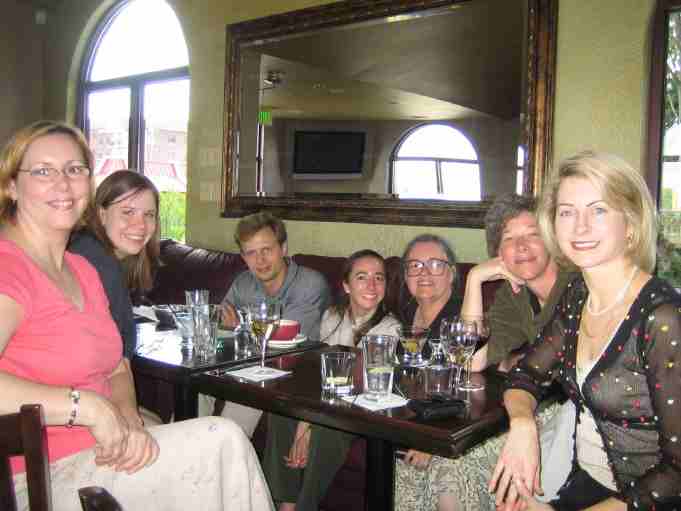
Margaret Morris, Meghan Hughes (Morton), Eric Graban, Tarez Graban, Pat Sullivan, and Gigi Taylor celebrating Tarez’s dissertation defense in June 2006 (Photo by Capp & Gino’s staff).
Jenny Bay: You know it’s interesting that we tend to talk in past tense. Pat is still with us! And that is an important point. Not only is she still alive, but she is alive in us every day.
Pat used to tell us having students fill out evaluations at the end of the semester gives you a limited picture of a course’s impact. Some classes take years to reveal their value to us. For me that holds true with her too. The lessons I learned from Pat have become richer over the years. What is your take on Pat’s philosophy on evaluations? Can you share something you learned from her that has lingered and evolved over time?
Tarez Graban: I couldn’t agree more with Pat’s philosophy—and indeed, the philosophies of all the Rhet/Comp faculty—on how a course’s impact is observed, felt, measured in situ and over time. I feel fortunate that we had such great faculty—incredibly productive scholars who could also teach well and who knew better than to work harder than their students. I remember that Pat especially took great pains to revise her courses from year to year, in response to student feedback, but also that she had to balance what we thought we wanted with what she knew we needed in terms of intellectual and affective preparation.
Laurie A. Pinkert: I, too, remember her attention to course preparation. You could tell she took her teaching seriously not just in terms of the classroom delivery but in terms of her “intellectual and affective preparation”—that’s such a great way to put it, Tarez. I remember her keen sense of focus, too. Her way of focusing on the task at hand, so that when she was with you—she was fully and totally with you. Of course, that would mean that you weren’t going to have her attention when she was focused on other things, but it also meant she wouldn’t be distracted by those things when she was listening to you. I remember the ways we grad students lined the hallway outside Pat’s office on Friday afternoons, waiting for a chance to meet with her to discuss our projects. As soon as you entered her office, she was present with you—and only you. For those precious minutes, you had her ear and her attention.
Tarez Graban: I also remember Pat encouraging me to choose and fight my battles wisely, both inside and outside of the classroom. She anticipated how quickly my energy reserves could and would be depleted; I had a tendency to lose myself completely in any new endeavor because I loved being a graduate student in the program. In one poignant advising session, she diagnosed my biggest problem. She said something like, “Tarez, you’re like someone who assumes they’re always missing out on some great party.” She was right. This early articulation of FOMO would end up posing a serious challenge to my productivity, causing me to say “yes” to everything without considering the consequences. I’m finally learning that opportunities don’t disappear simply because I can’t commit to them now. There will always be more things to do.
Jenny Bay: Tarez, that’s great. She totally recognized FOMO. I think she might have diagnosed that in me too. 🙂
Laurie A. Pinkert: I remember one semester I was agonizing over giving up the chance to teach a 300-level advanced composition course (a seemingly huge deal to me as a graduate student) in order to accept a dissertation fellowship. She looked at me, and said something like, “Laurie, you will have the rest of your career to teach new courses.” I couldn’t see that in the moment—all I could see was the possibility of missing out on something great, but she could see what I would gain. And helped me gain perspective.
Huiling Ding: I definitely agree that teaching evaluations can’t measure the long-term impacts of a class or of a mentor. I really enjoyed the empirical research class that I took with Pat. I was fascinated by all the readings she put together, which were interdisciplinary, and I enjoyed working on qualitative research and did an ethnography for that class. In our meetings on my dissertation updates, Pat emphasized the use of either visuals or clear presentation of updates. That pushed me to work really hard in visualizing everything from theoretical frameworks to methodologies and findings. That’s something I’ve been doing throughout the years, which is a really important way to make ideas accessible to readers.
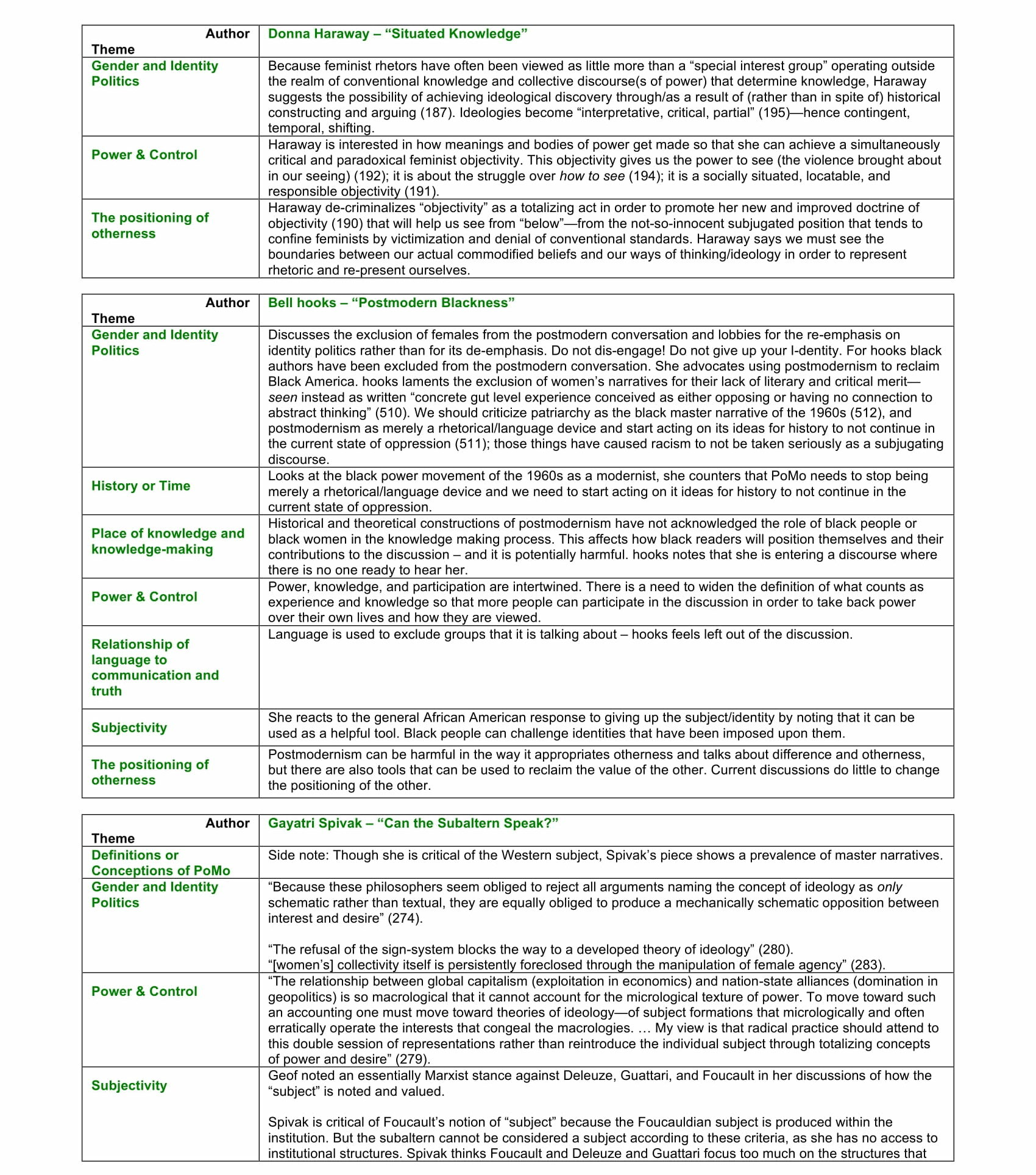
A grid in which Tarez Graban transfers Pat Sullivan’s gridding methodology into Thomas Rickert’s “ENG 626 Issues in Rhetoric and Composition: Postmodernity” seminar (Grid courtesy of Tarez Graban).
Tarez Graban: Yes, Huiling, you’ve reminded me of how central modeling and visualization were to Pat’s seminars. I find myself leaning on these strategies to work through challenging problems.
Jenny Bay: Pat used to tell me (and others) that Purdue was a place where you learned to do more with less. I think that is a Purdue philosophy and whether Pat learned that at Purdue or had it all along, I don’t know. But I do know that Pat could take one line or phrase and say so much about it. I think she taught students never to overlook small points or observations. You could do a lot with one small insight. I also think Pat always valued women and women’s perspectives. She embodied feminist approaches without always being explicit about it.
Alexandra Hidalgo: I’ve taken her “do more with less” lesson with me to every endeavor I’ve undertaken since we met in 2008. It’s such a useful way to think about what we have and what we can accomplish with it.
Emily Legg: Oh the “do more with less” couldn’t ring more true for me right now. I stepped into the role of director of Professional Writing here at Miami University about a year and a half ago; it’s at a time when university administration is pressuring departments to do more recruiting and to build up our majors more. At the same time, we aren’t getting hires, graduate lines are being cut, and colleagues have left for greener pastures. I’m still pretty newly tenured, so I try to channel Pat’s ability to “do more” with what we have. Pat’s advice has given me the tools and guts for speaking up about out-of-the-box ideas to recruit students and build community. I think this is now called “guerilla marketing,” but for me, it’s Pat marketing: bring folks in because the community is there. Also, swag and buttons help.
Jenny Bay: Oh my gosh, the buttons! I loved the “Rhetoric, Indiana” one the best.
Tarez Graban: I still have my “Rhetoric Rules” button!
Emily Legg: Jenny, I’ve taken the button-making advice so to heart that our maker space at the library had to put a limit on the number of buttons people can make there. I had a “button making” event paired with making other crafts together to welcome our majors and minors last year, and we had over 80 students attend because of the buttons! They still talk about that. I definitely tried to channel the “Rhetoric, Indiana” button vibe.
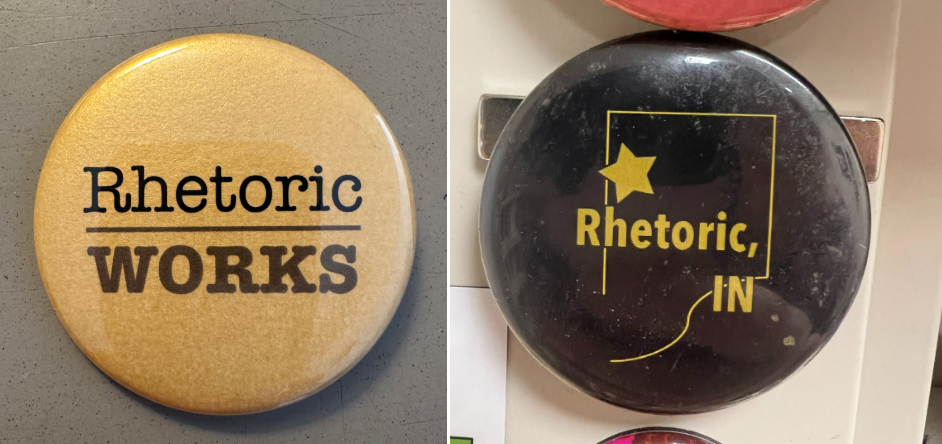
“Rhetoric Works” and “Rhetoric, IN” buttons made by Pat Sullivan for CCCC Purdue Reunions (Photos courtesy of Jenny Bay).
Gosh, there are SO many lessons and small moments of advice that she has shared with me over the years that I have woven deeply into my own teaching and mentoring. AND for me, I think that’s the big takeaway: teaching and mentoring happen in the small moments—the “hall meetings,” the times you walk by an open office, the quiet times of writing together, whether physically in the same room, or digitally in a Google Doc. It’s when I think of those small moments, that the big lessons come back to me. Pat had a way of reading against the writing that was there. I don’t mean this in a bad way, but in a way that she could read what you really wanted to say or make connections that you might not have seen yourself, or had trouble articulating.
With me, she recognized that I always felt like I struggled with writing. I don’t know how many times I felt so anxious about writing in a shared Google Doc that I would literally jump out of a piece we (Pat and I) were working on together to quickly “hide” my digital self. I know she noticed this. So, one day after I pasted a whole section of my dissertation that I had written from 2–4am in “secret” into our shared Google Doc, she said: “Emily, did you know how cultural your writing is? You are researching Indigenous storytelling, and your writing reflects that research. You are writing the way your ancestors would want—you are telling stories and writing to your ideas instead of the academic ways of making your claims first. Keep doing this.” Granted, she also helped me learn to revise my meandering ways of writing, but that little comment she made outside of class or outside of anything I had written for her classes is so deeply a part of my teaching and my research.
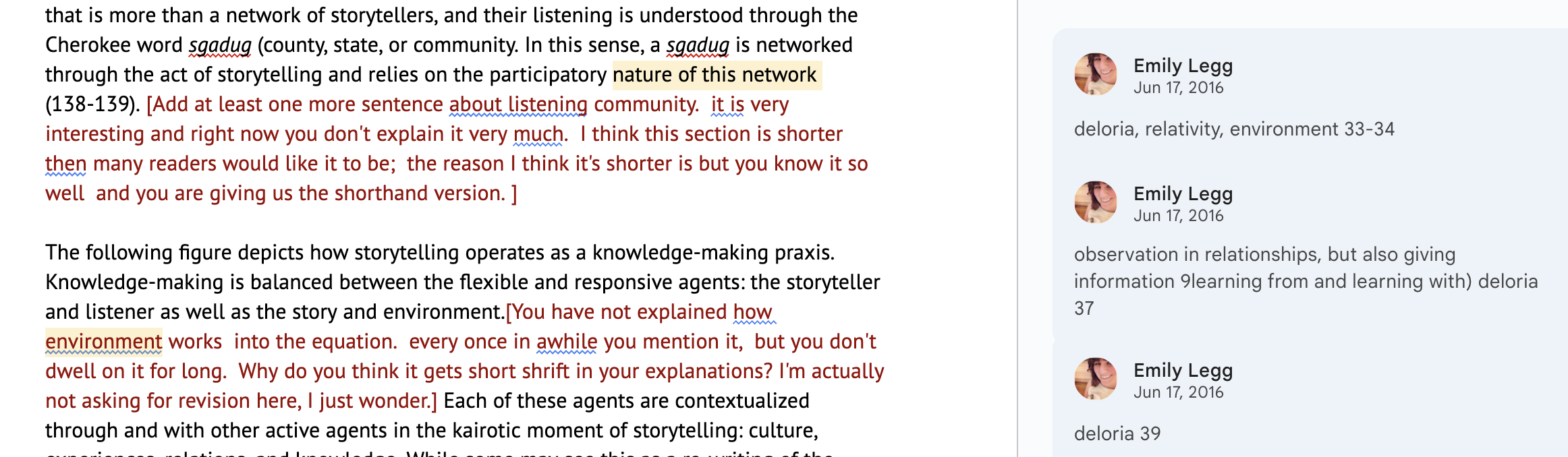
An example of Pat Sullivan’s developmental edits of Emily Legg’s dissertation (Screenshot courtesy of Emily Legg).
I finally stopped worrying about being an imposter who didn’t know what “rhetoric” was and never took a composition class before I taught one. But I learned from Pat to champion what you know and feel deeply and that all rhetorical styles and all writing is generative and valuable and worthy of being read. Just this week as I was teaching one of our 200-level professional writing courses, I told students this story about how Pat wouldn’t let my head get in the way of my writing. So, her small teaching moments are still being taught.
Laurie A. Pinkert: When I think about Pat’s impact on me, I’m reminded of the way I started writing memos to her when I turned in assignments. I would include a cover memo that described what I was confident about, what I still had questions about, what I could really use her feedback on, etc. I later did this when I submitted dissertation chapters to her. I can’t say that I would have felt comfortable being so vulnerable with all my graduate faculty—“Hi, Professor, I’m turning in a ‘finished’ paper at the end of your course, but here’s what I still don’t know.” But, I wasn’t afraid of saying this to Pat because I knew she knew (and valued) that the paper wasn’t the final answer anyway—that the conversations were ongoing.
Emily Legg: Laurie, I LOVE your memo writing to Pat! She would share your coding and writing with me as inspiration when I was working on my diss. 🙂 She was always good about reminding us that writing and research is never done…which I think is another question…
As for course evaluations, thanks to Pat, I never try to take those too personally, because I know that a course can’t truly represent teaching and learning, and evaluations can’t capture what impacts us as scholars and teachers, especially down the road. Also, just in case Pat is reading my comment about evaluations: I’m sorry I never filled them out for your classes in graduate school. Maybe I took this advice too much to heart. But it’s also why I probably try not to read mine immediately after I’ve taught a course—if I’ve made an impact in my teaching, I’ll know by the ways students feel comfortable coming back and sharing stories with me.
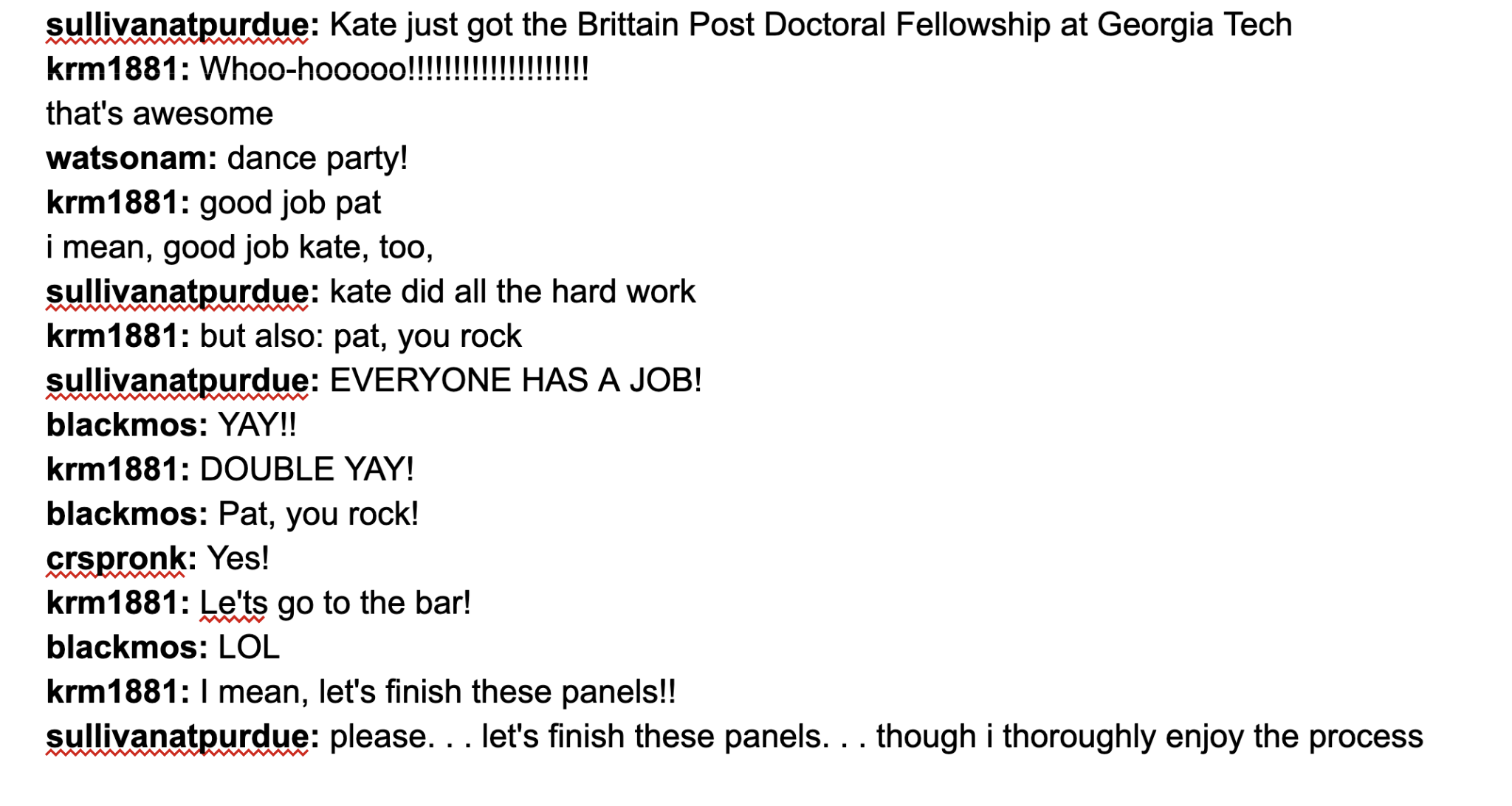
Chat Log Between Pat Sullivan, Sam Blackmon, Alex Layne, Emily Legg, Caitlan Spronk, and Kristen Moore as they were organizing Feminisms and Rhetorics Conference proposals in 2011 (screenshot courtesy of Emily Legg).
I used to listen to Pat’s stories on studying with the legendary Walter Ong and how she triangulated empirical data in her research, and I’d think I’d never catch up to her. Twelve years into my own professorial endeavors, I have my own stories to tell. Pat still feels unique in her erudition, though—someone I continue to work toward measuring up to. What do you want Pat to know about how she inspired you to keep growing as a teacher, scholar, and human being?
Emily Legg: Well, I’ll start crying happy tears if I share everything (ok, too late—the tears are flowing). There are times when I feel like I will never live up to Pat or her expectations and plans for me. She always thought more of me and my abilities than anyone else, and during a time when I was struggling the most. My dad passed away my first semester as an MA student at Purdue, and it was such an upheaval in my life since my dad and I had recently reconnected after years of being apart (OK, more tears). I was lost and that transferred over to my coursework and plans in graduate school.
Everyone at Purdue took me under their wings, but Pat let me cry. And there were so many moments that I needed to, maybe for silly reasons, but that didn’t matter. That’s what the crying chair in her office was for: not because you should cry in graduate school, but that it was okay to cry because you had family there to help you through. She taught me that as a scholar, teacher, and researcher it’s okay to be a human and to feel deeply. Those feelings and experiences are connected to you as a teacher and as a scholar and can inform your approaches to bringing in the humanity, to being a human.
While I don’t have a great crying chair in my office, I do make sure to add a “basic needs and emotional wellness” policy in all of my syllabi. I remind students that they are first and foremost a human with needs and challenges and celebrations. The work they do will always be connected to that and that grace (and yes, even tears) are a part of that. Pat inspires me to put the human(ity) first. Whether it’s reframing my research methodology, structuring syllabi, chairing committees, working with other faculty, I always try to channel Pat’s giving nature.
Jenny Bay: Sadly, I think when Heavilon Hall was shut down, the crying chair went with it. That piece of furniture was a landmark—big, stuffed, bright blue chair that was almost the center of her office. So many students sat in that chair and poured out their hearts to Pat. It was always okay to cry with Pat.
Emily Legg: I feel like I’m crying with her now. In a good way! And it’s so refreshing.
Laurie A. Pinkert: Whew! This is a hard question to answer. I hope Pat knows that she inspired me to always strive to be a more generous thinker. I remember Pat telling my cohort of graduate students very early on that she didn’t want us to be scholars who only knew how to critique: when she assigned an article for us to read, she wanted us to engage with it in full, to recognize its contributions, its insights, its limitations, its context, its connections. She reminded us that there were always people—real people—enmeshed in the issues being discussed and represented by those papers we were reading. And she wanted us to read generously because she knew we had a lot to learn from the ways that others asked the questions that were important to them, looked for answers through new or established methods, or drew conclusions about their data and its relevance.
Jenny Bay: I love the focus on being generous, Laurie. I agree completely that moving away from critique and learning to value and build on others’ knowledge was a hallmark of Pat’s approach.
Emily Legg: Generous in everything! In giving and in thinking! I completely agree. I remember a more direct teaching moment Pat had with me about learning how to think generously about graduate applications. She wanted to train and prep me for faculty work and for serving on admissions committees. I think she had a way of seeing the future because I’ve been doing just that for the past several years. But I remember she told me to think and read generously as folks may not yet know what they are thinking but there are nuggets of golden ideas under the surface.
Tarez Graban: I want Pat to know that, because of her teaching and mentoring, I understand intellectual authenticity. It’s no good to posture or pretend to be someone I’m not. I am the questioner I am because of her, I am the historian I am because of her, and I am the historiographer I am because of her. In truth, there’s not a professor I had at Purdue or a course I took at Purdue that hasn’t profoundly influenced me. But Pat has had a huge influence on how I teach graduate seminars and mentor graduate students, and even on how I direct a graduate program. I also want Pat to know—if she doesn’t know this already—that our collaborations at conferences, in print, and even as guest lecturers when I was at Indiana University, helped me to become a better collaborator in turn. Laurie, Jenny, and Emily: that generosity you mention really did extend beyond just the student-advisee relationship, and I was constantly floored by Pat’s ability to write fulsomely yet succinctly, to put deep thought into both logic and expression, and to title her pieces so effectively!
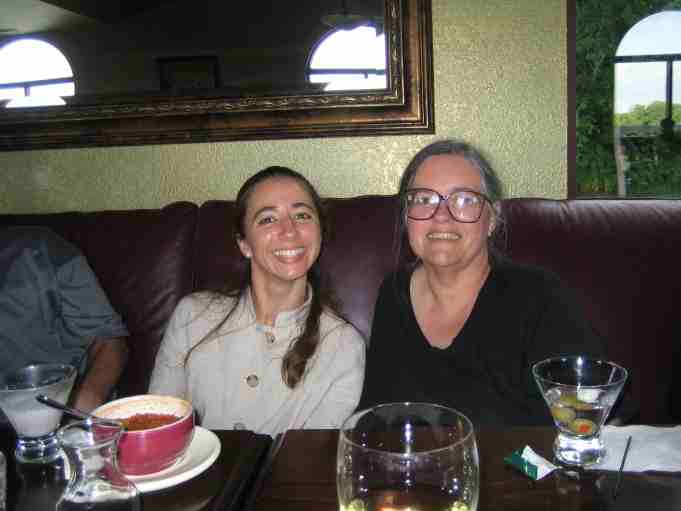
Tarez Graban and Pat Sullivan at Capp and Gino’s in West Lafayette (photo by Capp & Gino’s staff).
Her analytic methods still guide my scholarship and teaching. Erudition is an apt characterization! I know I’ll never measure up to Pat intellectually, and I’m only now beginning to recall and recognize the ways in which she exercised patience with me and my peers as we navigated her course materials. Looking back, we read so much—we were made to be responsible for so much—and the only way we got through it was to learn to read synoptically, to bring voices into conversation on lingering issues, to consider whose voices were left out of the conversation and how those omissions occurred. I’d also like Pat to know that I haven’t stopped gridding in 20 years. Gridding has become a signature methodology for me and for my students. Never before Pat’s seminars could I have understood or accepted gridding as a generative activity.
Laurie A. Pinkert: I was thinking about those grids, too! Gridding involves mapping individual articles or data sources in a column and then using the rows to identify topics of interest or relevance. This activity allowed me to see connections that I would have otherwise missed. It’s so visual in nature, speaking to Huiling’s earlier note about Pat’s affinity for the visual. It’s also analytical in nature, exemplifying Pat’s keen ability to see connections. It’s also a generative method of invention in itself, highlighting Pat’s aptitude for helping others articulate and develop their ideas. I not only use this technique myself but also teach it to writers across disciplines—from nurses to engineers—to help them find strategies for synthesizing and understanding the research and scholarship in their fields.
Emily Legg: Yes, the grids!! I have passed that on to so many students! And I still grid. And I don’t lose those grids because I know I’ll need them again. Pat always explained them to me as a sort of external hard drive so that you can free up your brain memory and process more. I love that.
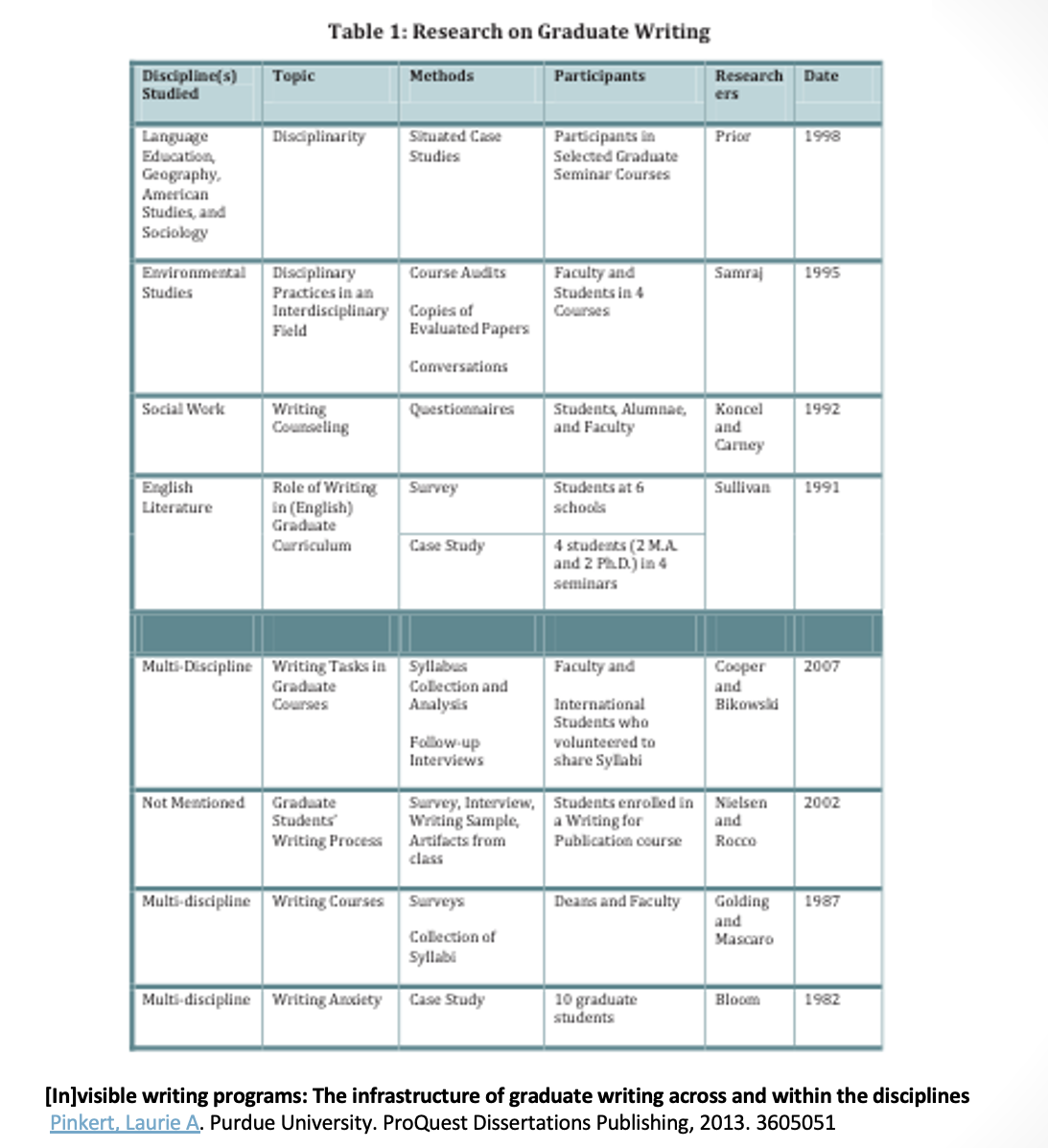
Grid visual from Laurie A. Pinkert’s dissertation (Grid courtesy of Laurie A. Pinkert).
Huiling Ding: As a graduate program administrator, I always see Pat as the role model. She has been the one who was keeping our Rhet/Comp community together. I still remember Pat standing or sitting somewhere near the conference hotel lobby during CCCC each year just to talk with students and alumni as they walked to conference sessions. She was the one who held the community together in the CCCC reunion parties by greeting everyone and giving out awards.
For me, her inspiration comes from many places: her ability to serve as a cornerstone of our Rhet/Comp community, to mentor so many of us through our dissertation projects, and to support us through arduous job search processes, crafting our teaching philosophy, CV, and cover letter. I managed to go to all her CCCC talks after graduation and meet classmates and alumni there, which made me feel like an eager student listening to Shifu, or the Master’s wise words. All her time commitment, emotional labor, and just being a supportive, authentic mentor to everyone—these are the things I’ve always looked up to and tried to work toward.
Jenny Bay: Honestly, Janice Lauer might be the founder of the RC Program at Purdue, but Pat is the heart of the program. Pat taught everyone how to think rhetorically, how to research ethically and creatively, and how to value others as human beings first. She always treated students and colleagues as people with thoughts and feelings. Those values drove how she administered the program with its focus on community and care. She always sought the best in people, even when they might be doing terrible things.
Tarez Graban: Jenny, that last statement (about seeking the best in people) is both true and humbling.
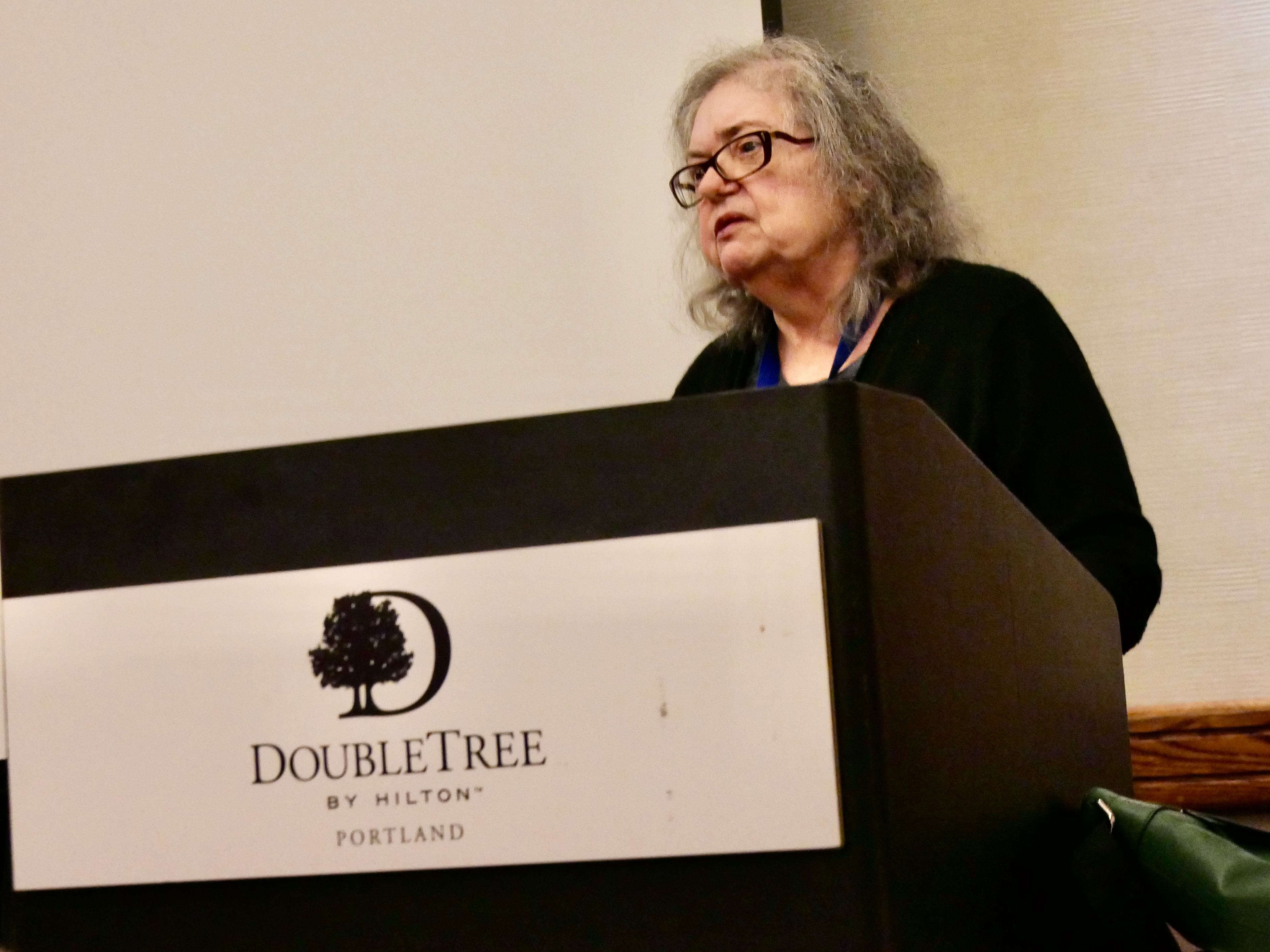
Pat Sullivan presenting at ATTW in 2017 (Photo by Alexandra Hidalgo).
At her 2017 presentation at the Association of Teachers of Technical Writing (ATTW), Pat encouraged us to learn to collaborate with our future selves. She suggested we approach and organize projects as if they hold information and ideas we’ll return to over our careers—I think of that presentation whenever I begin a new project and revisit an old one. How has Pat influenced how you approach your current work and how you chart your professional trajectory?
Huiling Ding: For me, one of the most influential things came from seeing Pat’s ability to teach radically different classes, i.e., classical rhetoric, modern rhetoric, and empirical research methods and her ability to work on radically different projects and engage students in scholarly and reflective conversations. I think that’s something that helps me collaborate with my future self, knowing that you are not doing just one type of research and that you need to connect your current research with ongoing trends and needs. She kept reminding me to pay attention to the classification problem, because in pandemic management, how patients get classified will directly determine whether and how they can get treated and what type of benefits they get, which nudged me to focus on social justice in research on risk communication and risk management of epidemics and pandemics.
Laurie A. Pinkert: So, true, Huiling! Pat’s knowledge is capacious and she could never be boxed into only one area of expertise—I think it’s easy to think that you need to do only one thing, especially in academic environments that sometimes laud this. But she led a professional trajectory that allowed for meaningful evolving scholarly responses to urgent issues—all the while maintaining important commitments to justice and equity, to feminist approaches, to student-oriented pedagogy across all of her work.
Huiling Ding: Those metacognitive lessons really stayed with me. I have been moving away from health, communication, and medical rhetoric to artificial intelligence, data sciences, ethics, responsible AI, and human-centered design. This transition was partly inspired by Pat’s ability to engage in radically different intellectual projects. For me, if AI is transforming everything right now and disrupting how we write, communicate, and make decisions, I may as well focus on that and the power dynamics surrounding those algorithmic impacts.
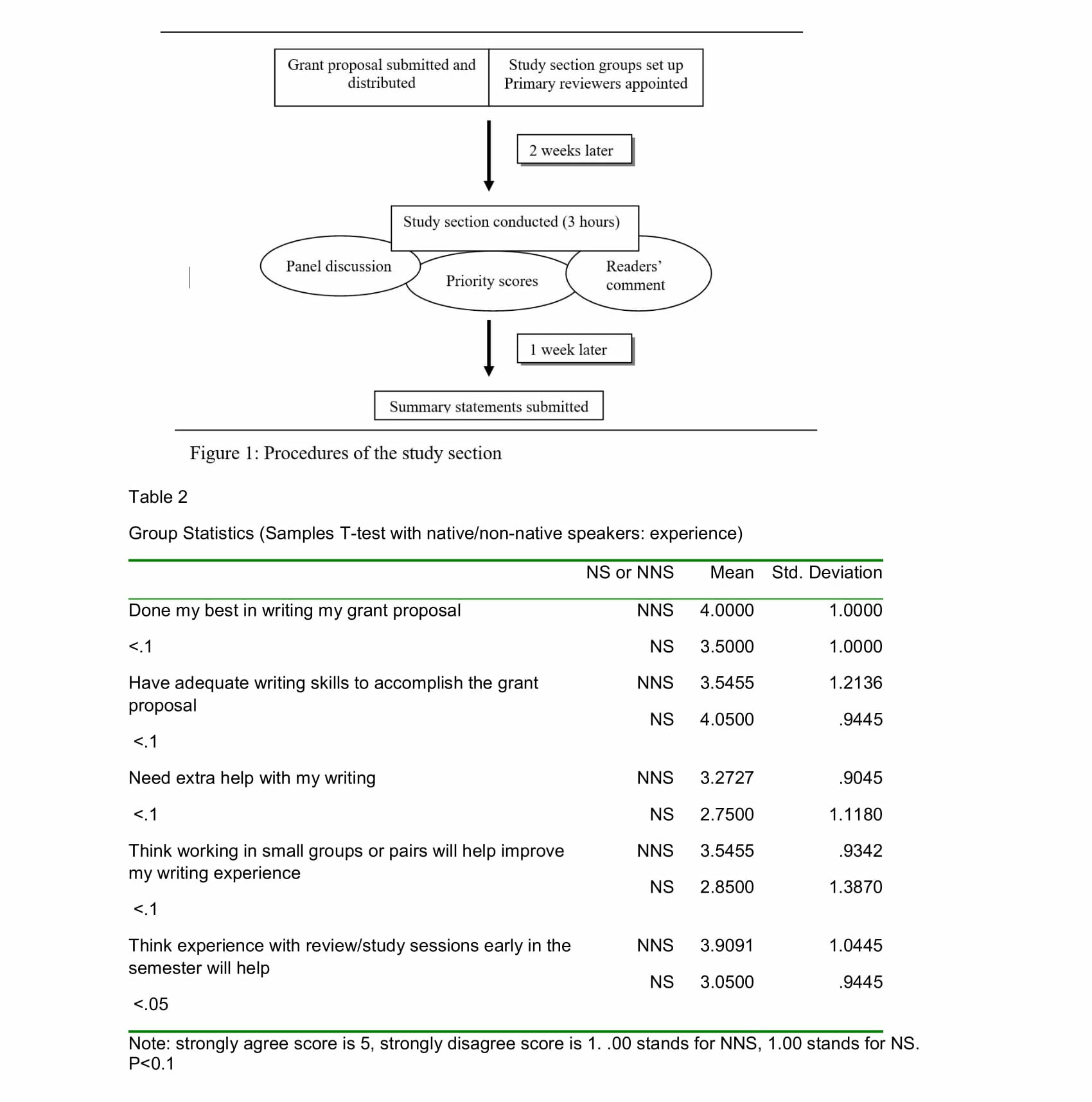
Example of how Huiling Ding uses grids in her own work (Grid courtesy of Huiling Ding).
Another influence that I got from Pat is to think about research programs (What is your research program? How do you define your research program? How do you make it coherent?) as well as our conversation surrounding paradigm change. The paradigm is going through profound changes in how people write, how people talk with algorithmic audiences, and how decisions get made by algorithmic tools. That helped me to make the decision that I myself can go through a paradigm change to learn about AI and AI ethics and to engage in more personally and professionally urgent and relevant topics.
Emily Legg: Pat and I actually sent in a proposal for an article on this exact topic! While the reviewers didn’t seem to think it was a good fit, we thought our title was clever: “Whelming the Cloud” (we had gone down a rabbit hole one day about how you can be overwhelmed but why not whelmed). What we were interested in was how we archive our current selves in intangible digital clouds and what those everyday, “whelming” digital traces could be for our future selves as scholars and teachers. Looking back, she had a unique way to help me process information: think of everything as a cloud of knowledge, with or without form. Those traces of thoughts and knowledge might not mean much now, but if we are diligent archivists, our thoughts are kept safe in teaching notes, old syllabi, and grids from previous research. Our knowledge is there, waiting for us when we are ready for it, tucked safely away in the cloud. The whole idea of “archiving” oneself is now what I call my “heart work” in higher ed: it’s my research and teaching that’s waiting for me to listen to it. Pat helped me understand that storytelling is that kind of research and teaching we can do for our future selves. Again, she helps me think out of the box and generously about what can (and should!) be counted as scholarship.
Jenny Bay: Whelming—I love it. Anyone else have that moment where Pat is talking about something and you have no idea…and then the next day, or week, you look back and realize what she was saying…and how profound it was? That happens to me all the time. She will say brilliant things, and it sometimes takes me a while to figure them out.
Alexandra Hidalgo: Yes! I definitely experienced the aftereffects of a Pat conversation. Her mind operates at a high level, so sometimes your subconscious needs to do the work in the background and then voilá! It’s epiphany time!
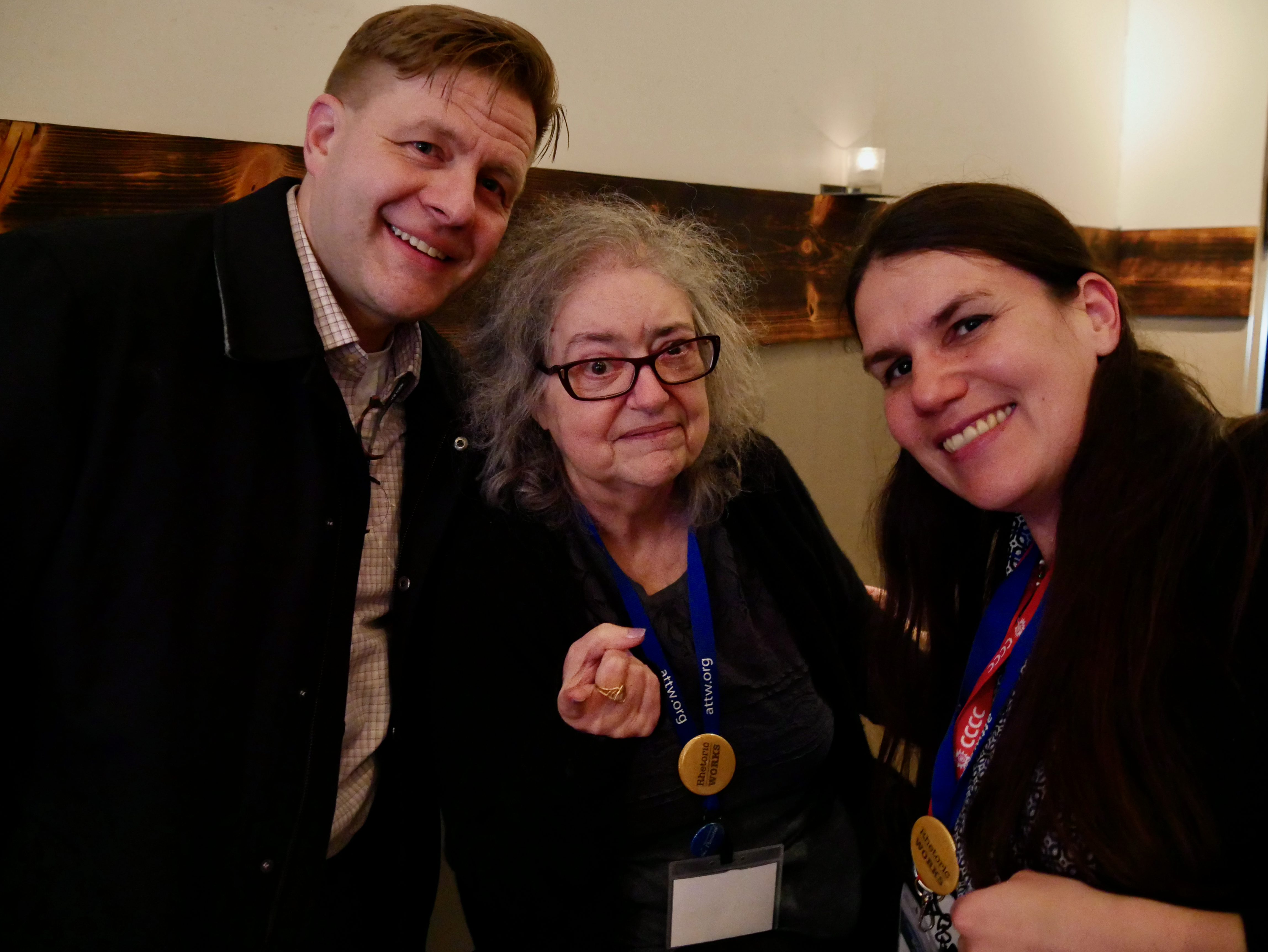
Jeff Grabill, Pat Sullivan, and Alexandra Hidalgo at the 2017 CCCC Purdue Party (Photo courtesy of Alexandra Hidalgo).
Jenny Bay: I swear she spoke in parables sometimes.
Emily Legg: I ran into some Purdue alums, and we had a “Purdue hallway meeting” reunion and were just talking about this at CCCC. We were remembering when Pat would somewhat lift her head up, look off in the distance, and say something clearly profound and we would have no idea what she meant. But that it might come back years later, and it was mind blowing. Honestly, I don’t think I connected our chats about archiving with telling stories to our future selves until this conversation. So, if I can break a fourth wall: Thanks, Pat! I get it now! Time to whelm the clouds!
Tarez Graban: This idea of remaining in dialogue with one’s own research projects is so very Pat! For years, she led a PhD job placement group, guiding us through the multi-step process of preparing for and then navigating the academic job market, and in it she taught us to map out (in great detail) three- and five-year trajectories to account for the teaching, research, and service/administrative opportunities we wanted to ensure for ourselves once “in the job.” I did this, and have been doing it ever since. It has helped me to recognize that some projects can simmer on the back burner until I’m intellectually ready to complete them, while other projects can be prioritized because I might need to learn something from them now.
Jenny Bay: One aspect of scholarship I think I learned in grad school but that was driven home by Pat was to read deeply and broadly. Pat always brought in scholarship from outside of the field. She would bring in conversations from other disciplines, other journals, and explain how other scholars were having the same conversations but from a different perspective or using different theories. That kind of rich intellectual work is so important. It’s how we solve problems in the world. It can’t come only from our own discipline but must be interdisciplinary. I try to remember that when I review journal articles or work on my own research. We have to spread outward in order to have an impact. I don’t know if this quite answers the question, but it is something I continue to think about in my own work. How to get outside of myself and my own lens.
Laurie A. Pinkert: Yes, Jenny, the depth and breadth that Pat encouraged is vital. If you look at my interests, you might not initially think that I’d be an obvious choice to be mentored by Pat. I was pursuing a secondary area in Writing Program Administration, and she wasn’t the one teaching the WPA Seminars or the WAC courses that comprised that area of the curriculum, but Pat is a programmatic thinker through and through, and she’s probably one of the biggest reasons I see my programmatic work in the deep and broad ways I do: as a kind of professional/technical activity, as always and already a research-generating/research-embedded activity, and as an inventive activity that cannot help but pose new questions that need to be answered.
What is your favorite Pat story and what do you think it can teach those hoping to have similarly fruitful careers and lives?
Jenny Bay: Perhaps more than anything, I think Pat has taught perseverance no matter what. She has gone through several health issues over the years. I think it was 2007 when she had a health issue that lasted a long time. When she came out of it, she was so thin and frail. I asked her how she was recovering, and she told me they were having her do swimming. She got through it by reciting the rosary. I also remember when her brother passed away and she made it her goal to ensure his twin daughters were educated. She always perseveres and makes sure others are supported no matter what. Even when she has vision problems, she always does the work needed. That kind of resilience is amazing and I think it teaches all of us to be there for one another. She came back from that coma and did amazing things and worked with amazing students. Nothing seems to bring her down. When we get tired and distraught, it’s something to think about.
Alexandra Hidalgo: Laurie and I were in the first cohort of grad students Pat taught after she returned to teaching from her coma, and she was so generous, giving, and focused. She also shared stories about her illness and recovery, which she tied to whatever we were talking about that day. Her openness taught me how vulnerability in the classroom has a unique knack for helping us connect with students.

Alexandra Hidalgo, Caitlan Spronk, and Laurie A. Pinkert about to begin the second year of our PhD in 2009 (Photo by Nathaniel Bowler).
Emily Legg: It’s so hard to think of one favorite Pat story because honestly, I welcome her narratives in my head all the time. However, we mentioned Pat “holding court.” For me, Pat would hold court (writing hours, really) in the basement coffee shop in the underground undergraduate library. We would all sit there in silence and write. Well, we would start out that way. Pat would bring up a book she was reading, and somehow, she always was able to find PDFs of those books to share. So, writing time usually turned into her emailing book recommendations to us. I still have those PDFs saved. And in true Pat ways, those recommendations are still useful now. Beyond that, just being able to sit in quiet writing time with her and others taught me so much about what collaboration can look like. Sharing spaces and “court” with those around us can spark ideas and scholarship in ways that can’t be replicated in formal meetings.
Okay, I might have two stories, but they both happened during our writing group in that windowless coffee shop. As I mentioned, Pat and I would write together in a Google Doc, and finally, my last year as a PhD student, I felt confident enough to write at the same time that she was in my dissertation doc and reading it. She would comment and have conversations with me in the text of my writing, often in blue text. She would add comments or “gift” me a sentence that I probably could never have written in the ways she was able to make it profound. These in-text notes and “Pat sentences” were little textual gifts that helped me understand my own thoughts. The ways that Pat wove them through my dissertation still helps me see the unspoken collaborations, in writing and in conversations, that Pat and I shared. While completely on accident, some of Pat’s in-text comments to me are still hidden in my dissertation as little Easter eggs of her teaching. Thank goodness I’m terrible at copyediting because those breaks in my sentences still help me navigate my thoughts.
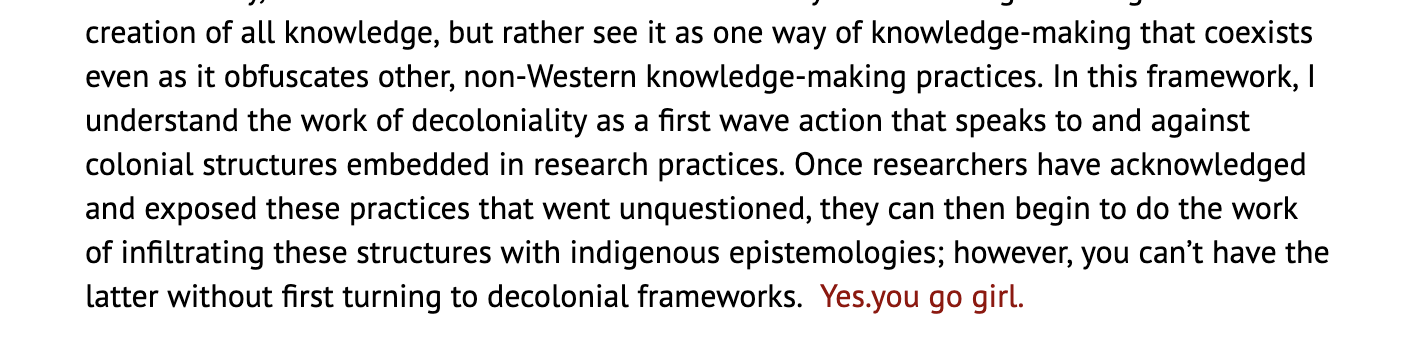
Words of affirmation from Pat Sullivan in Emily Legg’s dissertation (Photo courtesy of Emily Legg).
Tarez Graban: There are so many. I’ll never forget how Pat facilitated my prospectus defense while still suffering from the flu. She always put her students’ needs ahead of her own. Another time, just before I accepted my first tenure-track job, Pat sardonically reminded me to “smile and bring brownies” to department meetings before tenure, which I recognized as a veiled statement about the institutional politics that could mar and distract from more important things if I let them do so.
Years later, we drove to Feminisms and Rhetorics together (I picked her up in West Lafayette on the way to East Lansing). Too absorbed in our conversation, I forgot to turn left around Fort Wayne and about an hour passed before Pat finally and quietly suggested that I was going the wrong way. She had this measured internal mechanism—she seemed unflappable. I now recognize that Pat daily made choices about what she could and could not afford to let bother her. This has helped me considerably.
Jenny Bay: Tarez, I never realized that she did not let things bother her. It’s a great lesson for us all. She always had her eye on the ball. I think that was bound up in her generosity. Rather than be upset about something or someone, she thought the best of them so she could move on and do the work.
Emily Legg: Tarez, you reminded me of a “driving with Pat” story that I absolutely love! Pat suggested that Adam and I ride with her and her husband Peter to Colorado Springs for CPTSC (Council for Programs in Technical and Scientific Communication) and SIGDOC (Special Interest Group on Design of Communication of the Association for Computing Machinery) one year. We left incredibly early from West Lafayette. Here I was thinking that I would sleep a lot of the way (we mistakenly decided we could drive it all in one day) or that I would read something “for fun.” Not so. Pat and I sat in the back and she pulled out her laptop. It was the first time I learned what a mobile hotspot was. She had me join her hotspot, and we wrote the entire way to Hays, KS while Adam and Peter listened to sports radio in the front seat. So, even on the move, Pat would facilitate a writing group with graduate students. We ended up taking some scenic stops along the way, especially since there wasn’t any cell phone reception from Hays, KS to almost Colorado Springs.

Emily Legg and Adam Strantz at a Purdue football game using tickets that Pat Sullivan placed in their MA gift bags (Photo courtesy of Emily Legg).
Huiling Ding: A favorite story I tell about Pat is the job search class, which typically would not take place in the classroom. We usually would meet in a cafeteria or some other casual place, sitting together and going through the beautiful package of printed materials of sample CVs, cover letters, and teaching materials that Pat meticulously put together and printed out, often in color, for us, to support us through the job search process. With that type of mental guidance, the job search became less intimidating because we had a community and someone who was really caring and shared success stories and coping strategies with us. That made the job search process less lonely and much more tolerable.
Laurie A. Pinkert: Yes, Huiling, I think one of Pat’s legacies was her commitment to “job group,” a year-long intensive professional development course for students who were graduating from the PhD program. Even though this wasn’t a credit-bearing course, it operated much like one, with weekly meetings, assigned documents to draft, and feedback—real, candid but constructive feedback—on your job documents. I didn’t know how uncommon this kind of mentoring was until I talked with other graduating students or recent grads who were often bemoaning their lack of preparation for their job searches.
In these meetings, Pat was candid about what had worked for others, about what kinds of conversations search committees tended to have, etc. She made the often-hushed topics of the job search process not just an acceptable topic of conversation but a required one. And she tried to make us see that we were NEVER in competition with each other for the jobs available that year—we were supposed to be each other’s biggest advocates, giving valuable feedback on documents and cheering each other on all the way! Perhaps, it’s my work with Pat that grounded my own work as Director of Undergraduate Programs at University of Central Florida, where we revised our Capstone course to help prepare students for job search processes and expectations, helping them articulate their writing and rhetoric qualifications for work in a range of fields and industries.
Emily Legg: I just want to say—I still have my job group materials!
These are trying times to be an academic—or a human being, period. What can we learn from Pat and her accomplishments that might help us stay hopeful and committed to our pedagogical and research journeys even as the world seems to be falling apart?
Tarez Graban: “Hopefulness” is a tricky word at the moment, as I’m often losing sight of precisely what I should be hoping for, but “commitment” is a concept I know Pat would get behind. Pat’s career seems to be defined by commitment. Her ability to commit to something greater than what’s immediately in front of her makes her a formidable colleague in crises like this one. I’m not sure I’m quite there yet. I’m still mourning the loss of things I don’t want to let go of, and I don’t have Pat’s steadfast ability to pivot. But I do have intellectual fortitude, and I do realize the need to be strategic, to be smarter than the threat, and to speak truthfully and authentically to power.
Jenny Bay: Pat reminds us how to have hope in a younger generation. She would come to my son’s baseball games while she was reading for class. She has always been so proud of her undergraduate students and what they are doing in the classroom. And she always tells me about her grandchildren and how they are doing. Pat gives me hope that if the university as we know it burns to the ground, we will always have family—however we define it. She worked hard to create a sense of family at Purdue, which was so hopeful for students and faculty who may not have had one. I think Pat’s students from Purdue have that commitment to creating a sense of family in their lives, and I find hope in that.
Laurie A. Pinkert: You know, Jenny, what you said is making me think differently about something she used to say when she used to talk about graduate students in the program at Purdue. She used to say something like: “We admit students who want to change the world.” Does anyone else remember this?
Alexandra Hidalgo: I remember that, Laurie. It made me feel good but also responsible. She wanted us to change the world. She believed we could. That meant we should!
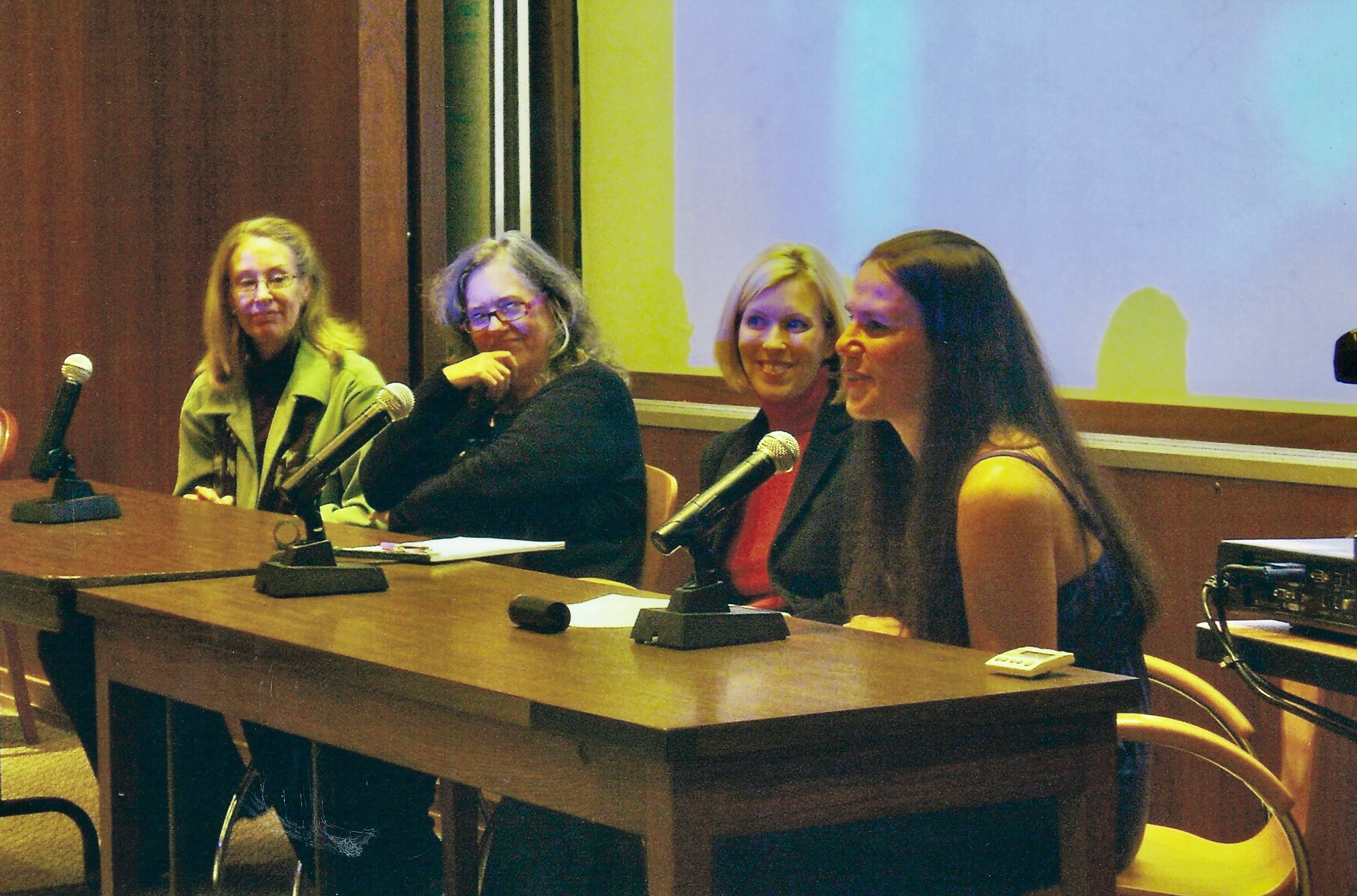
Patricia Hart, Pat Sullivan, Jenny Bay, and Alexandra Hidalgo at the discussion of Alex’s documentary Perfect at Purdue in 2009 (Photo by Nathaniel Bowler).
Tarez Graban: Laurie, I also remember that! I took a quiet pride in knowing that each year a handful of students were identified and admitted as a cohort whose strengths and talents would complement the whole. I was thrilled to be one of a cohort, and I do feel as if we were all very well prepared for whatever we took on next.
Emily Legg: I remember that too, Laurie! I remember thinking that changing the world must be like becoming a well-cited scholar or making a huge name for yourself. But that wasn’t the change she meant, I don’t think. I know she believed we could all be that big name and she has hopes for all of us. But the change we make is the relationships we’ve built over the years. I remember we used to talk about the Purdue family and how we were all connected through our chairs as siblings in different generations. Pat always meant for us to find hope in those future generations, and that is a lasting legacy that lives on beyond the citations, publications, or programs we are a part of.
Laurie A. Pinkert: Yes, Emily, Tarez, and Alex, that’s just it. I do think she means it literally. And I think, as I hear Jenny’s comments, that, for Pat, this understanding of change is probably also about seeing the value of our contributions beyond the university that might just “burn to the ground” or that might just not exist in the ways it does today. Rhetoric changes things because it cannot help but do so. And as responsible change-makers we see the possibility in the new, the changing, the evolving.
Jenny Bay: Oh my gosh, Laurie, I love that. Rhetoric can’t help but enact change. That is so Pat!
Emily Legg: And NOW I know what rhetoric is! I’ll have to tell Pat I figured it out finally. Rhetoric can’t help but enact change—yes! We are rhetorical beings with generations of change to come after.
Huiling Ding: Watching Pat cope with illnesses, recover from them, and go back to the classroom—that was really inspiring. I talked with Pat briefly about her illnesses and diagnosis, and she shared her experiences of going through misdiagnosis and waiting for the right treatment and how that embodied experience transformed how she approached medical rhetoric and health communication. That really highlighted for me the human aspects of medicine and patient-provider communication and ways to stay resilient in spite of tremendously difficult health challenges. I think all those are inspiring, for the world would definitely be falling apart with misdiagnoses and ineffective treatments. But when she got the right diagnosis and treatments, she recovered very quickly and bounced back to work with students again. That was something that was really inspiring. Pat’s commitment to helping students grow gives her and people around her hope, comfort, and inspiration.
Laurie A. Pinkert: One of my most poignant memories of Pat is when she described a bit of the admissions process for the Rhetoric and Composition graduate program. She explained that the process wasn’t just designed to admit students in ranked order but rather to admit them in an order that represented the different secondary areas that the program offered. So, if a student pursuing a Professional Writing specialization declined their admission, another student seeking that area would be admitted. This occasioned the opportunity for a breadth of student interests to be represented in each cohort and for faculty expertise not be stretched too thin with a high volume of students in need of one specific faculty advisor. But more than that, it allowed students to learn from the very different ways that their colleagues thought and the insights they brought to courses or projects, generating fruitful possibilities for the kind of collaboration that benefits from diverse thinkers and the kind of mentoring that is possible when the more seasoned students could pass their knowledge to those incoming. It was the antithesis of the competitive graduate program models I was cautioned against.
Emily Legg: Not being in competition with each other was so important to her! Definitely in the job market, but also all during graduate school. She would think carefully about each graduate student, and who might be on their committee or their chair. I feel like she had a way of gently guiding us from not competing with each other to understanding how we all complemented each other. She had a knack for figuring out everyone’s moves, but I think that’s mostly because she was so understanding of how our community functioned and who we were as members of that community as well.
Jenny Bay: Yes, no one was in competition. Everyone has their own gifts and talents. It doesn’t matter if students were from the same program—everyone is unique. Pat could see promise in students like no one else. She had a gift for putting together cohorts. She was very intentional about it. And she looked at applications in ways I can’t even explain and saw gifts in students that could be cultivated.
Emily Legg: All of those moments with Pat remind me of how important being in community with those around you is, especially right now. Everything happening is causing a fog of low morale everywhere, but being in community are the tools that help me (and hopefully others) see through the fog to the hopefulness that can live beyond it. Pat taught all of us how to be a good community member. She taught us how to build community through building connections in the small things. We don’t have to have a big networking event for that community—we can sit in windowless coffee shops or stand in hallways and be with those around us and support those around us.
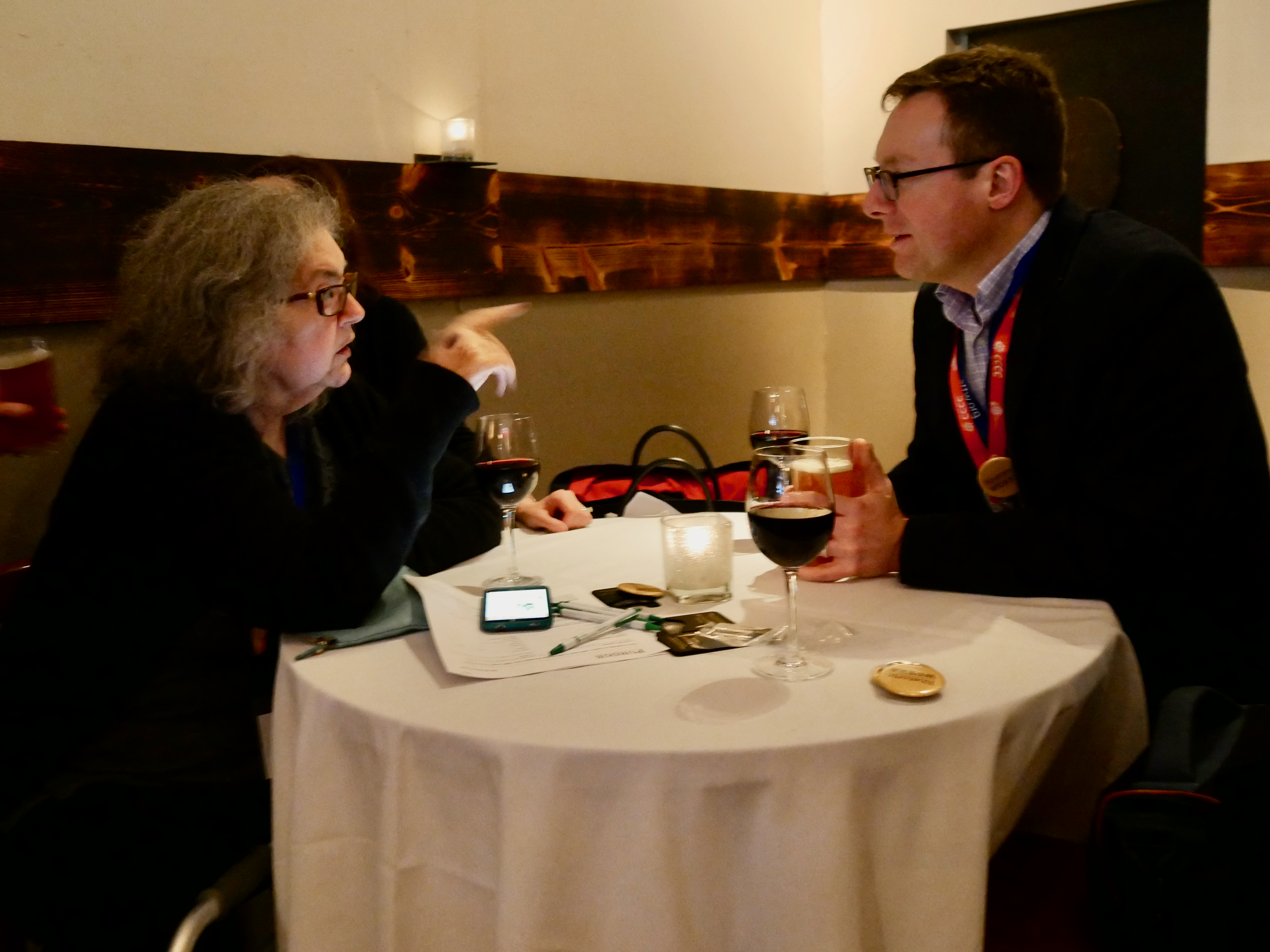
Pat Sullivan and Bill Hart-Davidson at the 2017 CCCC Purdue Party (Photo by Alexandra Hidalgo).
Jenny Bay: Being in community is so important, and it is important to Pat! She had a way of creating that community intentionally and making it seem completely unintentional.
Emily Legg: Unintentionally intentional! Or intentionally unintentional, ha. I liken it to her playing 4D chess on the USS Enterprise (sorry for the Star Trek reference). She knew that the subtle moves and changes she made by being in community would create waves in the future and only grow.
Jenny Bay: Yes, absolutely, I wish I was so perceptive and tuned in.
Emily Legg: Same! I strive to be at least, but I don’t know how she does it. She is a remarkable scholar, teacher, but most importantly, remarkable family.
About the Authors
Dr. Jennifer Bay is Professor of English in the Technical and Professional Writing undergraduate major and in the graduate program in Rhetoric and Composition at Purdue University. Her research focuses on community engagement and experiential learning, internships, digital rhetorics, and rhetorical theory. Her work has appeared in journals such as the Journal of Business and Technical Communication, Journal of Technical Writing and Communication, IEEE Transactions on Professional Communication, Technical Communication Quarterly, Computers & Composition, Programmatic Perspectives, as well as in edited collections. Most recently, she has published on AI, data rhetorics, and equity and inclusion in the TPC classroom.
Dr. Huiling Ding is a Professor of English, a University Faculty Scholar, Director of Labor Analytics and Workforce Development at the Data Science Academy, and Faculty in the Ph.D. program in Communication, Rhetoric, & Digital Media at North Carolina State University. She is the author of the award-winning book titled Rhetoric of a Global Epidemic: Transcultural Communication about SARS, which received the National Council of Teachers of English (NCTE) Conference on College Composition and Communication (CCCC) 2016 Best Book Award in Technical and Scientific Communication. In addition, her articles won the 2013 Nell Ann Pickett Award for Best Article in Technical Communication Quarterly and the 2008 Editor’s Pick New Scholar Award for Written Communication.
Dr. Tarez Graban is an associate professor of English, Honors teaching scholar, and director of the Rhetoric and Composition graduate program at Florida State University. Her work has appeared in journals such as African Journal of Rhetoric, College Composition and Communication, College English, Gender & Language, Peitho, Rhetorica, and Rhetoric Society Quarterly, as well as in several edited collections. With Wendy Hayden she published Teaching Through the Archives, and with Hui Wu she published Global Rhetorical Traditions. Her current manuscript, “Rhetorika Afrika,” offers a rethought notion of feminist rhetorical critique for textual scholars of the transnational archive who must read and curate their subjects in a critical space occurring somewhere between the North Atlantic and the Global South. She serves on FSU’s Faculty Senate Steering Committee; is Chair of the FSU’s Honors Program Policy Committee; is Chair of the CCCC Standing Group on Global & NonWestern Rhetorics; and is past president of the Coalition of Feminist Scholars in the History of Rhetoric and Composition. From 2013 to 2020, she led the Digital Scholars / DH Reading & Discussion Group at FSU, and from 2018 to 2021 she was Director of Research and Fellowships with the Demos Project for Studies in the Data Humanities at FSU. Finally, her work continues on Linked Women Pedagogues, which traces the intellectual contributions of under-represented women teachers in rhetorical studies at home and abroad, from North America’s Progressive Era to the present.
Emily Legg is a Cherokee Nation citizen and an Associate Professor and Director of Professional Writing at Miami University of Ohio. Her research centers Indigenous methodologies of storytelling as a decolonial and materialist research practices in writing and rhetoric, and she brings these methodologies to both her historiographic recovery work and classroom pedagogies. She hopes that by challenging ourselves to become better teacher-scholars, we all can create spaces where community knowledge begins and inclusive teaching can happen.
Laurie A. Pinkert is an Associate Professor of Writing and Rhetoric and Director of Writing Across the Curriculum at the University of Central Florida (Orlando, FL). She also coordinates an interdisciplinary fellowship-writing initiative and previously served as the Director of Undergraduate Programs in Writing and Rhetoric at UCF and the Composition Coordinator at Humboldt State University (now called California State Polytechnic University, Humboldt in Arcata, CA). Her scholarship has appeared in College Composition and Communication, College English, Composition Studies, WPA: Writing Program Administration, Reflections: A Journal of Community-Engaged Writing and Rhetoric, and the International Journal of Ethics Education. Her research on disciplinary identity development within and through writing extends beyond the field of writing studies and has been funded by the National Science Foundation to further investigate the relationships between individual and collective values, STEM enculturation, and disciplinary identification.
About the Moderator
Alexandra Hidalgo is a Venezuelan writer, filmmaker, theorist, memoirist, and editor whose documentaries have been official selections for film festivals in 15 countries and been screened at universities around the United States. She is the recipient of From the Heart Productions’ inaugural “Carole Joyce Award for Excellence in Documentary Storytelling.” Her videos and writing have been featured in The Hollywood Reporter, IndieWire, NPR, The Criterion Collection, and Women and Hollywood. She writes about relationships and the creative life in her Love in Many Genres Substack, and her All the Love! YouTube channel, which features “Stories About Family, Books, Movies, and TV” content, garners 25,000+ views a month. She has a PhD in English from Purdue University and an MFA in Creative Writing from Naropa University and is associate professor and Crow Chair of English at the University of Pittsburgh. Her video book Cámara Retórica: A Feminist Filmmaking Methodology for Rhetoric and Composition received the Computers and Composition Distinguished Book Award. Her scholarship has been published in Kairos, Composition Studies, Enculturation, and Peitho, among others. Her video essay, “Motherhood on the Screen,” received the Kairos Best Webtext Award. She is co-founder and editor-in-chief of the peer-reviewed journal constellations: a cultural rhetorics publishing space.
Production Credits
Copy Editors: Natalie Cohen and Alexandra Hidalgo
Posted by: Natalie Cohen
Editorial Assistants: Megan Simmermeyer and Natalie Cohen
Social Media Manager: Evelynn Pugh
Editor-in-Chief: Alexandra Hidalgo
Related posts:
 Recovering What’s “Swept Under the Rug”: Embodied Academic Experiences as Cultural Rhetorics
 Stories that Lead to Action: An Exploration of US Political Rhetorics
 Facilitating Stories of Immigration in Rural North Central Florida
 A Call for Algorithmic Justice: A Review of Meredith Broussard’s More than a Glitch: Confronting Race, Gender, and Ability Bias in Tech
 Transformative Care as Pedagogy: A Review of Mimi Khúc’s Dear Elia: Letters from the Asian American Abyss
 Seeking Refuge through Decolonial Counterstories: A Review of Cruz Medina’s Sanctuary: Exclusion, Violence, and Indigenous Migrants in the East Bay