
Tommie Leigh McPhetridge, Miami University
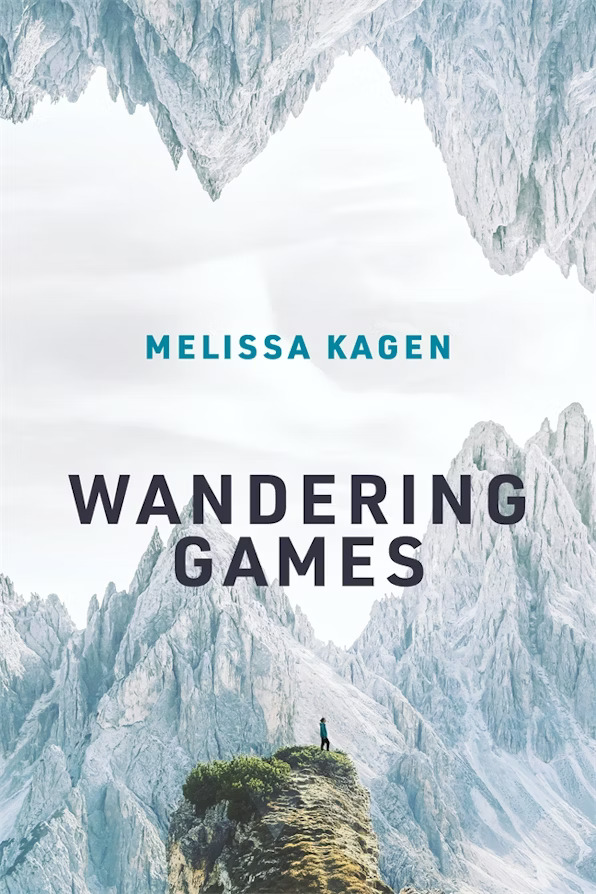
Kagen, Melissa. Wandering Games. The MIT Press, 2022.
Wandering Games by Melissa Kagen challenges a reader’s understanding of the utility of wandering within a video game to explore critical theory and the history of walking. The author takes the fairly rudimentary mechanic of walking in video games and highlights its ability to create meaning far beyond a means of transportation. Walking is an element often only highlighted in “walking simulators,” or games where walking is the goal; but Kagen’s notion of wandering furthers walking beyond just a character moving across the screen. Pushing the boundaries of what a “walking simulator” as a genre can do, Kagen analyzes the single mechanic of wandering across seven different video games, all of which would not typically be identified within the genre of walking simulator. Her research reveals how wandering engages the player in discourse surrounding work, death, gender, and colonialism. Kagen reaches out to digital media studies, game designers, and game scholars to create a theorized exploration of how wandering is central to making meaning within a video game.
The introduction of Wandering Games serves as Kagen’s justification and explanation of her research terms. She defines what she means by wandering, walking simulator, and her core themes of work, death, gender, and colonialism. Most notably, she states that her goal is “to uncover how wandering thought has woven itself into the fabric of games that might not think of themselves as such” (Kagen 26). Her staging in this chapter is historically focused, creating her parameters of the core themes and situating the field of walking simulators as participants in the history of walking. Kagen focuses on histories of walking through time and activism, walking as a form of pedestrian performance, and digressions in literature as other examples of wandering. By situating her analysis as engaging with these fields, she takes the relatively tight concept of video games and relates them to the greater history of the world that they come from. The rest of the book follows with chapters that focus on a video game and one or more of her core concepts.
In “Late Capitalism: Caring for Corpses in Return of the Obra Dinn,” Kagen explores Return of the Obra Dinn (2018), in which the player character (PC) must find and assess the bodies of the crewmembers aboard the Obra Dinn. Kagen’s exploration of wandering in this chapter looks at death and how walking simulators subvert the player’s traditional engagement with death. Often death, and more specifically killing, is the goal of a video game; beating and killing enemies in order to gain resources or progress. But in walking simulators, the player encounters death, usually by an abandoned land or lost people, rather than cause it. Late capitalism blends with death in Return of the Obra Dinn by forcing the player to assign monetary value to the deaths that they encounter, asking the player to participate in the capitalist landscape while being supremely uncomfortable faced with the death of the Obra Dinn’s crew members. Her analysis of Return of the Obra Dinn ends with the point that satisfaction, either through death or completion of a goal, is not always in the hands of the player. Sometimes, a game can delay that satisfaction indefinitely, leaving the player to wonder about their engagement with the game, something that a traditional video game wouldn’t do.
“Romantic Precarity: Eastshade as a Fantasy of Work” develops an analysis of Eastshade (2019), a wandering game that features exploration as a means of inspiration for the wandering painter PC. Continuing her analysis of late capitalism, Kagen builds into Eastshade’s romantic notions of wandering, both as the provincial young man questing for self-exploration and romantic attunement to nature and the unknown. Where the PC in the game wanders through a new landscape in search of vistas to paint, the player is confronted with late capitalism and the realities of labor. The player must reckon with the fact that the PC desires to paint and fulfill the artistic requests of his late mother, but the player’s goal of running errands and completing quests changes the narrative from painting for the love of the trade to painting for economic labor. Kagen’s analysis of Eastshade ends with a comparison of precarity and the economic/labor realities of Eastshade with the realities of the creators of the game. Just as the PC paints “for the love of the craft,” the developers created Eastshade while facing financial hardship and time constraints.
Ritual of the Moon (2019) is a game that questions the player’s relationship to time, gender, and disability. In “Walking in Circles: Bodily Constraints in Ritual of the Moon,” Kagen centers gender and wandering, and how the body and its intersectional identities can constrain the player’s relationship to wandering. Kagen’s analysis of wandering delves into intersectional identities and how constraints of identity ask the player to confront misogynistic ideas of wandering women, women’s values of time, and chronoatypical time—“asynchronous with a heteronormative script of life events like marriage and reproduction, utopian in its visions of possible futures, or out of step with traditional norms of productivity and pace” (Kagen 75)—as a queer and disabled construct. She builds up her analysis of Ritual of the Moon to ultimately posit that the player must confront their relationship to pleasure and playfulness when playing. Ritual is not a fun game where the PC becomes happier and more fulfilled the more that you play. Rather the player must play Ritual every day for thirty days to help the PC avoid further pain and disability by performing a daily ritual that saves the world. Ritual of the Moon gives walking an incredibly salient purpose and forces the player to understand the power of every step that the PC makes.
“Traveling Through: Decentering the Explorer in 80 Days” is Kagen’s major foray into colonialism in video games, specifically how conquest and exploration are vessels for colonization. This chapter focuses on two games, a video game called 80 Days (2014) and a board game called Reise um die Erde (Trip Around the World) (1872), both games inspired by Jules Verne’s Around the World in Eighty Days. Kagen shows how physical board games like Reise have often engaged with notions of colonization, centering white colonizing characters who conquer or explore (and exploit) foreign lands. This chapter argues that the typical colonizing narrative of a video game, wherein the PC encounters a new land, explores through acquiring (stealing) resources and conquering (killing) natives, is subverted through 80 Day’s gameplay. By decentering the narrative away from the protagonist, the game further enacted decolonization by shifting the gameplay away from completing the goal of global navigation to focus on the narratives of each person the PC encounters.
Kagen’s fifth chapter is titled “Language Worlds: Empire and Undoing in Heaven’s Vault.” Furthering her conversation on colonization, Kagen shows how Heaven’s Vault (2019), a game focused on linguistics and the uncovering of ancient traditions, illustrates how marginality breaks the mold of colonization. The PC is a woman of color in a space landscape that has long been colonized. Her dual identity as a marginalized ethnicity operating in a colonized city affords her new ways of engaging with knowledge and meaning making, which is ultimately the reason for her success in the game. Kagen draws from decolonial theory and Black postmodernism to show how reframing history through marginalized narratives opens paths towards new futures that are only possible with a decolonized framework. The exploration of wandering in this chapter shows how exploration and excavation are not always colonial tools of conquest, but how centering marginalized identities can make the player practice resisting hierarchies and hegemony.
In her final chapter, “After Life: Death Stranding and The Last of Us Part II,” Kagen makes a bold move comparing two AAA video game titles, The Last of Us Part II (2020) and Death Stranding (2019), to wandering games and walking simulators. By this time in the text, the reader is familiar enough with the genre of walking simulator to understand how the once derogatory term can be a useful framework for understanding how video games offer critical thought and engagement for the player. Kagen’s analysis of the two games in this chapter tie together her final thoughts on wandering with death and bodies at the center. Her main point in this section is that post-apocalyptic landscapes like those found in the aforementioned video games offer new conversations surrounding conquest in video games (how can one conquer a landscape that has been ravaged already?) and face an unimaginable threat and the reality of death.
Kagen’s conclusion is a carefully constructed reminder of her research focus on wandering. She offers hope that her work will reach gamemakers and readers alike to show the importance of an otherwise ambient mechanic. Kagen’s call to game designers asks them to attune to the possibilities of the wandering body (138). If gamemakers can question the mechanics of walking or wandering in their game, they might better understand how PCs can be vessels for player navigation of critical discourse and an understanding of both game and theoretical history. Meanwhile, her hope for scholars is to offer a framework of taking a single concept (wandering) and tracing it across multiple mediums and genres. If the book is truly meant to reach game designers, its intense grappling with theoretical and historical texts may prove too dense for some designers to hold onto. However, Kagen’s expert weaving of theory with explanations of video games and modern reality may soothe what is otherwise a theoretically dense text. By offering a framework for scholars to build from, Kagen also reaches out to scholars who are unfamiliar with video games and gives them a way into the field and a practice they can take with them.
Wandering Games would be particularly useful for those trying to understand how video games can act as vessels of critical discourses and often engage in theoretical understandings of the world, both fictional and real. While people who are unfamiliar with video games may be intimidated by this area of focus, Kagen’s framework of analysis offers a unique way to engage with her text and invite conversation between scholars and their media of study.
Acknowledgements
My thanks to Tim Lockridge, who provided the exigence for this paper and the encouragement to share it with the world.
About the Author
Tommie Leigh McPhetridge is a second year PhD student in Composition and Rhetoric at Miami University. Her research interests tend toward pedagogy, community, and meaning making practices. In particular, she is interested in researching how emotions and the desire for connection lead to relationships and a strengthened sense of community, both inside and outside academic spaces. Tommie holds a BA in English from Whitworth University and an MA in English from Western Washington University.
Production Credits
Book review editor: Ana Milena Ribero
Editorial Assistant: Megan Simmermeyer and Natalie Cohen
Copyedited and posted by: Natalie Cohen
Social Media Manager: Evelynn Pugh
Editor-in-chief: Alexandra Hidalgo
Related posts:
 A Call for Algorithmic Justice: A Review of Meredith Broussard’s More than a Glitch: Confronting Race, Gender, and Ability Bias in Tech
 Transformative Care as Pedagogy: A Review of Mimi Khúc’s Dear Elia: Letters from the Asian American Abyss
 Seeking Refuge through Decolonial Counterstories: A Review of Cruz Medina’s Sanctuary: Exclusion, Violence, and Indigenous Migrants in the East Bay
 Creating Home through Narrative: A Review of V. Jo Hsu’s Constellating Home: Trans and Queer Asian American Rhetorics
 Deep Feelings and Intentional Communities: Honoring Patricia Sullivan’s Legacy
 Restoration and Connection: Where Rhetoric Meets Art