
By Alexander Slotkin, Florida Atlantic University
For those of us who don’t hide our Middle Easterness under one Jewish “we,” it becomes tougher and tougher to exist in an American context hostile to the very notion of Easterness [sic]…To be a European or American Jew has hardly been perceived as a contradiction, but to be an Arab Jew has been seen as a kind of logical paradox, even an ontological subversion.
—Ella Shohat, “Dislocated Identities: Reflections of an Arab Jew”
Introduction
Dear Reader,
I’ve hesitated to write this piece.
Well-meaning colleagues,
none of whom share my background,
worry that my work risks sounding
too divisive.
“Now is not the time,”
they say, year after year.
“We must present a united Jewish front.”
Yet I find myself asking:
If not now, when? When, precisely,
does my identity become permissible
—convenient, even—for discourse?
I am an American Iraqi Jew—or, more broadly, a Mizrahi Jew, a term used to describe Jews of Middle Eastern or North African descent. To be an Iraqi Jew in the United States is to be seen as a contradiction: our identity doesn’t fit within Eurocentric narratives that posit Jewishness and Arabness as opposites. As Iraqi Jewish scholar Ella Shohat observes, “Americans are often amazed to discover the existentially nauseating or charmingly exotic possibilities of such a syncretic identity” (“Dislocated Identities” 8). I typically find myself compelled to explain why such an oxymoronic figure like myself exists, especially in a country and discipline where Jewishness is often conflated with the culture and traditions of Jews of non-Iberian European descent (known as the “Ashkenazim”). In “an American context, we face again a hegemony that allows us to narrate only a single Jewish memory, i.e. a European one” (8). But by telling stories about our rhetorical traditions, I hope to create new spaces for our voices within cultural rhetorics, a field and practice dedicated to studying the everyday writing and rhetoric practices of specific groups. While this essay was first written for people who, like me, have yet to see themselves reflected in the rhetorical scholarship we read, its audience is broad: everyone—Jews and non-Jews alike—benefits from engaging with rhetorics from diverse positionalities.
This is an earnest plea for new beginnings. This is also a ghost story.
I grew up listening to ghost stories about jinn, genies from Arab mythology who might toy with you for amusement or, on darker nights, claim your body as their own (not quite the cheerful blue character from Disney’s Aladdin, is it? My grandmother Joyce Marie Saleh Slotkin warned me that jinn hide in every dark corner of our home, waiting to catch us off guard just as they had our family in Basra, Iraq (Figure 1). “I’d hear your great-grandmother,” she would recount, “loudly cursing the jinn for borrowing her clothes and returning them stained.” A keen observer could only ever catch glimpses of these jinn in their fleshy disguises; their true form is invisible to the eye. But each flap of their wings or coil of their tails left behind imprints (writing) if you only knew how to read them. These ghost stories taught me that storytelling isn’t about cobbling together the right words or saying the right things; instead, storytelling is about creating relationships between and across worlds. And yet, although all communities tell stories, not all stories are valued equally in rhetoric and composition.
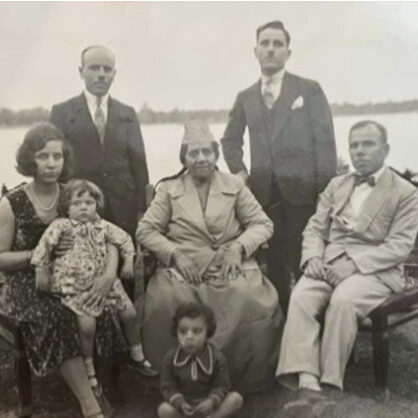
Photo of my family, the Saleh family, on the Shatt Al-Arab River in Basra, Iraq. The men wore Western suits in the fashion of the British Empire, which colonized Iraq from 1914 – 1932. Before their occupation, the Ottoman Empire had colonized the region from 1534 – 1704 and again from 1831 – 1914. This latter period of colonization is reflected in the head covering the woman in the center (my great-great-grandmother) is wearing. Photo courtesy of my father, Robert Slotkin.
I was never assigned anything to read from an explicitly Jewish point of view while studying rhetoric at the undergraduate and graduate levels.[1] Instead, I needed to find these texts on my own, none of which I found from conversations in cultural rhetorics. Raising this issue to non-Jewish scholars in the field online or at conferences often earned me swift dismissals, with one well-meaning professor writing, “You don’t see Jewish people on syllabi?? Really? I studied under Jewish Scholar 1, 2, and 3…[I was] influenced by Jewish Scholar 4 and others.” Of course, I had read works by and studied under scholars who happened to be Jewish, but I was never formally introduced to an author or text discussing Jewish meaning-making practices.[2] As scholars in rhetoric and composition, we often assign and cite work by Jewish authors without discussing Jewish rhetorics; we often teach the words of people who are Jewish without explicitly focusing on Jewish meaning-making practices. This is as much an observation as it is a critique. At the same time, Jewish approaches to rhetoric typically center Ashkenazi norms, unintentionally framing European Jewish culture, history, and traditions as the default Jewish experience, a practice known as Ashkenazinormativity.
When scholarship in rhetoric and composition takes up Jewish rhetorics as its subject of study (that is, Jewish forms of communication, argument, and expression), it most often engages the contributions and perspectives of Ashkenazi Jews. In their 2014 collection, Jewish Rhetorics: History, Theory, Practice, the first currently known book to carve out the scope and significance of Jewish rhetorics as a subfield of rhetoric and composition studies, Michael Bernard-Donals and Janice W. Fernheimer state that there is little work on the meaning-making practices of Mizrahi and Sephardi Jews, the latter referring to Jews of Iberian descent (xxvi). Apart from two essays engaging with Sephardi voices, their foundational collection:
emphasizes practices, history, and theory that would be familiar to or that have been generated by Jews of Ashkenazi descent. This is not to say that there are not equally important and valuable contributions from the Sephardi and Mizarchi traditions. We are sure there are, and we encourage whoever is reading the chapters in this volume to be very aware of both these gaps and the need to fill them with further research. (xxv)
Part of the reason there hasn’t been much work on Mizrahi and Sephardi rhetorical traditions has to do with the discipline’s unfamiliarity with the traditions and “languages necessary to study Sephardi and Mizrachi texts” (xxvi), emphasized by the lack of cross-engagement between Jewish and rhetorical studies. Likewise, there are markedly fewer Mizrahi scholars in rhetoric and composition than Ashkenazi or even Sephardi ones, resulting in some Sephardi representation and a noticeable absence of Mizrahi voices. But given the proliferation of Mizrahi writings in recent years, including memoirs, interviews, testimonies, documentaries, and scholarly research, it is high time this gap is addressed by someone.
There are no jinn in Europe.
I want to take a moment to explain that while I contrast Ashkenazi and Mizrahi frameworks throughout this article, I do not mean to impose a simple oppressor-oppressed binary. Although this work comes against the backdrop of complicated intergroup conflicts for representation and cultural authority, the goal is not to position Ashkenazim and Mizrahim as competitors or to indict Ashkenazi rhetorics. Ashkenazi dominance in Jewish rhetorical scholarship coexists, and at times overlaps with, shared histories of Jewish marginalization and oppression by antisemitic and anti-Jewish groups. Moreover, Jewish identities are anything but simple. While members of the Jewish faith popularly use terms like Ashkenazi, Sephardi, and Mizrahi to describe themselves and others, these terms are deceptive; they group Jewish communities by geographical regions they may or may not be inhabiting, conflating cultural differences and historic struggles in the process. Just as Iraqi Jews have a different history than their Iranian and Yemeni counterparts, so too do German Jews differ culturally from their Polish and French neighbors. Jews use these terms while also recognizing the differences between individual communities, something that is often lost in public discourse. My intention in writing this article is to expand our disciplinary framework to include understudied meaning-making practices, to explore specifically Mizrahi practices.
If the nascent field of Jewish rhetorics is going to do the critical work of engaging rhetorical traditions that reflect the richness, beauty, and diversity of Jewish communities worldwide, we must begin constellating Mizrahi voices and traditions. Likewise, if cultural rhetorics is going to continue constellating the stories, experiences, and traditions of overlooked, marginalized, and oppressed voices, we must begin engaging Jewish traditions—Ashkenazi, Sephardi, and Mizrahi. This last point, I feel, is especially important given rhetorical studies’ unfamiliarity with Jewish ways of making meaning. Engagement beyond mere representation matters, and cultural rhetorics’ focus on understanding a group’s practices within its own cultural logic offers an avenue for meaningfully engaging with Jewish rhetorics (Grayson). Hence, this article seeks to put Jewish rhetorics and cultural rhetorics into deep conversation with one another, bringing attention to Iraqi Jewish meaning-making practices in the process. In doing so, I aim to constellate diverse Jewish voices from within and outside of academia to help others do the same.
Constellation as a metaphor denotes how various practices come together within a cultural context to form a web of meaning. Constellating Jewish rhetorics through a cultural rhetorics framework “allows different ways of seeing any single configuration within that constellation, based on positionality and culture,” to matter (Powell et al. 1.2). Emphasizing the relational nature of meaning-making, Malea Powell further expounds upon the metaphor, writing, “We are thinking, for example, of the way that different cultures have different ways to draw relations between stars in the sky, and how naming those relations, those constellations (Ursa Major, the Bear, the Big Dipper, the pathway to Sagittarius) is an act of meaning-making” (1.2). Working across cultural rhetorics and Jewish rhetorics pushes us to confront the relationships we choose to leave unseen. It also helps create space for scholarship from positionalities that follow, expand upon, and diverge from conversations in Jewish rhetorics today to illustrate what this nascent field can become tomorrow. And that, of course, means more stories.
Storytelling As Method: My Orientation to Jewish Rhetorics
Storytelling as a rhetorical method enables individuals from marginalized and oppressed communities to speak to the ongoing colonial and extractive conditions that make up their reality. Stories help o/Other histories and experiences to matter in academic discourse. In “Constellating Stories and Counterstories: Cultural Rhetorics Scholarship Principles,” Kimberly Wieser explains that stories are “something all humans share, and cultural rhetorics gives us a space to make the connections between our stories, those of others, and stories in the field. Cultural rhetorics allows us to make stories central, to ‘constellate’ them in order to make meaning” (n.p.). In making stories central to their work, cultural rhetoricians necessarily implicate themselves in that work, drawing on experiences that reflect their relationship to the communities they engage with and write about. The storyteller is always already part of the story. The story I’m telling is not about me. Still, I think it’s important to speak more deeply about my community and positionality, as well as my orientation to Jewish rhetorics, so you can better understand where I’m coming from.
My community, the Iraqi Jewish community, is in danger of disappearing—and I don’t mean that figuratively. Iraqi Jews are Indigenous people who lived in Iraq as early as 500 BCE, well before the capital city of Baghdad was founded. In the 1940s through the ’60s, most Iraqi Jews were violently forced from their homeland and fled into permanent exile. This was in large part due to the country-wide adoption of Arab nationalism intertwined with Nazism, a blending of ideologies that led government authorities to publicly endorse Nazi propaganda and anti-Jewish legislation, treating Jews as Zionist actors with Western interests rather than fellow Iraqis (see Moreh; Shenav). These anti-Jewish attitudes only became more pronounced following the creation of the State of Israel. Around 160,000 Iraqi Jews were living in Iraq before the start of their mass exodus (Basri). At the time of writing this article, that number is just four (“Iraq’s Jewish Community Dwindles”).
But we are not yet ghosts. Our story is told, in part, by the cultural artifacts and communal spaces left behind (Figure 2). Graveyards, synagogues, and architectural landmarks continue to speak to our existence, which is why they’re constantly under threat of erasure, such as when President Abdul-Karim Qasim (1914 – 1963) destroyed an over 600-year-old Jewish cemetery. When “Qassem ordered the bones removed and the place bulldozed, it was a horrendous thing for the community. Not all the bones could be salvaged in time, and the remains of hundreds of thousands of our ancestors were destroyed” (Zelouf 170). If no one from the community is living in the area today, how can these cultural spaces continue to bring us together? And if these spaces are razed, reduced to the scattering of rocks and bones, existing only in the testimonies of a generation that will one day die, how can these places bind the living to the dead? To erase a people from a land, you must first erase the memory of those people on that land and, with it, any proof of those people ever living and dying. Any attempt at disconnecting any Indigenous population from their land is an act of genocide.[3]

Figure 2. Photo of my great-grandparents Sabiha and Heskail Saleh (left) and my grandmother’s uncle Phillip (right) standing in the large garden my family kept near the Saleh family compound (background). The compound housed my great-grandparents, their four children, and their parents and overlooked the Shatt al-Arab River separating Iraq from Iran, making it a desirable location. For this reason, the city of Basra relocated my family, demolishing the home my grandmother grew up in to build a corniche waterfront road. Our connection to that land is only memorialized in photographs and stories. Photo courtesy of Robert Slotkin.
I do not wish to dwell here on the ongoing genocide of Iraqi Jews, which has long since extended into legal arguments between Iraqi officials and Iraqi Jews about who owns Jewish documents reclaimed from Saddam Hussein’s basement (Figure 3).[4] Instead, I want to observe that recognizing the genocide against Iraq’s Indigenous Jewish population (as I am doing here) is not merely additive but transformative; we need these constellations going forward in a range of ways. For example, can platforming Iraqi and other Mizrahi voices help Jews and non-Jews alike to deconstruct preconceived Western notions of Jewishness? Can a deeper understanding of the specificities of Iraqi Judaism and its history help us to further recognize the insufficiency of labels like “Mizrahi,” which group all Arabic Jews together to strip our identity, even as we adopt and reclaim the term? And can acknowledging the removal of Iraqi Jews from their homeland as a genocide help us to call the senseless killing of Palestinians by the same name? The answer to all of these questions, I believe, is “Yes.”

Photo from my dissertation research showing the burial site of damaged Torah scroll fragments and other religious writings in the New Montifore Cemetery in Long Island, New York. These texts were recovered during the U.S. raid of Saddam Hussein’s intelligence building. Photo taken by me
In “The Invention of the Mizrahim,” Ella Shohat explains that “[t]he same historical process that dispossessed Palestinians of their property, lands, and national-political rights was intimately linked to the process that dispossessed Arab Jews of their property, lands, and rootedness in Arab countries while uprooting them from that history and culture within Israel itself” (7). Shohat goes on to call for a relational analysis of the forced departure of Arab Jews from predominantly Muslim countries, one that disrupts what she characterizes as a Zionist framework for repositioning Arab Jews and Palestinians as antagonists.[5] This framework mirrors Western-colonial logics by portraying European Jews as modern figures worthy of study and Arab Jews as premodern anomalies, creating “a kind of unspoken agreement between Zionism and Arab nationalism to perform a total cleansing of Arab-Jewish culture” (Snir 206). It’s worth quoting Shohat at length on this issue:
One can no longer deal today with subaltern identities such as Mizrahim or Palestinian citizens of Israel (or the larger Middle Eastern diaspora) on the basis of purist definitions of identity that often end up becoming ahistorical and even oppressive schematizations. Given the displacement of Jews from the Arab Muslim world and their contemporary presence largely in the “West” (Israel, France, Great Britain, the Americas), it is more than ever impossible to collapse a complex, layered culture into a simplistic division of East versus West or Arab versus Jew. Diasporic identities are not homogenous [sic]. Often, displacements are piled onto earlier displacements. For Arab Jewish communities, the traumatic move to Israel came in the wake of the partition of Palestine, a process over which they had no control and in which they, like the Palestinians, were the objects and not the subjects of history, even if this objectification for Palestinians took a different, infinitely more violent form. (This is not to suggest that once in Israel Mizrahim have not been part of this violence against Palestinians.) (“Invention of the Mizrahim” 18)
Shohat’s insistence on relationality invites readers to reconsider how they understand Mizrahi and Palestinian identities, suggesting that the construction of one implicates the construction of the other. Mizrahi and Palestinian identities are not discrete or oppositional, but are instead co-constituted through overlapping colonial, national, and diasporic events. More fully understanding the ongoing state-sponsored killing of Palestinians requires attending to the construction of Arab Jewish identities, including that of Iraqi Jews. The very process that estranged Iraqi Jews from their land in the past is entangled with those that render Palestinians stateless and disposable today.
It’s important to note here that I am not an Indigenous Iraqi—at least not entirely. As my grandmother would lovingly remind me, I’m an American. But whereas she didn’t have a choice but to be an Iraqi Jew, I choose every day to be part of my community through my actions. And that’s important, especially as community leaders throughout the United States continue to voice fears over their erasure. As one community elder, Shlomo Bakhash, asked in 1999, “Are we the last of the Iraqi Jews? Who is to blame for our extinction? Certainly not our forefathers, not our grandparents, not our parents[;] they did what they had to do to preserve our culture. We are to blame[;] it is us who are facing extinction” (n.p.). If storytelling is about creating relationships, then it’s also about surviving and ensuring that our culture lives on. If we continue to tell and share our story even after losing access to our ancestral land, then we can continue to live l’dor v’dor, from generation to generation (Figure 4). And if storytelling produces and reproduces culture, then the decision by Iraqi and other Mizrahi Jews to tell our stories is also an act of survival.

Family photograph from my parents’ wedding, one of the few images that holds nearly everyone who once lived in Iraq—my grandmother, her three sisters, and their mother—gathered beside their family, standing together after history tried to scatter them. They survived the Farhud, the violence that left Iraqi Jews across the country murdered, beaten, and raped. Warned by a family friend to leave, they drove overnight from Basra to Baghdad, covering some 340 miles and leaving their home and nearly everything they owned. Later, they learned that the friend who warned them was publicly executed. I write so their survival is not mistaken for silence. Photo courtesy of my mother, Audrey Slotkin
Because one of my goals in this article is to encourage non-Jewish rhetoricians to engage with Jewish meaning-making practices, I think it’s important to provide a brief overview of contemporary Jewish rhetorics. The following section offers a short literature review that introduces readers to some conversations and trends in the field. It also begins to situate Mizrahi rhetorics within the broader landscape of Jewish rhetorical studies by etching out the contours of its absence in the field’s formative development.
There can never be one origin for a field of knowledge in a constellation. The same is true for Jewish rhetorics. If we believe that all rhetoric is cultural and all culture is rhetorical, then Jewish rhetorics has existed as long as Jewish communities have made meaning. Stories about jinn and the traditions Iraqi Jews maintain to keep them at bay are as much a part of Jewish rhetorics as reading the Talmud. As Malea Powell et al. explains in their article “Our Story Begins Here: Constellating Cultural Rhetorics,” “all work in the discipline [of rhetoric] is already focused on or arises from specific cultural practices” (2.2; original emphasis). Every cultural practice in Jewish communities worldwide represents localized or shared traditions that define a Jewish stance on rhetoric, and rightfully so. They all deserve our attention.
Situating Jewish Rhetorics L’Dor V’Dor: A Brief History of the Field
The body of Jewish rhetorics scholarship that I am discussing in this article is newer, coming together as a subfield of rhetoric and composition in the early 2000s with the publication of Andrea Greenbaum and Deborah Holdstein’s 2008 Judaic Perspectives in Rhetoric and Composition, the first disciplinary book we currently know of to focus exclusively on Jewish rhetorical traditions. That is not to say, however, that Jewish rhetorics didn’t have its antecedents, with one of the earliest mentions of the phrase appearing in 1949 (see Daube). The 1980s also saw a good deal of work on Jewish rhetorics, such as David Stern’s 1981 essay “Rhetoric and Midrash: The Case of the Mashal” and Arthur Lesley’s 1984 article “A Survey of Medieval Hebrew Rhetoric.” In his 1985 work “Pre-Modern Jewish Study of Rhetoric: An Introductory Bibliography,” Isaac Rabinowitz describes the topic as a “comparatively neglected field of rhetorical study, one that certainly deserves, and will bounteously reward, more extensive cultivation” (144). So, while the subfield of Jewish rhetorics is new to rhetoric and composition, it is by no means new to Jewish scholars.
One notable milestone in the study of contemporary Jewish rhetorics is the 2010 publication of College English’s “Special Topic: Composing Jewish Rhetorics.” This special issue emerged from conversations held at the 2007 Rhetoric Society of America Summer Institute Workshop on Rhetoric and Jewish Studies (“Talmidae Rhetoricae” 578). Traces of this conversation can be found throughout the special issue, with each contributor addressing the same questions from a different perspective: “What makes rhetoric distinctly Jewish? Or what does Jewish rhetoric look like?” Topics in this issue include discussions of cultural expression, memory, and religious texts, setting the scene for later scholarship. Unfortunately, none of these brilliant contributions takes up the question from a Mizrahi perspective.
The article that comes closest to decentering an Ashkenazi perspective is Susan Handleman’s “The Philosopher, the Rabbi, and the Rhetorician.” Drawing on the work of a Sephardic French thinker named Rabbi Yehouda Leon Ashkenazi (Manitou), Handleman seeks to articulate an ethical-religious discourse regarding how Jewish communities construct themselves in relation to others and how this construction influences their rhetorical theory. She practices a “classical Jewish rhetorical” method of study, describing it as “a kind of nonlinear midrashic exegesis where I am line-by-line glossing, explaining, commenting, and elaborating on a passage whose every word or phrase is assumed to have many levels of meaning. I, too, will be the philosopher, the rabbi, and the rhetorician” (594). Handleman, however, does not discuss Manitou’s Sephardi background or culture, focusing instead on his French-Jewish identity and relationships.
Some articles in the issue refrain from addressing identity along Ashkenazi, Sephardi, or Mizrahi lines altogether. Instead, they focus on premodern and modern rhetorical practices through which Jewish rhetors build community with others. For instance, in “A Virtual Veibershul: Blogging and the Blurring of Public and Private Life among Orthodox Jewish Women,” Andrea Lieber explores how blogging functions as a safe space for Orthodox Jewish women to express themselves. Specifically, she contends that “these blogs represent the articulation of a new kind of ‘public’ private—one that facilitates an extraordinary opportunity for self-expression…[without] compromising social and religious boundaries” (622), a space described as a virtual veibershul. Yet the use of veibershul—a Yiddish term for the women’s section of an Orthodox synagogue—reveals an unspoken norm. While Lieber defines the term in her article, the title nonetheless presupposes an audience familiar with Ashkenazi culture. The word itself is vivid and descriptive, but the absence of any discussion of Ashkenazi rhetorics allows that cultural frame to remain unmarked and, thus, normative.
Similar issues of normativity emerge in Jewish rhetorical scholarship beyond College English’s special issue, particularly in studies of the rhetorical techniques and philosophies found within religious texts. For example, Steven B. Katz’s essay “The Hebrew Bible as Another, Jewish Sophistic: A Genesis of Absence and Desire in Ancient Rhetoric” approaches the Tanakh or Torah as a Jewish rhetorical text, emphasizing the primacy of language in a Jewish rhetorical tradition. Katz’s observations ring true for many Jewish communities, and he does a fantastic job of situating this practice as rhetorical. But by focusing intently on what these texts mean, we risk losing sight of the people reading them. I contend that we risk universalizing an audience that doesn’t exist if we don’t consider community-specific practices. Any discussion of Jewish rhetorics should include the everyday reception and perception of Jewish meaning-making practices. Privileging content over context contributes to upholding the “Euro-American practices” that Powell et al. say “go as the unmarked ‘mainstream’ in our discourse about what counts in the discipline” (2.2). Not all Jewish communities approach Jewish texts similarly, even if we read them together in Hebrew. But there is room to think about positionality in Jewish rhetorics.
Mara Lee Grayson’s “Assimilation/Appropriation: What Jewish Discourses in Rhetoric, Composition, and Writing Studies Tell Us about the Limitations of Inclusion” does the necessary work of exploring how Jewish discourse is marginalized in rhetoric, composition, and writing studies (RCWS), drawing in part on the experiences of Jewish scholars in the field. Her study documents how Jewish culture and rhetoric are assimilated into (and appropriated within) RCWS discourse, suggesting that “inclusion is not inherently equitable, nor does it necessarily change the structures of white supremacy” (57). Grayson highlights how Jewish discourse is always at risk of being conflated with and consumed by white, Western rhetorical traditions: “We have assimilated, we are told. We aren’t underrepresented. Why, then, can’t we find our knowledges, voices, or experiences in so many of the disciplinary spaces we have been allowed to access” (64)? Grayson’s question to RCWS is equally relevant to the issue of Mizrahi inclusion in Jewish rhetorics. Just as Jewish rhetorics have been assimilated into RCWS without actual representation, Mizrahi meaning making practices have been absorbed within Jewish rhetorics without any visibility. If Jewish rhetorics is meant to characterize what a distinctly Jewish approach to rhetorical studies looks like, then why can’t Jews from the “East”—from countries like Tunisia, Egypt, Iraq, Iran, Yemen, Bahrain, Uzbekistan, Tajikistan, Turkmenistan, and Afghanistan—find our knowledges, voices, or experiences in the disciplinary conversations we belong to? Jewish rhetorics (and rhetorical studies more broadly) has the potential to deeply nuance discussions of Jewish experiences in relation to race and culture, but not without Mizrahi representation.
My goal in the following section is to briefly illustrate how Jewish rhetoric emerges from political, racial, cultural, and religious contexts to demonstrate what a more diverse approach to Jewish cultural rhetorics might look like, an avenue I hope we can all build upon. To this end, I take inspiration from Janice W. Fernheimer’s work on how Jewish conceptions of identity interface conversations about race, decentering Ashkenazi voices as the norm. In “Black Jewish Identity Conflict: A Divided Universal Audience and the Impact of Dissociative Disruption,” Fernheimer specifically analyzes the Israeli parliament’s refusal to recognize the African Hebrew Israelites [6] as Jews over disputes about their Hebrew ancestry. She calls attention to the processes by which “most ‘white’ and recognized Jews connect hegemonic Jewishness with Ashkenazism, Westerness, and whiteness” (65), explaining that “[t]he Ashkenazic hegemony has meant that other Jews who do not fit the European profile (Ethiopians, some Jews of Sephardi/conversos descent) and even some who do (such as Jews from the Former Soviet Union) are often asked to ‘authenticate’ their status earlier with corroborating documents (birth or marriage records) or by undergoing halachic conversion” (53). Halachic conversion—a stringent process for converting to Judaism, often over the course of several years—becomes a gatekeeping mechanism. [7] To be Jewish is to either trace one’s lineage through a Jewish mother or undergo conversion, and the inability to prove the former leads community leaders to require the latter. What Fernheimer’s work points to is the fact that some Jewish identities are accepted without question because of their proximity to whiteness, Ashkenazism, and Westernness. This dynamic is evident in the experiences of Mizrahi and Sephardi Jewish refugees arriving in the United States, including members of my community. Many were not recognized as Jews—because of their names, their tongues, and their appearance—and, as a result, were denied support from Ashkenazi-dominated Jewish institutions, including hospitals and synagogues.[8] Some people enjoy the privilege of being read as Jewish, while others need to fight for their place at the table. I aim to take my seat at that table as an Iraqi Jew, as someone who makes meaning from folktales about jinn, as someone who can be too Jewish to be Arabic and too Arabic to be Jewish.
Future Avenues for Jewish Rhetorics: Exploring Cross-Cultural Composition
What follows are possible avenues that Jewish rhetorics scholars might take to center non-European meaning-making practices, drawn from Iraqi Jewish traditions. These avenues are informed by the overlap between cultural rhetorics and Mizrahi studies, a subfield of Jewish studies attempting “to re-map the terrains of a critical Mizrahi scholarship within a multicultural relational approach that assumes a non-finalized and conjunctional definition of identity” (“Shaping of Mizrahi Studies” 93). Just as cultural rhetoricians strive to constellate different practices and traditions, Mizrahi studies takes a relational approach to the study of Jewish history and tradition by exploring how Jewish identities emerge across time through their cross-cultural interactions. The following examples from Iraqi music and folklore demonstrate how Mizrahi rhetorics adds to cultural rhetorics’ burgeoning constellation by recognizing everyday forms of Jewish compositions and the cultural contexts they inhabit.
One avenue for diversifying conversations in Jewish rhetorics is to explore writing and composition practices that reflect how Jewish traditions are influenced by other cultures outside of Europe. For example, Iraqi and Kuwaiti Jewish music builds upon Arabic traditions to create sounds that rhetorically move the body by tugging on the listener’s emotions. Shlomo el-Kevity, the son of famous musician Salah el-Kuwaity, a man who, along with his brother Daoud, created the popular musical troupe the “Kuwaity Brothers” in the 1920s (Figure 5), explains:
There is a term in Arabic that doesn’t exist in Western music called tarab. Tarab is a kind of ecstasy. In other words, when I experience tarab it’s as if I am under the influence of a drug. I absorb the music to such an extent that I begin to be a part of it. I cry with it, really cry, I feel it flowing in my veins, I feel it in my blood. It’s a kind of mood that my body is in, like a kind of hypnosis. One of the reasons Arab songs are very long is that a person cannot experience a state of tarab from a three-minute song. It has to be 20-minutes long so that he can enter this process of tarab. When you talk to someone who understands and loves Arab music he will tell you: this song made me experience tarab. Or, ‘I listened to it, but it’s not for tarab.’ The Kuwaity Brothers’ songs made people experience tarab. (18)
What el-Kevity describes as tarab, that hypnotic feeling that puts listeners into a state of ecstasy, is rhetorical. The listener identifies themselves with the musician playing the music, as well as the music itself, and moves accordingly: they become in tune with their body and the embodiment of their emotions. Tarab refutes what Malea Powell characterizes as “the biggest colonizing trick of them all—erasing real bodies in real conflict in the real world by separating mind from body, theory from practice” (“Chair’s Address” 401); tarab is a reminder that we experience rhetoric through an intellect that runs throughout our bodies. Sadly, the Kuwaity Brothers’ music and their contributions to the practice of tarab remain largely overlooked by many Arab and Jewish audiences.

The Kuwaity Brothers with Yusaf Za’arura, a world-renowned Iraqi Jewish musician, in Baghdad, Iraq, in 1935. Image shared freely under Creative Commons (CC By-SA 4.0) by Wikipedia user MA.HW (“Iraqi Maqam Performers”).
After secretly emigrating to Israel to flee anti-Jewish persecution in 1951, the Kuwaity Brothers’ musical and cultural contributions would no longer be documented in Iraqi media. Government authorities continued to play their music but:
denied that the songs they were listening to belonged to the Kuwaity Brothers, because they were Jewish. For decades, when their songs were played on the radio or by other troupes, the Kuwaity Brothers’ names were not mentioned…In addition, musicians in the Arab world taught their songs and young people learned these songs without knowing who wrote them. (el-Kevity 20)
This issue of censorship was compounded by a lack of interest in Mizrahi cultures in Israel. Their music was stolen in Iraq and, due to the brothers being Arab, failed to garner any interest in Israel. Eli Amir, a bestselling Iraqi author in Israel, describes how Iraqi Jews were first received: “They thought [of] us as Arabs, and Arabs were Israel’s enemies. So they didn’t know how to handle us…Arabs were considered primitive, defeated. Their language was considered stagnant, their music monotonic and primitive” (195). Racist attitudes abroad (Israel) and censorship at home (Iraq) contributed to the relative obscurity of the Kuwaity Brothers and their contribution to Iraqi music. The recovery and preservation of Iraqi, Kuwaiti, and other Jewish musical traditions represents a rich area of study that lends itself to a Jewish rhetorical analysis.
A Jewish rhetorics orientation to these and other forms of cross-cultural compositions also creates space for understanding religious texts as something that’s lived rather than read, practiced in a specific place at a particular time, and constellated within an already textually saturated environment. For example, music is a significant component of religious life for most Jewish communities. While some of these songs are shared globally, others are tied to the histories accumulated in specific regions. As a group Indigenous to Iraq, Iraqi or Babylonian Jews “had integrated local music and maqams [a type of Arabic hymn] and applied them to the words of the Bible” (el-Kevity 23). These songs, these stories, ground Biblical Jewish rhetorics in lived Jewish experiences that come from a deep and sacred relationship to the land. Many songs were crafted to accompany the land the singer walked on and the direction they walked in, for “they sang when they visited the tomb of Ezra the Prophet and the tomb of Yhezkel the Prophet and all the way they sang songs of pilgrimage, then special songs for visiting the grave, and songs for the way back from the grave” (23). Iraqi Jews practiced a land-based literacy that enriched their religious customs, one that recognized their presence in space and their cultural interactions with the different peoples that inhabited it, one that adds to cultural rhetorics’ understanding of Jewish peoples.
Likewise, there is room to consider how the stories told by Jewish communities around the world originate through cross-cultural interactions, including my own community’s folktales about jinn. Jinn originate from pre-Islamic Arabic religions, gaining substantial philosophical and ontological significance through the Qur’an. Jinn live where language thins: beneath the shadows of date palms, between the reeds on river banks, and in our memories of living beside the Euphrates and Tigris before either river knew to answer to their names. Belief in jinn among Jewish communities is largely unique to Mizrahi Jews because of their historical proximity to Arabian and Judeo-Muslim cultures. These stories form a rich tapestry of beliefs about reality, knowledge, and ethics—stories that challenge the assumption that Jewish traditions are monolithic. A cultural rhetorics approach to Jewish rhetorics would allow us to see these and other folktales as evidence of relationships, geographical movements, and cross-cultural exchanges.
There are undoubtedly other forms of cultural rhetorics practiced by Jewish communities that would enrich our understanding of Jewish and cultural rhetorics. What do we stand to learn by treating popular Jewish music and other forms of cross-cultural composition as a cultural rhetorics practice that connects diasporic and/or Indigenous communities to their homeland? How can we recover and center non-privileged Jewish voices that engage in conversations with non-Western multimodal practices and rhetorical meaning-making traditions? And how might they expand what is typically considered an object of inquiry in Jewish rhetorics? These are questions that we may not know the answer to or that cannot be summed up by just one answer. But I hope that they inspire new avenues of inquiry.
Our Responsibilities as Scholars and Teachers
It’s dark outside as I write this conclusion. The Florida wind blows the trees and bushes in my backyard, pushing their dark silhouettes to and fro. I think about the jinn hiding in the darkness between each branch and each leaf, waiting for someone to walk by. A rat darts out from one of these shadowy masses, scurrying across the top of my neighbor’s fencing—an unusual sight in my area. Is it a jinni, or is it a rat? Sometimes, the stories jinn write into our world come to us as animal markings. Other times, a rat is simply a rat. [9] Is this story Jewish? Or is it something else? “While I wish I could offer a clear-cut and straightforward answer about which values, beliefs, rituals, and traditions are definitively Jewish, I don’t think there is one; or to be more blunt, I don’t think there is only one, or could be, or should be” (“Talmidae Rhetoricae” 580). The plurality (and perhaps even uncertainty) in what counts as “Jewish” in Jewish rhetorics is what allows for all Jewish communities to be heard; the different languages we use to name the stars in our constellation and the paths we chart between them come to matter. We need to begin centering o/Other Jewish stories in our classrooms and our scholarship if we are to recognize the contributions all Jewish communities make to the study of rhetoric and composition.
I’ve sought to reimagine the possible trajectories and avenues for studying Jewish approaches to rhetoric by calling attention to the absence of Mizrahi rhetorical practices within Jewish rhetorics. The examples of rhetorical Jewish practices from my family and community illustrate the cultural depth we stand to gain by including non-European Jewish traditions, histories, and practices in our work (Figure 5). It is incumbent on all scholars studying Jewish rhetorics to consider their role in expanding our scope of study to include the everyday forms of writing and rhetoric in Jewish communities worldwide. Likewise, rather than just assigning and citing texts that happen to be written by Jews, it is the responsibility of all rhetoric and composition scholars looking to broaden our field to engage specifically Jewish meaning-making. A cultural rhetorics framework, with its focus on examining how meaning is constructed within specific cultural contexts by suppressed voices, will help us to do both.
Notes
[1] This is not a critique of the excellent scholars who trained me, but rather a reflection of what is typically left out of our disciplinary curriculum.
[2] In this context, “meaning-making” refers to the ways Jewish individuals or communities interpret, create, and adapt Jewish texts and traditions that resonate with contemporary life. Depending on the community, this may include rhetorical practices engaging with religious or rabbinical texts, but it can also involve cultural or embodied practices such as speaking regional Jewish dialects or designing tombstones—acts through which people actively create and transmit cultural knowledge. One such example would be the use of Judeo-Iraqi Arabic, a dialect of Arabic spoken by Iraqi Jews that is sadly endangered at the time of writing this article (Eberhard et al.).
[3] I want to be clear: this statement applies to all Indigenous peoples past and present, including but not limited the Uyghurs in China, the Palestinians in the Gaza Strip, and the tribes on whose land I write: the Tequesta, Miccosukee, Seminole, Mascogo, and Taíno.
[4] In 2003, sixteen American soldiers in Iraq combed through Saddam Hussein’s intelligence building, finding in the basement a collection of stolen Iraqi Jewish documents and books, including but not limited to school records, applications, meeting minutes, and Torah scrolls. These water-damaged texts were flown to Washington, D.C., where most have been preserved in the National Archives (the exception being damaged Torah scrolls—our holy books—which were buried in accordance with Jewish law). While many Iraqi Jews argue for the archive to stay in the United States, the Iraqi government contends that these texts constitute an instructive and invaluable part of the Iraqi peoples’ history and heritage and should therefore be returned to Iraq. According to archivist Bruce P. Montgomery, “It is certainly ironic that Iraqi officials now consider the Iraqi Jewish archive as part of Iraqi cultural heritage only after the State expunged its Jewish population. But this belated realization, if not aggressive and archaic assertion of political and cultural sovereignty, cannot serve as justification for Iraq expropriating the cultural heritage of a people that it despised and purged from the country just because they once resided within its territorial borders” (188-189). Originally intended to be sent back to Iraq in 2018, the archive remains in the United States today, allowing the very people whose culture and history it represents to access it.
[5] The subject of Zionism’s relationship to Arab Judaism is complex and multifaceted, with some Iraqi Jews considering themselves Zionists first and Iraqis second. However, it would be wrong to say that some Zionist ideologies do not Orientalize and problematize Arab-Jewishness. Baruch Levy, an Iraqi Jew who assimilated into Israeli society by joining and rising through the ranks of the army, exemplifies this attitude best: “The Ashkenazi pioneers [in Israel] ‘set the pattern of the way of life, which, in my opinion, was very important, because they created the foundation for a Westernized society,’ he said. ‘Later on, when people came from Arab countries, they had to integrate into that society, and rightly so, because I for one would not want this country to be an Oriental country. A Western society offers freedom—freedom of mind, freedom to achieve, and everything that we know today in terms of economics, education, science, democracy, and society. So I think that all those who speak about discrmination do not take into account the value of Israel as a Western society and what it means to integrate into such a society’” (qtd. in Morad et al. 192).
[6] Not to be confused with Beta Israel, a widely recognized group of Jews from Ethiopia.
[7] The process is overseen by a sponsoring rabbi and a Jewish rabbinical court and includes, amongst other things, kabbalat ol mitzvot (accepting the weight of G-d’s commandments, 613 in total) and immersion in a ritual bath known as a mikveh.
[8] See Aviva Ben-Ur’s Sephardic Jews in America: A Diasporic History for a detailed account of this phenomenon.
[9] Here, I allude to Andrea Riley Mukavetz’s article “Developing a Relational Scholarly Practice: Snakes, Dreams, and Grandmothers,” specifically her discussion on the meaning of snakes: “Anzaldúa, McKay, and Harjo make visible that sometimes a snake is just a snake. And, sometimes it’s a teaching on locating oneself in the ongoing paracolonial landscape. The teaching here is learning to take the time to find out and not expect the answers to come immediately or easily” (566). Likewise, understanding what might shape a Jewish approach to rhetoric requires practicing patience and nourishing relationships with others.
References
Bakhash, Shlomo. “Jews of Iraq, A Will to Survive.” Babylonian Jewish Center New York, 1999, http://www.bjcny.org/our.htm
Basri, Carole. “The Jewish Refugees from Arab Countries: An Examination of Legal Rights – A Case Study of the Human Rights Violations of Iraqi Jews.” Fordham International Law Journal, vol. 26, no. 3, 2002, pp. 656-720.
Ben-Ur, Aviva. Sephardic Jews in America: A Diasporic History. New York University Press, 2009.
Bernard-Donals, Michael, and Janice W. Fernheimer. “Introduction.” Jewish Rhetorics: History, Theory, Practice, edited by Michael Bernard-Donals and Janice W. Fernheimer, Brandeis University Press, 2014, pp. vii – xxxii.
Daube, David. “Rabbinic Methods of Interpretation and Hellenistic Rhetoric.” Hebrew Union College Annual, vol. 22, 1949, pp. 239-64.
Eberhard, David M., Gary F. Simons, and Charles D. Fennig (eds.). “Arabic, Judeo-Iraqi.” Ethnologue: Languages of the World, 2025. https://www.ethnologue.com/language/yhd/
Fernheimer, Janice W. “Talmidae Rhetoricae: Drashing Up Models and Methods for Jewish Rhetorical Studies.” College English, vol. 72, no. 6, 2010, pp. 577-89.
———. “Black Jewish Identity Conflict: A Divided Universal Audience and the Impact of Dissociative Disruption.” Rhetoric Society Quarterly, vol. 39, no. 1, 2009, pp. 46-72.
Grayson, Mara Lee. “Assimilation/Appropriation: What Jewish Discoursess in Rhetoric, Composition, and Writing Studies Tells Us About the Limitations of Inclusion.” College Composition and Communication, vol. 75, no. 1, pp. 56-74.
Greenbaum, Andrea, and Deborah H. Holdstein, editors. Judaic Perspectives in Rhetoric and Composition, Hampton Press, 2008.
Handleman, Susan. “The Philosopher, the Rabbi, and the Rhetorician.” College English, vol. 72, no. 6, 2010, pp. 590-607.
Hidalgo et al. “Constellating Stories and Counterstories: Cultural Rhetorics Scholarship Principles.” constellations: a cultural rhetorics publishing space, no. 4, pp. 1-21.
“Iraq’s Jewish Community Dwindles to Fewer than Five.” France 24, 28th March, 2001. https://www.france24.com/en/live-news/20210328-iraq-s-jewish-community-dwindles-to-fewer-than-five
Katz, Steven B. “The Hebrew Bible as Another, Jewish Sophistic: A Genesis of Absence and Desire in Ancient Rhetoric.” Ancient Non-Greek Rhetorics, edited by Carol Lipson and Roberta Binkley, Parlor Press, 2009, pp. 125-50.
el-Kevity, Shlomo. “Shlomo’s Account.” Iraq’s Last Jews: Stories of Daily Life, Upheaval, and Escape from Modern Babylon, edited by Tamar Morad, Dennis Shasha, and Robert Shasha, Palgrave Macmillan, 2008, pp. 14-25.
Lesley, Arthur. “A Survey of Medieval Hebrew Rhetoric.” Approaches to Judaism in Medieval Times, edited by David R. Blumenthal, Brown Judaic Studies, 1984, pp. 107-33.
Lieber, Andrea. “A Virtual ‘Veibershul’: Blogging and the Blurring of Public and Private among Orthodox Jewish Women.” College English, vol. 72, no. 6, 2010, pp. 621-637.
MA.HW. “Iraqi Maqam Performers (Chalgi) Led by Yusuf Za’arur. Early 20th Century (Ensemble).” Wikipedia, 8 Feb. 2016, https://commons.wikimedia.org/wiki/File:Arabic_Takht.jpg
Montgomery, Bruce P. “Rescue or Return: The Fate of the Iraqi Jewish Archive.” International Journal of Cultural Property, vol. 20, no. 2, 2013, pp. 175-200.
Morad, Tamar, Dennis Shasha, and Robert Shasha. “On the Outside: Introduction.” Iraq’s Last Jews: Stories of Daily Life, Upheaval, and Escape from Modern Babylon, edited by Tamar Morad, Dennis Shasha, and Robert Shasha, Palgrave Macmillan, 2008, pp. 191-193.
Moreh, Shmuel. “Introduction: The Historical Context.” Iraq’s Last Jews: Stories of Daily Life, Upheaval, and Escape from Modern Babylon, edited by Tamar Morad, Dennis Shasha, and Robert Shasha, Palgrave Macmillan, 2008, pp. 1-10.
Powell, Malea. “2012 CCCC Chair’s Address: Stories Take Place: A Performance in One Act.” College Composition and Communication, vol. 64, no. 2, 2012, pp. 383-406.
Powell et al. “Our Story Begins Here: Constellating Cultural Rhetorics.” enculturation: a journal of rhetoric, writing, and culture, vol. 25. https://enculturation.net/our-story-begins-here
Rabinowitz, Isaac. “Pre-Modern Jewish Study of Rhetoric: An Introductory Bibliography.” Rhetorica, vol. 3, no. 2, 1985, pp. 137-44.
Riley-Mukavetz, Andrea. “Developing a Relational Scholarly Practice: Snakes, Dreams, and Grandmothers.” College Composition and Communication, vol. 71, no. 4, 2020, pp. 545-565.
Shenhav, Yehouda. “The Jews of Iraq, Zionist Ideology, and the Property of the Palestinian Refugees of 1948: An Anomaly of National Accounting.” International Journal of Middle East Studies, vol. 31, no. 4, 1999, pp. 605-630.
Shohat, Ella. “The Invention of the Mizrahim.” Journal of Palestine Studies, vol. 29, no. 1, 1999, pp. 5-20.
———. “Dislocated Identities: Reflections of an Arab Jew.” Movement Research: Performance Journal, no. 5, 1991/1992, p. 8.
Snir, Reuven. “‘These Hearts, Can They Reach Tranquility?’: Arabic Poetry by Jews During the 1950s.” Arquivo Maaravi Revista Digital de Estudos Judaicos da UFMG, vol. 15, no. 28, 2021, pp. 205-232.
Stern, David. “Rhetoric and Midrash: The Case of the Mashal.” Prooftexts, vol. 1, no. 3, 1981, pp. 261-91.
Zelouf, Aida. “Aida’s Account.” Iraq’s Last Jews: Stories of Daily Life, Upheaval, and Escape from Modern Babylon, edited by Tamar Morad, Dennis Shasha, and Robert Shasha, Palgrave Macmillan, 2008, pp. 168-176.
Acknowledgements
I’m grateful to Jennifer Lin LeMesurier for her generous reading of an early draft, which helped clarify my voice and sharpen my argument. Thanks also to Carsten Schapkow for his thoughtful guidance in addressing reviewer questions and strengthening this piece, and to the reviewers and editors for their feedback. My greatest debt is to the people whose stories and voices are strung throughout. To my great-aunt Tina Saleh Barland, for answering questions about life in Iraq and helping me glimpse the worlds our family carried into exile; to my parents, Robert and Audrey Slotkin, for allowing me to use our family photographs and for preserving the memories that make this work possible; and to my wife, Shira Slotkin, for her patience, insight, and willingness to listen to me as I worked through ideas.
About the Author
Production Credits
Copy Editors: Gissell Del Castillo and Alexandra Hidalgo
Posted by: Gissell Del Castillo
Editorial Assistants: Gissell Del Castillo and Natalie Cohen
Managing Editor: Megan Simmermeyer
Editor-in-Chief: Alexandra Hidalgo
Related posts:
 Countering Racial Enthymemes: What We Can Learn About Race from Donald J. Trump
 Digital Writing and Cultural Rhetorics Pedagogies
 Negotiating Impossibilities: An Introduction to Issue 8 of constellations
 Constellating with our Foremothers: Stories of Mothers Making Space in Rhetoric and Composition
 Facilitating Stories of Immigration in Rural North Central Florida
 Reproductive Liberation Requires Dismantling the Gender Binary: A Review of Doing Gender Justice: Queering Reproduction, Kin and Care by Shui-yin Sharon Yam and Natalie Fixmer- Oraiz