
Alexandra Hidalgo, University of Pittsburgh
Ben Lauren, University of Miami
Luhui Whitebear, Oregon State University
Moderated by Catheryn Jennings, Hamline University and Megan Simmermeyer, University of Pittsburgh
Introduction
I (Cat) am not an artist! I make no music, I can’t draw my way out of a paper bag, and my attempts at pottery and baskets are terribly wobbly looking. However, I am a great lover of art and of stories, and I have spent much of my life collecting as much and as many of both, so when the opportunity to participate in this conversation and talk about and share stories about those special places where career passion and creative passion come together, I quickly agreed. When I first started working with/for constellations as a graduate student, it was in the role of editorial assistant, and one of the things that editor-in-chief, filmmaker, and conversation participant, Alexandra Hidalgo, always reminded me to ask our authors during the publication process was to check with them about images! The visual aspect that images add to the text, that additional layer of understanding and revelation, asking participants to show and not only tell has been something at the core of the aesthetic and practices of the journal from the beginning, and with this conversation we go one step further by asking our rhetorician scholar/artist participants to share with about us the other kinds of things that they create—the art that allows other layers of context and understanding.
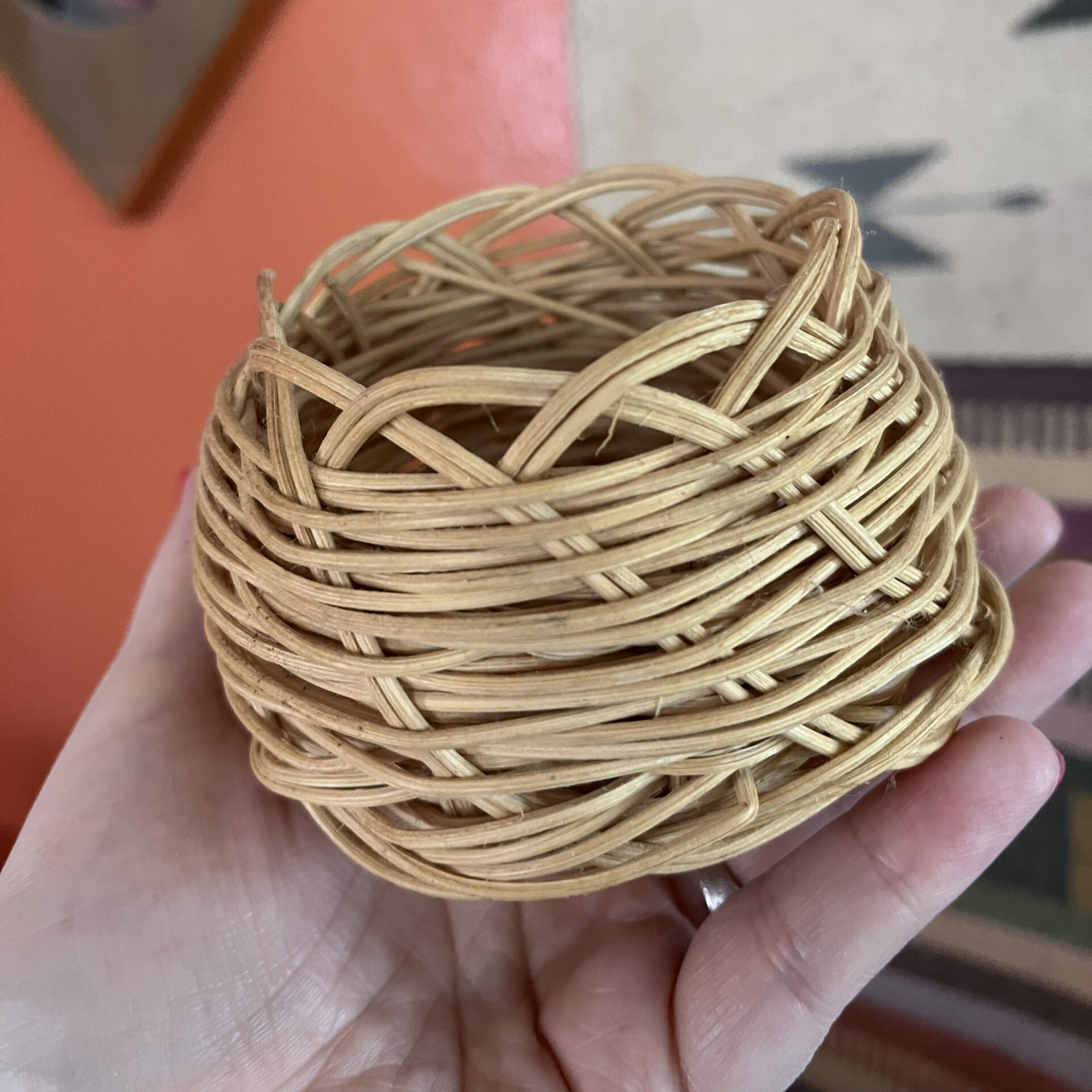
Catheryn Jenning’s small and terribly wobbly basket (Photo courtesy of Catheryn Jennings).
Like Cat, I (Megan) have always felt my life tangled with creativity, though I decided at a young age that I wanted to become the artist as well as the appreciator, and I have felt my connection to art most immediately through words. My mom used to read to me and my siblings every day when we were little, and when I could finally decipher the words for myself, I spent as much time as I could tucked between the pages of books. By fifth grade, I knew that I wanted to write novels, specifically fantasy. I remember showing what I thought to be original short stories to my fifth/sixth grade English teacher, who admired my work but said it felt familiar to other pieces she had read. Determined to create something new, something “better” than what I had previously written, I continued developing my creative writing, and penned my first full length fantasy novel between seventh and eighth grade, using notebooks and a variety of Sharpie highlighters and markers to fill the pages. Now, whenever I uncap a Sharpie, I am transported to those years, and that joy I felt while handwriting my first fantasy world and the characters who populated it. I continued to write throughout high school, producing a new narrative each year, but it wasn’t until my undergraduate years that I found my favorite story—one that I have spent the past ten years writing and rewriting into a shape that I feel is ready for me to start querying agents with the manuscript.
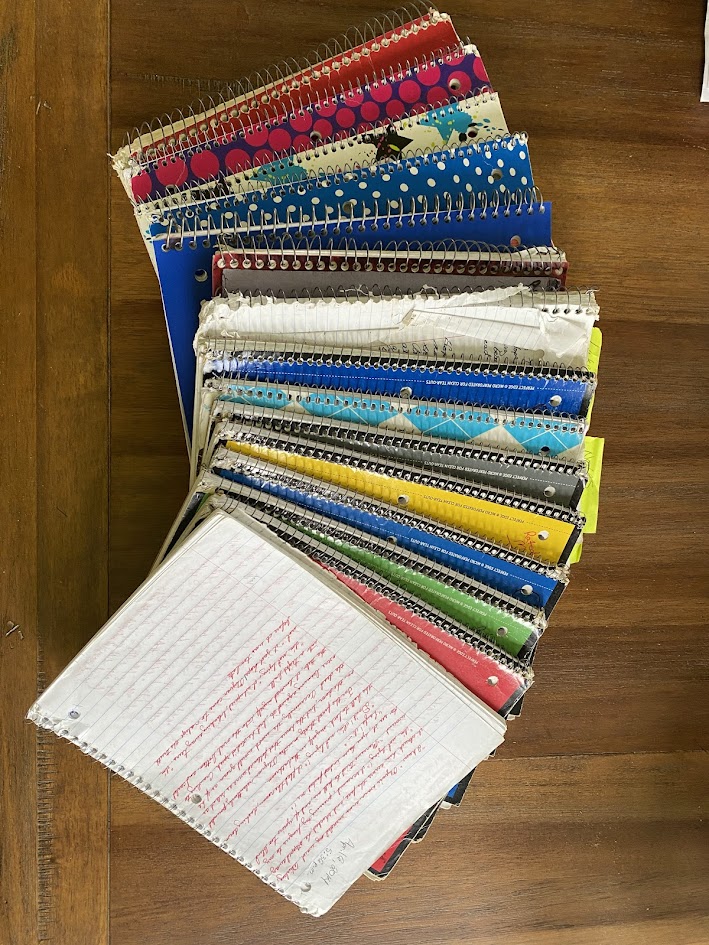
Megan Simmermeyer’s notebooks from her first novels (2008–2014) (Photo courtesy of Megan Simmermeyer).
My creative writing, however, has always run parallel to my academics. I have first and foremost pursued a career, collecting English degrees along the way in anticipation of a position in academia, but it never feels like enough to fully sustain the creativity I have cultivated since childhood. As conversation participant Ben Lauren points out when talking about the intersection of his art and scholarship, “What writing songs allows me to do that I don’t think my research has done as clearly is lead with emotion. The songs definitely work to capture a sense of feeling that I don’t think I necessarily focused on as much when doing my research.” I think about this in relation to my own work as a graduate student, one who wishes to engage in both scholarship and art. What can my art do that my scholarship can’t, both for myself and for others?
As practitioners of cultural rhetorics, we, Megan and Cat, like other practitioners of cultural rhetorics, challenge the canonical, often limiting norms of traditional academic practices. Weaving together a cultural rhetorics-informed mindset with a creative spark allows for the creation of art that pushes out the borders of expression even further. Making films and writing stories that offer glimpses into other lives, composing poetry that captures the spirit of a space, of a time, or of a community, and making music for a peer-reviewed album—these practices open wider the embrace of what we, as academics, compose and create, allowing for an even deeper understanding of the world that cultural rhetorics works to share. Participant Alexandra Hidalgo describes the creative process as a way to connect with others, saying, “One thing I’ve learned from filmmaking, which is such a collaborative art, is that making things with others bonds you in unique ways.” Throughout the conversation, our participants reflect on how their art helps them create community and how they are inspired to create while also shouldering the responsibilities and challenges of academic work. Creating art can be draining, but it also has the power to be restorative and to fill in the blanks that are left behind in the often rigid structures of higher education and research because academia is exhausting, and academic burnout is very real.
Creative ventures reach further across aisles and welcome in folks that may not have connections to academia, as participant Luhui Whitebear notes: “We all carry creative expression within. It just becomes devalued by society as we grow older. Coupled with the ways in which society at large uses judgement about what is and isn’t ‘good’ also creates barriers for many to explore their creative side.” Art can give voice to the different pieces of ourselves and offer connections we might not have otherwise forged. Art can be informed by or, in turn, inform our scholarship. Art allows us to reach toward subjects and spaces that some might view as inaccessible. We believe this conversation will inspire you to reach further in your creativity as well, whether you’re making art or enjoying the art others make.
What creative work do you engage with? Tell us how you got started and why you were drawn to that particular craft.
Alexandra Hidalgo: I suffer from a multitude of creative desires and inclinations. I wish I had one creative craft but I have many. Too many perhaps. The main two are creative writing and filmmaking. I can’t remember a time when I didn’t want to be a fiction writer. My grandmother Olga Briceño had been a very successful (at the time) writer of historical novels in Spain and the US in the 1930s and 40s. My father Miguel Hidalgo wrote a very unsuccessful philosophical treatise in the 1970s. Their legacy was one I felt compelled to continue. I wrote some lamentable poems during childhood and some less lamentable ones during adolescence. I’ve been writing even less lamentable fiction and nonfiction since college.
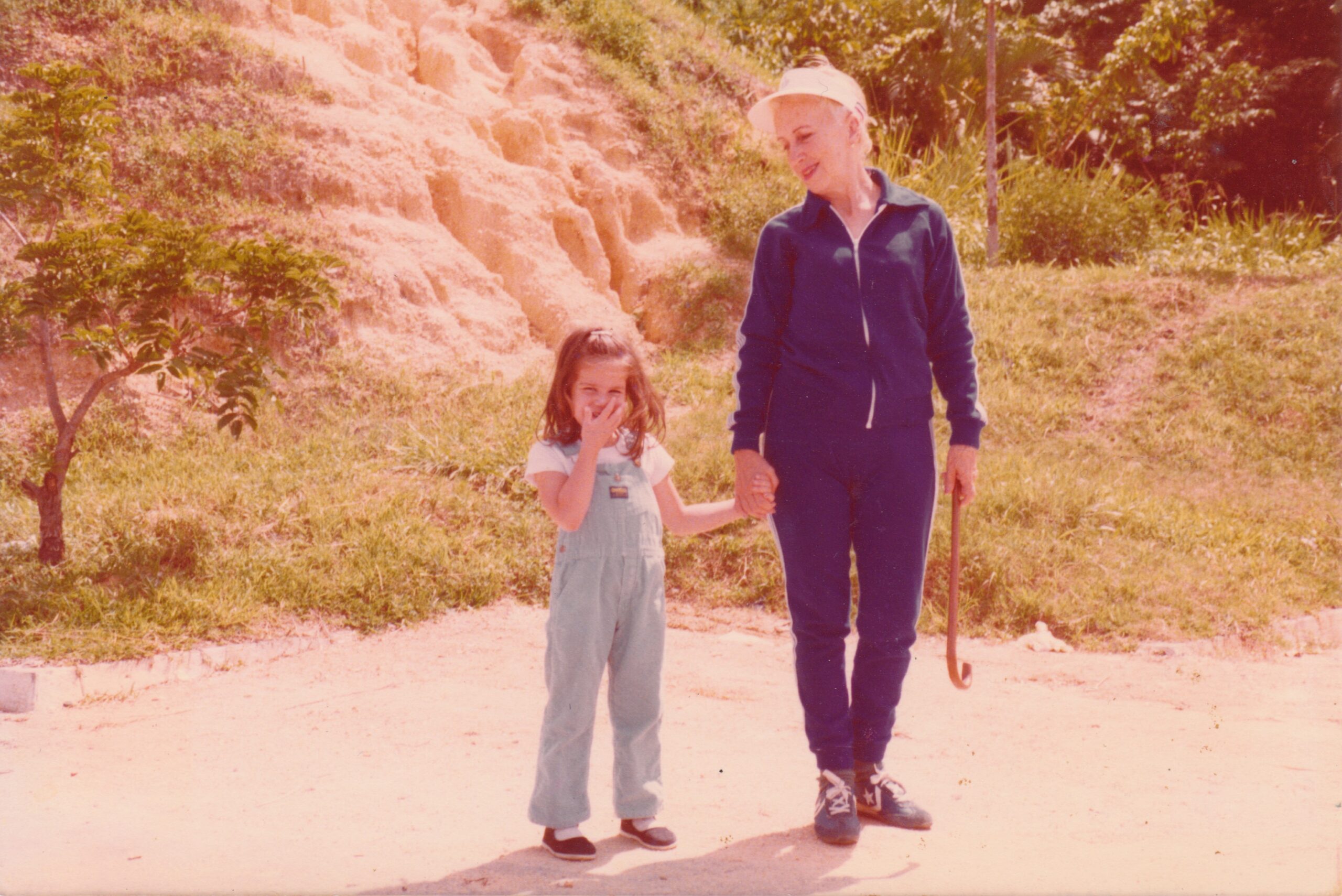
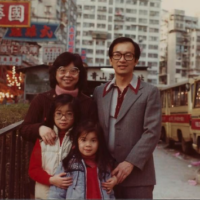
Alexandra Hidalgo in 1983 on a hike with her grandmother, the writer Olga Briceño. Olga went on walks every day as part of her creative practice, a legacy that Alex continues on (Photo by Miguel Hidalgo).
I began making films during the first year of my PhD. I just talked about this in the conversation about my dissertation chair and legendary scholar Pat Sullivan that we published on May 8. Basically, my artistic soul was dying doing only scholarship all the time, so I decided to add filmmaking to my repertoire. As I mention in that conversation, Pat and her husband Peter helped me audit a filmmaking class Peter was teaching and that jump-started my filmmaking career.
Ben Lauren: Alex, I remember having this conversation with you back at MSU after I had done a bunch of research in Professional and Technical Writing. You said, “make an album!” I read your book and realized you’d laid the groundwork for so many artists working in rhetoric and writing. When I wrote my own Hold Me Down: Toward a Rhetoric of Feel, I remember feeling sort of frustrated that the art—the music—couldn’t just stand on its own without all the theory attached to it. I’m curious what your thoughts are on the relationship between the art and the theorizing that goes along with that art today? In other words, have you figured out ways to let the art stand on its own without the theory attached to it? If so, how?
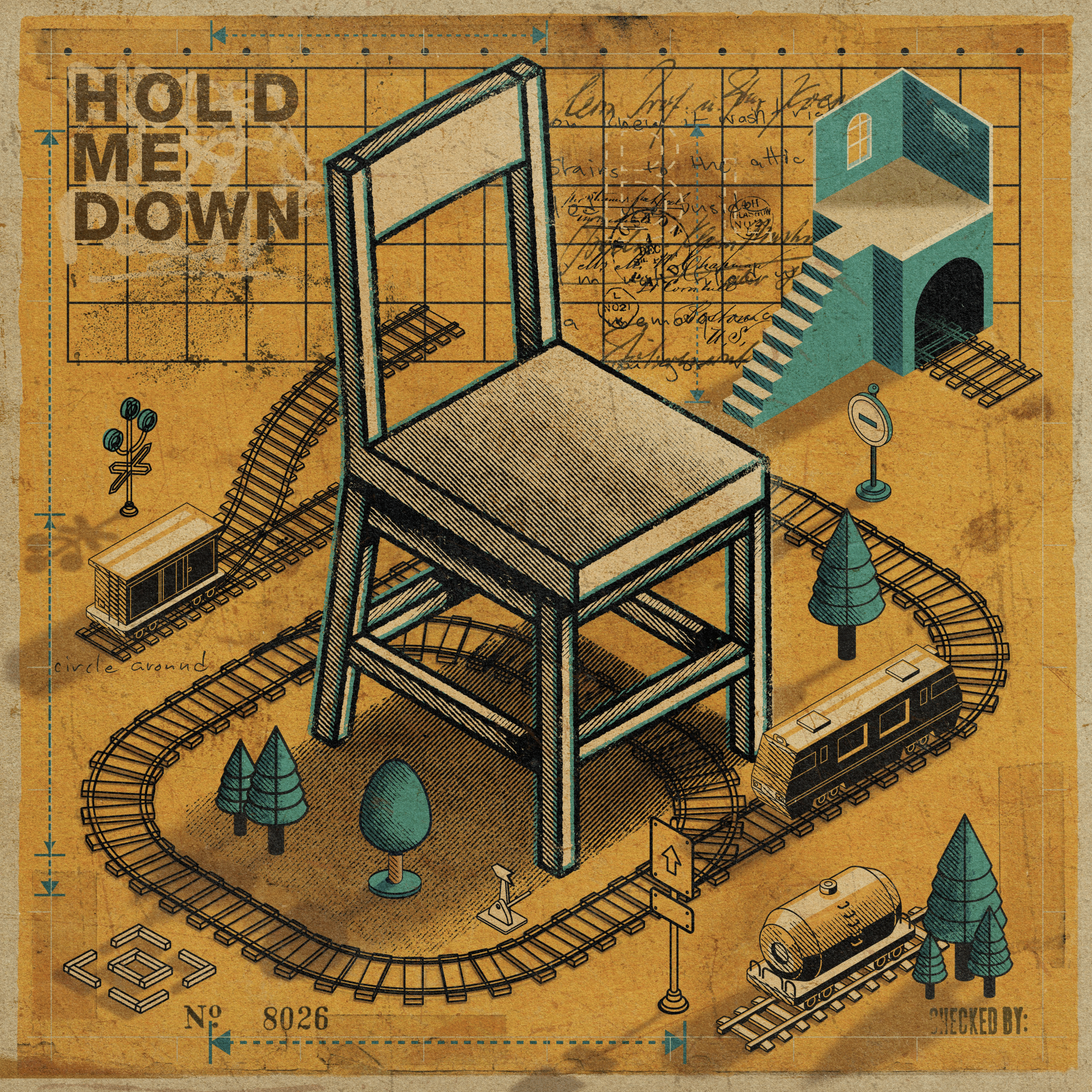
Hold Me Down cover art for Ben Lauren’s album.
Alexandra Hidalgo: Awe! I’m so glad Cámara Retórica was helpful. I think those of us with artistic leanings are happier academics and smarter researchers when we’re able to draw from our creative practices. The songs you crafted for your album are so moving and powerful. Hearing them in your dining room and also at conferences was a gift. Your album broadens what the field of rhetoric can be and what it can make us feel. In terms of my art standing on its own… Yes? I think so. I feel like my “Love in Many Genres Substack” is detached from my academic life. It deals with universal themes like motherhood, immigration, and finding balance in our lives, and most of its readers are not academics.
Ben Lauren: I guess the creative work I do most is write and record songs. I doodle and enjoy journaling. I got two degrees in creative writing before my PhD, so I find myself still drawn to poetry and (non)fiction here and there, but pretty much all of those interests surface in songs these days. I have a plan to one day write all the stories living in my head (I keep a running list of stories that I call my retirement project), but most often I write songs. On the wall next to me hangs my guitar. It stares at me whenever I’m working on something reminding me to play it.
I was drawn to songs at a pretty young age. I never considered myself much of a musician in that I wasn’t all that interested in what the other instruments were doing if it wasn’t central to the song. That hindered me as a songwriter for a long time as I didn’t get how drums, bass, guitars, keys, etc. worked to make a song happen. I learned that later on. As a result, I didn’t study music in the traditional sense. I studied songs—lyrics, melody, and structure. I wanted to make my own. When I picked up a guitar it was so that I could write my own songs. I didn’t want to be all that great of a guitar player. I just needed something I could use to lay the foundation of the song. I figured someone else could figure out how the different instruments would work together. I didn’t care so much about that part. I care about that a lot more now.
Songs somehow speak my language, more than any other form of communication I’ve come across, so they are the central way I encounter and process emotions and memories. They are a big part of how I encounter the world. I think that is because when I entered Kindergarten, I struggled learning to read and write, and songs were the best way for me to express myself to others. The more well worn paths (like writing a sentence) felt a lot more confusing. Songs were just the form of expression that immediately made sense, and so I gravitated towards them as my central form of expression. I started off singing constantly and eventually, learned to give songs some kind of structure that involved intentional melody and repetition. In other words, I learned to write songs rhetorically.
Alexandra Hidalgo: I think it’s funny, Ben, that you’re also drawn between various art forms. Maybe that comes from being a creative human? Perhaps we’re doomed to always be flirting with different art forms. And I mean doomed cheekily. Do you see writing songs as different from writing stories?
Ben Lauren: That’s a good question. I think songs definitely tell stories. Sometimes they are abstract, sometimes they are linear… I think what makes them different is songs are meant to be performed, which gives artists the ability to choose—to hone—a performance. Stories on the page can do that, too, but I would argue songs might be an even more powerful form in certain circumstances and for certain individuals.
Luhui Whitebear: For me, poetry is a way of telling stories. I have been writing poetry since I was a young person. I grew up immersed in the American Indian Movement and listening to John Trudell’s speeches and poetry, then later his music. I also knew him as an uncle my whole life. His work greatly influenced my life and personal work. Our community also did a lot of silk screening, mostly with the artwork of Judy Buffalo during much of my young life. I learned the power of creative expression that way to help not only inform others of who we are as Native people, but also of bringing everyone together. The power of drums as the heartbeat and songs that were outlawed until the late 1970s is also something that I grew up with and pass down to my own children. Photography has always been a way to help tell the stories of activism as well. That is probably part of why I love using images and photography in my own work even now. Art has always been part of my life both personally and through activism in this way.
Now I use art in my classes for students to have a way to express what they are learning and also how to make content from Indigenous Studies legible to the general public. I use songs as well in my courses to help tell stories from the perspectives of other activists. One of my favorite activities is having students create zine pages on topics related to the course content to share with others. I also provide space for them to submit creative work alongside written work through visual art, poetry, song, etc. It is really powerful to see what they create.
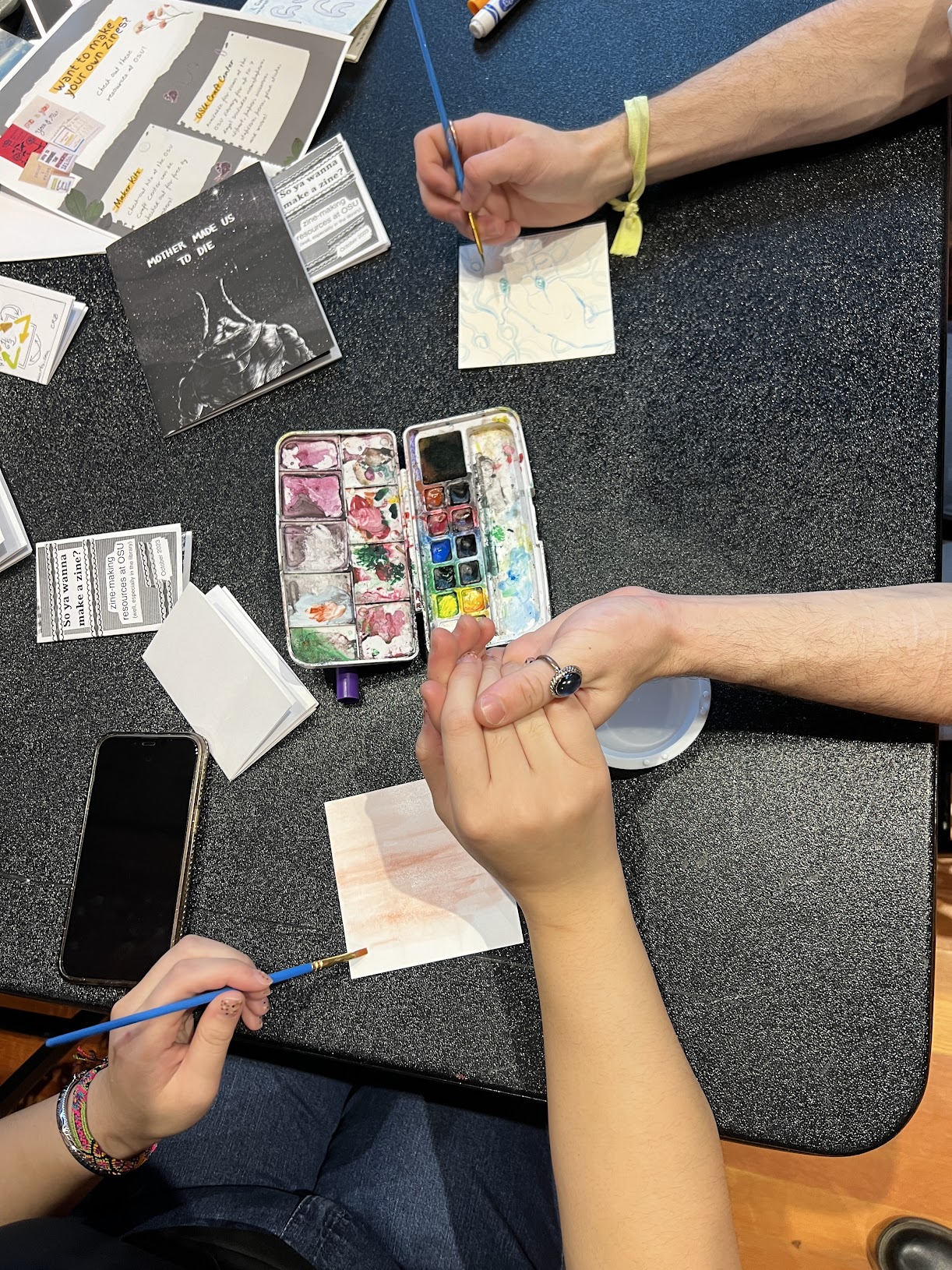
Zine table from Luhui Whitebear’s Arts and Social Justice Class (Photo courtesy of Luhui Whitebear).
Ben Lauren: I really love the idea of creative expression bringing people together. I’d love to learn more about how you do that in classroom settings!
Luhui Whitebear: Yes, that is a big part of several of my classes. Using creative expression to collectively tell a story or to help teach community outside of class has really brought students together in a beautiful way. It never ceases to amaze me to see a group of students that don’t know each other end up creating community and organize collective stations for community to engage with at the end of ten weeks.
Alexandra Hidalgo: What a wonderful way to create community in the classroom, Luhui. One thing I’ve learned from filmmaking, which is such a collaborative art, is that making things with others bonds you in unique ways. How generative that you’re having your students find their creative voices and come together through art.
What inspires your art? How do you find, make room for, and sustain your artistic drive and inspiration?
Ben Lauren: I don’t honestly have a common pathway for being inspired. Maybe the most common impetus includes people’s stories. If I’m connecting with people and their stories, that somehow comes out in a song. I think it is because I’m always looking for universal experiences—it’s like I collect them to feel less alienated—and so when I’m talking to someone and we’ve both had a similar experience that involves similar emotions, I feel inspired to capture that and share it with others in some way. Almost like putting words and melody together that represent that experience so we all feel less alone. And I have to do it. That’s what sustains me to do everything else that I do in academia and beyond. I don’t really understand why I have to do it, but I do. Everything else I do in the world is second to songwriting, except for my family. They are first, of course.
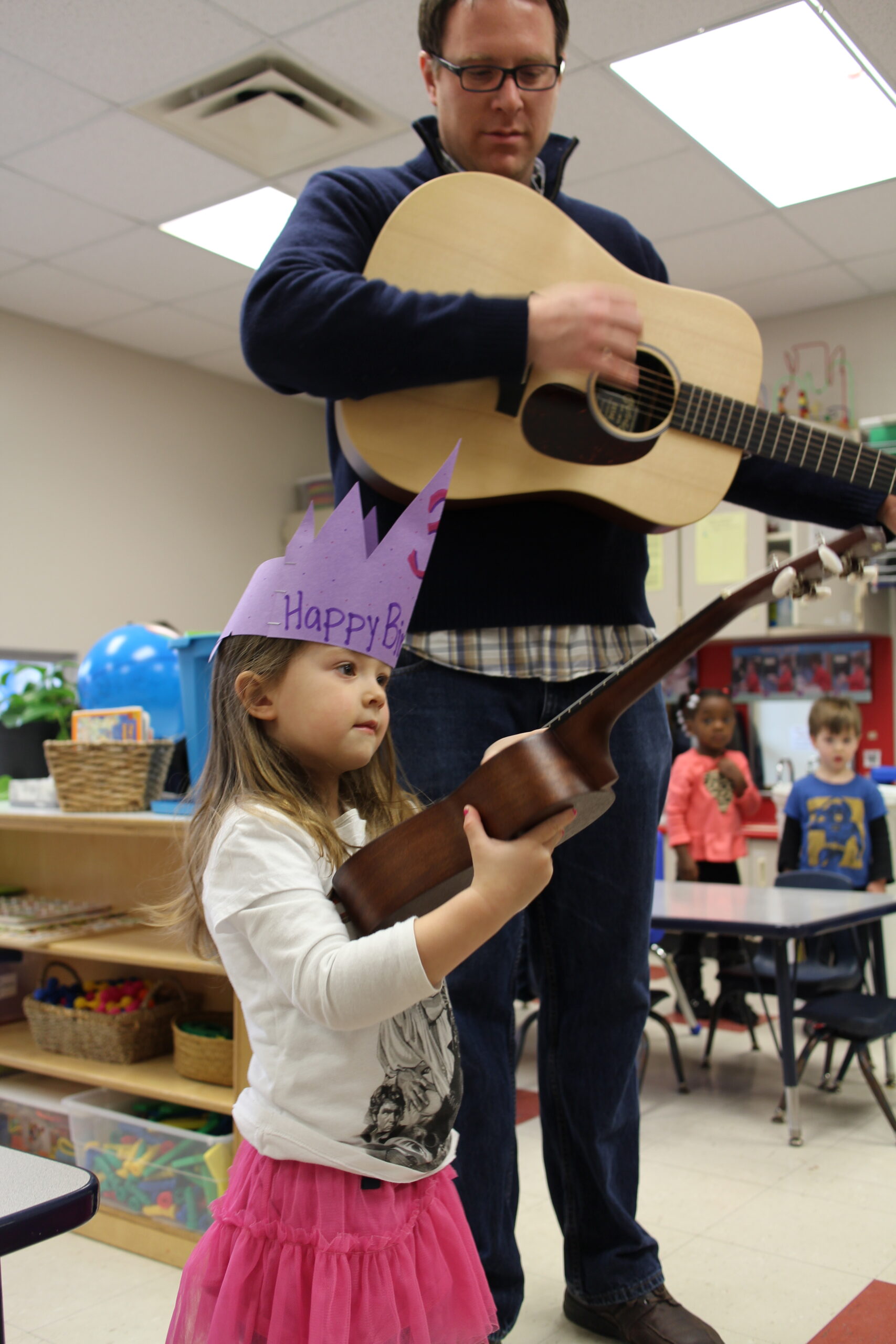
Ben Lauren playing at his daughter’s preschool in 2016 (Photo courtesy of Ben Lauren).
Luhui Whitebear: Song has a way to really connect and tell stories. It makes sense that they are so intertwined for you. A lot of the time we are told that storytelling only happens in one way. When I use songs in my classes about Indigenous activism, I tell the students that these are the soundtracks to the movement and what helped/helps bring the stories to a larger audience.
Ben Lauren: “Soundtracks to the movement” is such a great way to describe what songs can do and how far they can reach. I really like that.
Alexandra Hidalgo: I love the idea that we can dance to stories! We hear them, we feel them, and we let our bodies perform what we’re experiencing through dance. How beautiful and what an experience to share with students (even if we don’t have them dance. Ha ha!).
Luhui Whitebear: Yes, and the soundtracks move us with each other across time. They are like bridges between generations and the records (literally) to go back to. One of my favorite John Trudell quotes is, “When one lives in a society where people can no longer rely on the institutions to tell them the truth, the truth must come from culture and art.” I think this really speaks to that record keeping too.
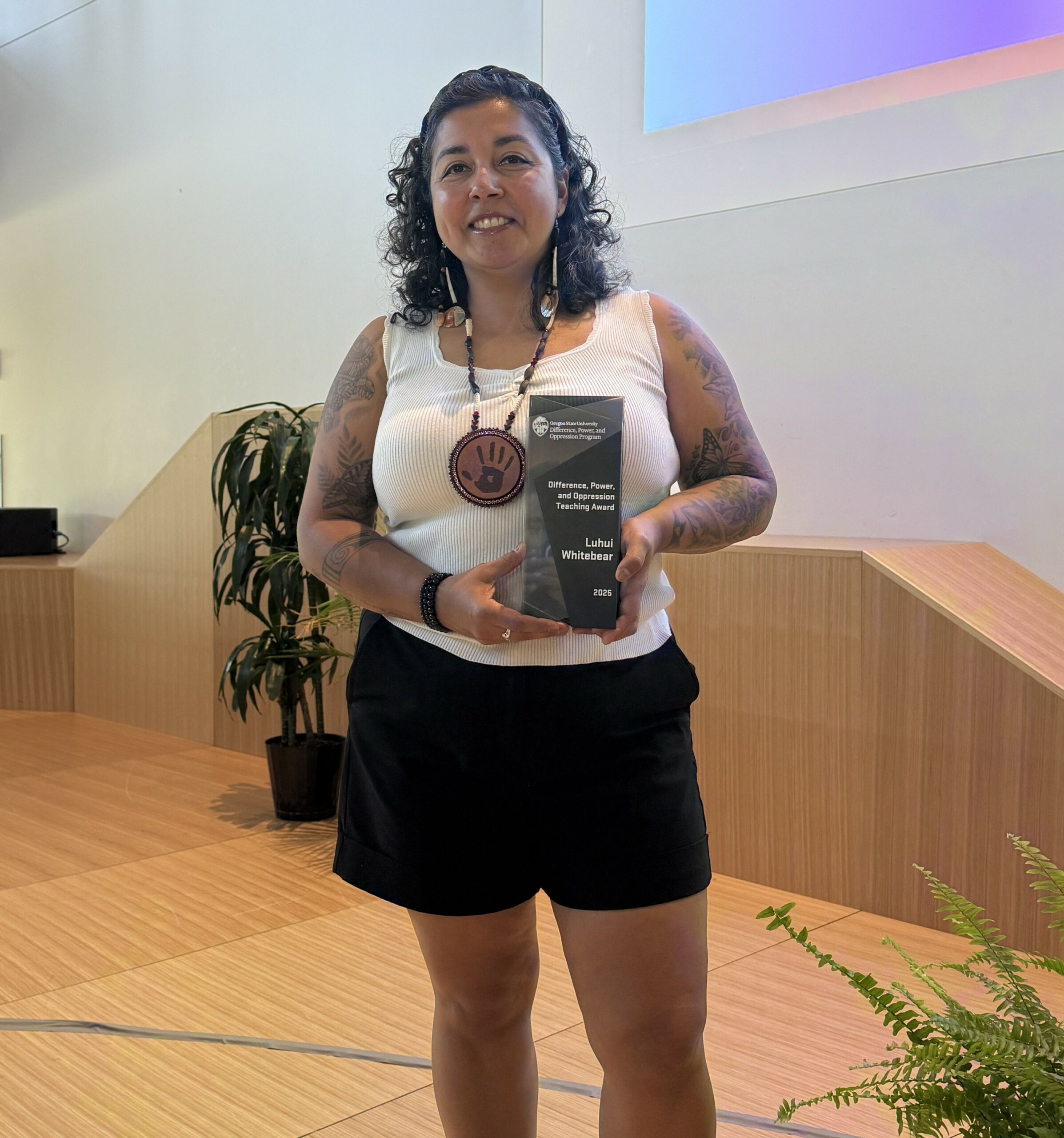
Luhui Whitebear holding her 2025 Difference, Power, and Oppression Teaching Award that she won for her Arts and Social Justice class at Oregon State University (Photo courtesy of Luhui Whitebear).
Alexandra Hidalgo: Continuing this ode to moving our bodies to rhythm: my fiction often comes to me when I’m dancing. I dance in my living room for a half hour every night and my two in-progress novels arrived during that practice. The characters showed up while I was dancing and demanded to be brought to life. That was the spark of the idea. As I craft the novels, though, much of the story gets fleshed out during dancing, meditation, yoga, getting up in the middle of the night to pee, and hikes through the woods. In other words, for fiction, I need to be in a receptive frame of mind so the characters will reveal themselves to me.
For filmmaking, the world is what inspires me. That sounds a little banal, but what I mean is that I’ll see something that I just have to film, whether it be a family event or art at a museum. Or I’ll watch a TV show or read a book that I have a million things to say about, and I’ll make a video to share those thoughts with others. So while my fiction writing process is internal and quiet, my filmmaking process is social and a constant collaboration with what I see, hear, read, watch. All of it.
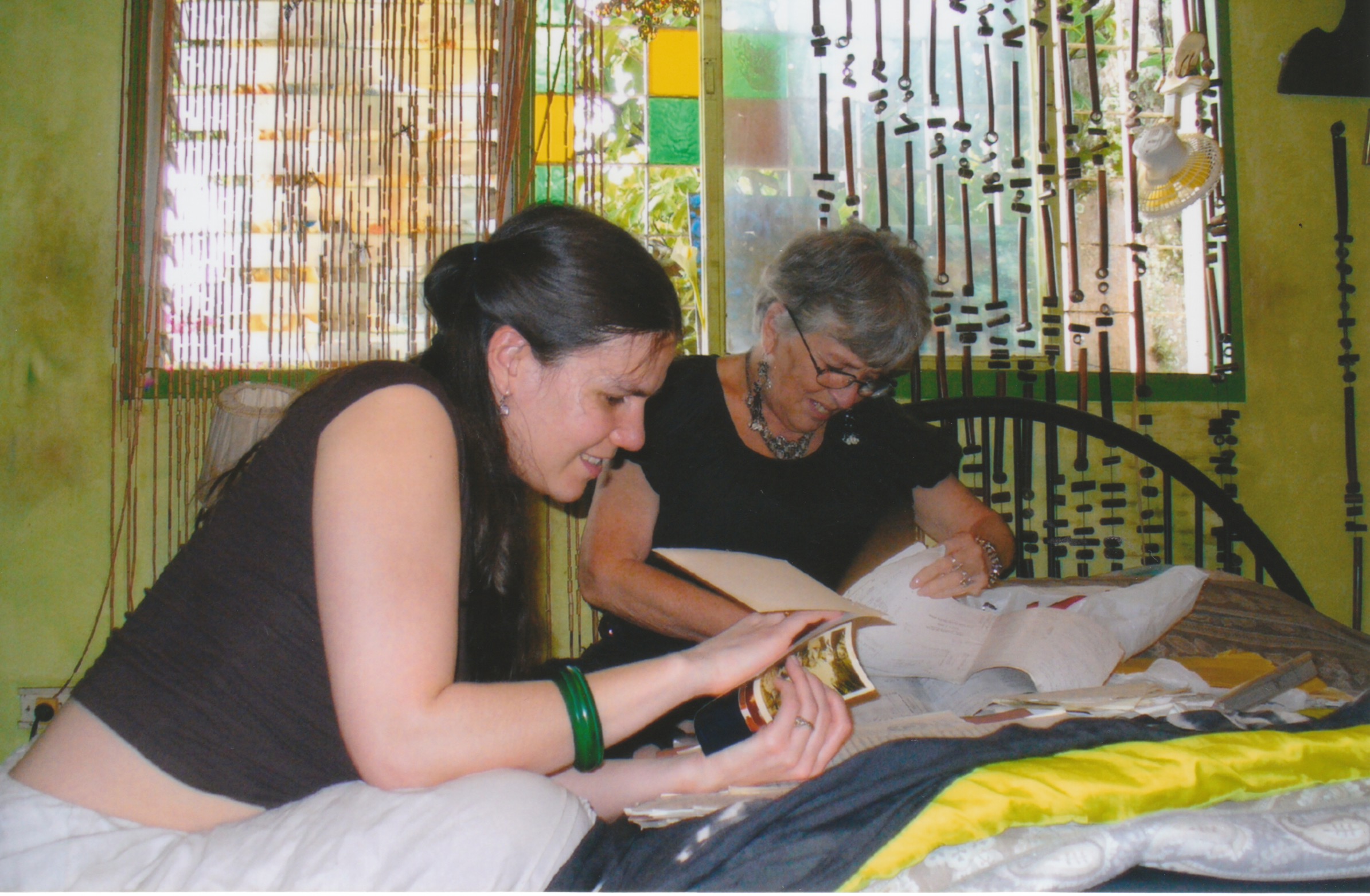
Alexandra Hidalgo and her Aunt Yarima Hidalgo Exploring at Their Family Archives Together for Alex’s Writing and Filmmaking Projects in 2003 (Photo by Caroní Arias).
The fact that they come to me differently and require different skills and kinds of concentration is what helps me sustain these two practices. When I get tired of one, I turn to the other and the creative process feels fresh again.
Luhui Whitebear: I love that you use movement as a way to bring your characters to life!
Alexandra Hidalgo: Thanks, Luhui! It’s an embodied creative practice, right?
Luhui Whitebear: Yes, exactly! That is part of why I love using art so much.
Ben Lauren: Dancing is such a great approach. I like long walks, too. Another way for us to find inspiration. Even cleaning up the garage can somehow turn into an idea!
Alexandra Hidalgo: Because your mind is quiet when you perform those kinds of tasks, and your intuition and your subconscious have room to tell you what they (you) want to do next.
Luhui Whitebear: My culture and upbringing is what drives and inspires my personal art and also the ways in which I use it in classrooms. What has been interesting to me is that much of my culture is sometimes described as art, but to me, it is just part of my life. In the arts and social justice class I teach, I ask the students to list out different forms of art on the first day together. They end up realizing how much of our life is surrounded by arts and how much of it we carry with us on our bodies as well, like jewelry, tattoos, fashion.
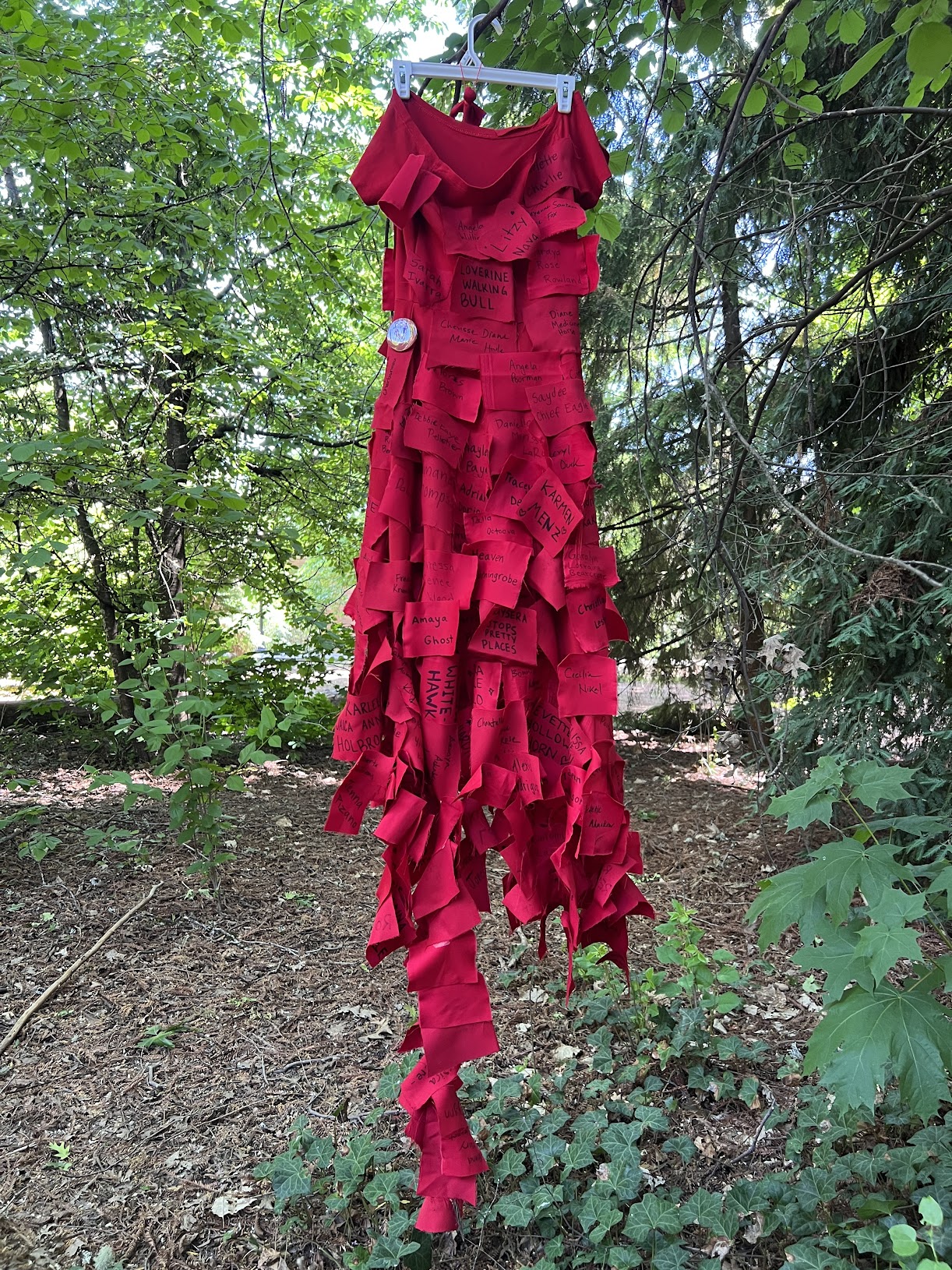
Completed dress from Luhui Whitebear’s Indigenous Feminisms class (Photo courtesy of Luhui Whitebear).
Alexandra Hidalgo: I love this idea that what outsiders see as art is, for you, simply your life.
Ben Lauren: The list that gets produced must be quite substantial. I bet that is a moment students carry with them well beyond the semester!
Luhui Whitebear: It does get long! They end up asking, what isn’t art? Great way for them to move into the course for the rest of the term.
How does your creative work connect with your academic work, if at all? Or, what does making art allow you to say, or not say, that your scholarship does not?
Luhui Whitebear: Creative work is very much a part of my academic work. I use storytelling and poetry along with other Indigenous rhetorical methods in my academic articles. It is hard for me to not use it in all of my work, but I do what I can to bring it in. Sometimes that is in the use of poetry or songs for source materials as well. I also use photography in some of my work. The overlay of visual and creative writing within academic articles and chapters is another way this shows up. I find that for many people, it is hard to visualize what I am talking about since much of my scholarship is discussing Indigenous activism. The barrier is always around the restrictions of using visuals in some works.
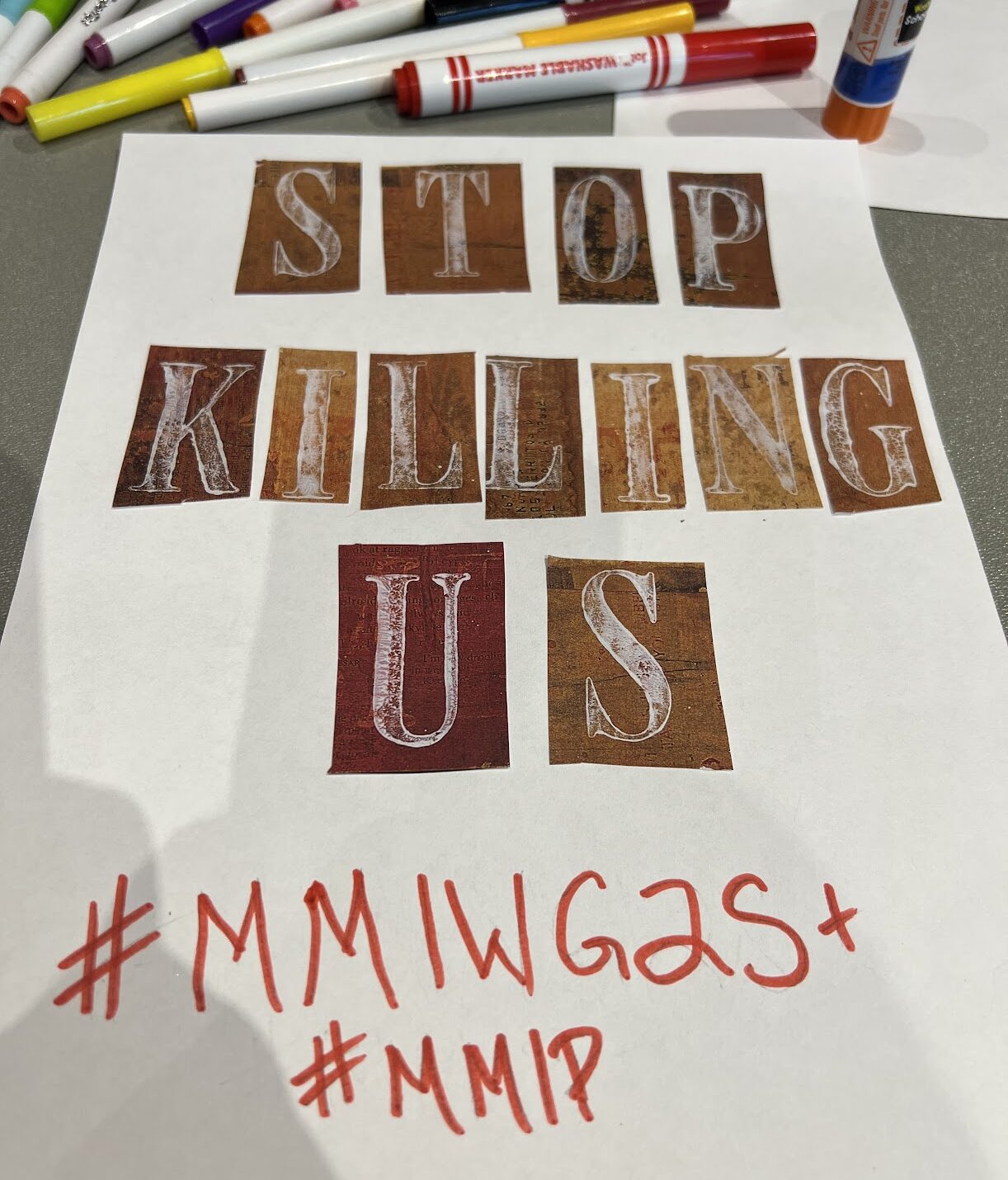
Zine table from Luhui Whitebear’s Indigenous Feminisms class (Photo courtesy of Luhui Whitebear).
Alexandra Hidalgo: Great insight on how images can bring to the forefront things that the culture at large is unable to grasp. For me, the blend of words and images, which we feature here at constellations, deepens the reach and emotional punch of our scholarship.
Ben Lauren: Also, I think using photography in that way helps your audience find other ways to make sense of the work. I love the idea that I can sit with an image to help me understand and relate to the work you produce. It’s really powerful (and a gift you give readers) to try to work through those connections. As I reflect on the question, Hold Me Down attempted to bring all my identities into collision. I’m not sure how successful it was. Doing so was unnerving for me in that I wasn’t entirely sure I wanted these personal and professional worlds to collide, but I tried it out. Now I’m writing another record haha. But, I don’t think it is because I was able to bring the worlds together capably so much as more songs came out and the story continued. I am glad for that part of the process, even if that first project remains one that feels almost too vulnerable. When I wrote the preface to Hold Me Down, I spent some time interrogating my motivation and general feelings about making an album like that one as scholarly inquiry. I decided to lean into the tension. What I realized is that the songwriter in me also is in all the other scholarship I’d produced too, but I was the only one who really understood how. In a sense, the identities were never separate. Maybe. What writing songs allows me to do that I don’t think my research has done as clearly is lead with emotion. The songs definitely work to capture a sense of feeling that I don’t think I necessarily focused on as much when doing my research.
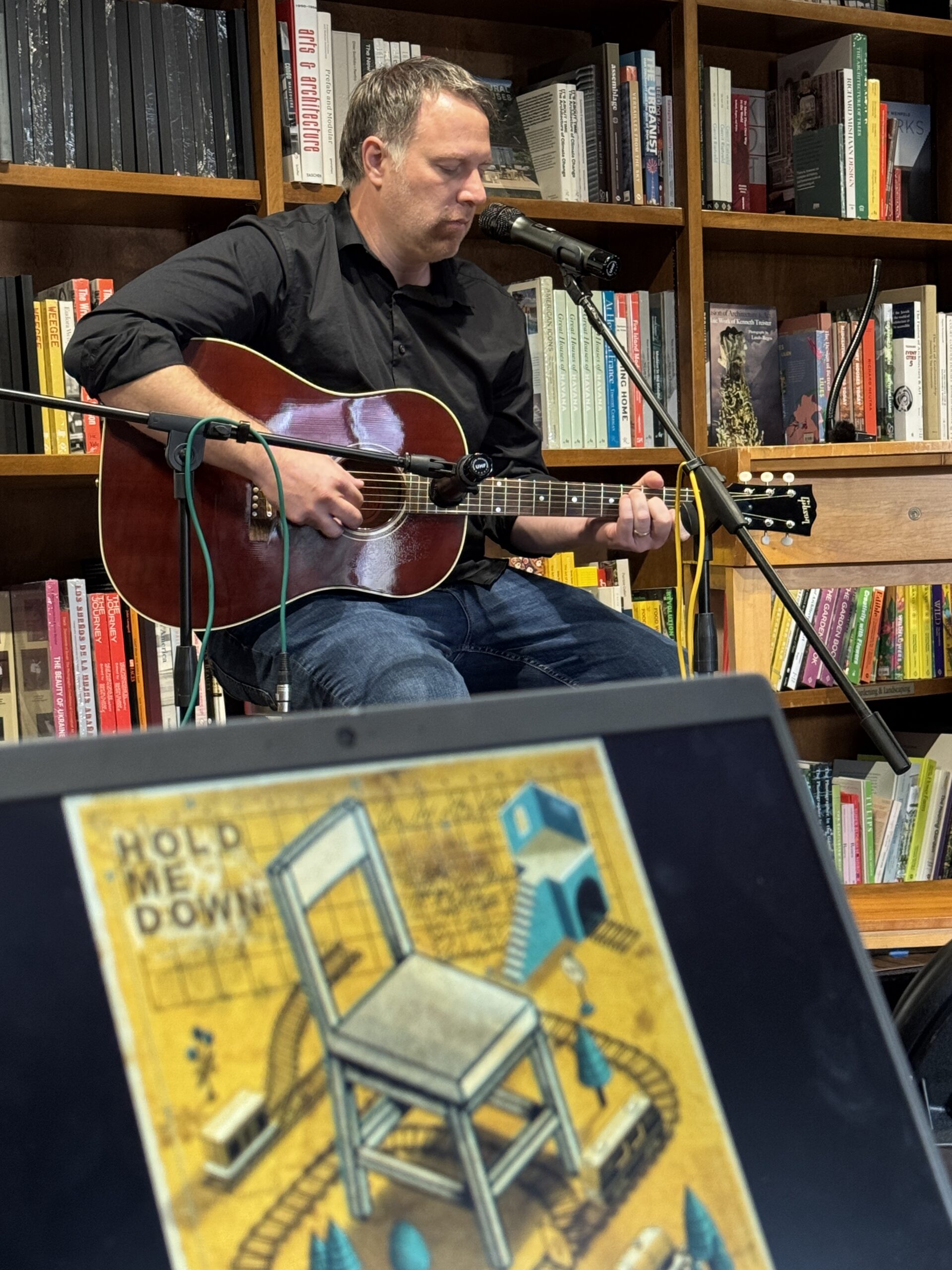
Ben Lauren playing Hold Me Down at Books and Books in Coral Gables, FL in 2025 (Photo courtesy of Ben Lauren).
Alexandra Hidalgo: What a wonderful notion that your songwriter self was there all along and now he’s truly out in the open. Having heard your music, the emotion is palpable and you help us feel what you feel and also find connections in our own life. We can (and should) write about affect in our scholarship. It’s vital, however, to have scholars like you who can take that affect out of the page and make us feel what you’re feeling.
Luhui Whitebear: Yes! We all carry creative expression within. It just becomes devalued by society as we grow older. Coupled with the ways in which society at large uses judgement on what is and isn’t “good” also creates barriers for many to explore their creative side. That is really beautiful that you have your work out now.
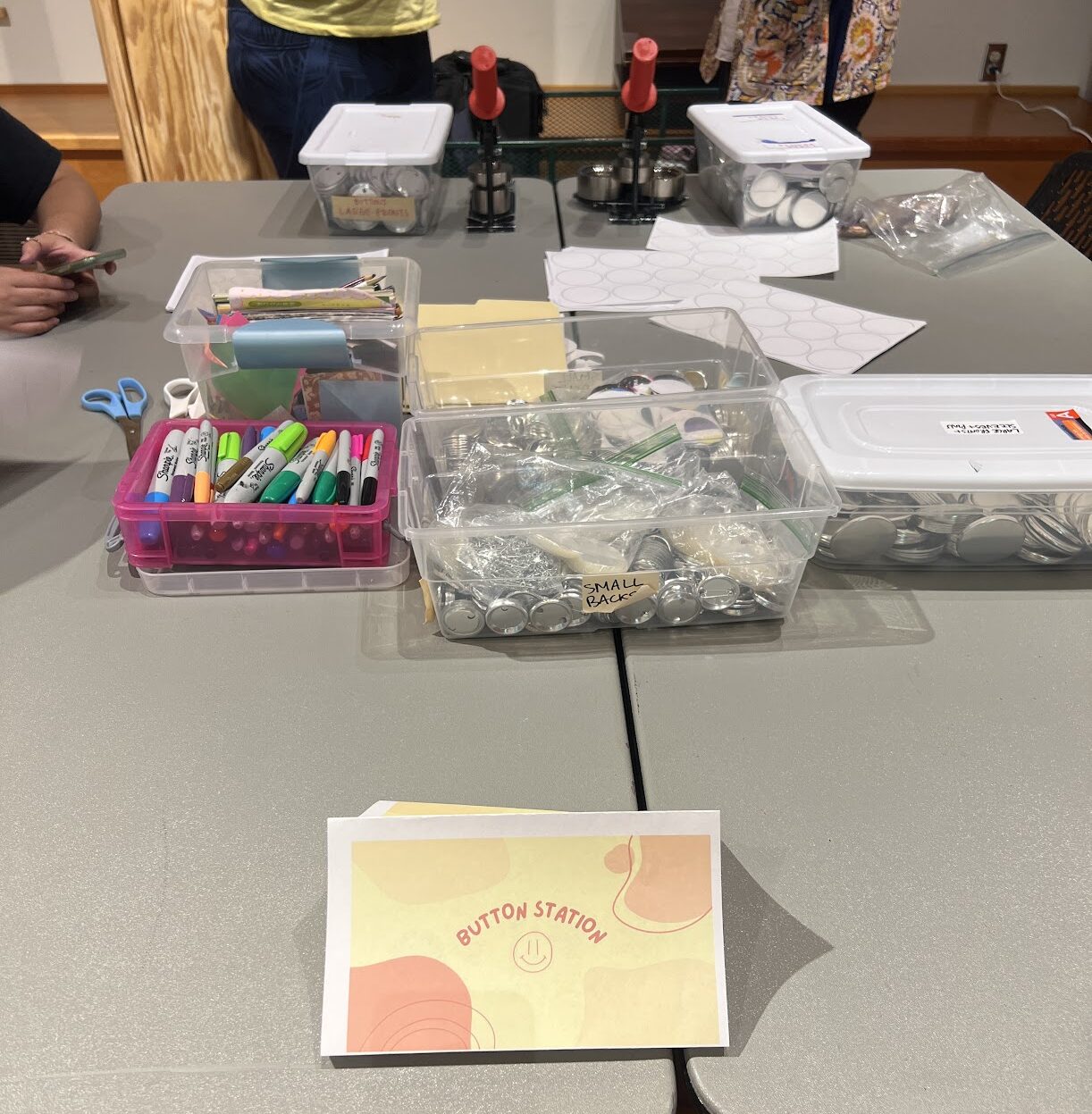
Button table from Luhui Whitebear’s Indigenous Feminisms class (Photo courtesy of Luhui Whitebear).
Alexandra Hidalgo: I built my academic career out of my creative one. From early on during my PhD I came up with a system that I recommend to others wanting to be artists and academics. Making art takes time and effort and tears and sweat. As I make my art, I keep notes on the process. What it feels like. What I’m learning. How collaboration works in that particular genre. What strategies work best and why. How it reflects, complicates, and expands academic processes. Then I publish scholarship about the process of making the art. Articles, book chapters, my video book. In the end, I have the scholarship, but I also have the art. In the case of my films, film festivals are peer-reviewed so I ask my departments to count film festival screenings for tenure and promotion.
Now that I have my YouTube channel, I make different arguments. I finished my Year End Review narrative last night. I’m going to quote from it here, because I think it’s helpful to see the the behind-the-scenes work one has to do make our art count:
“I took solace in a platform that has no gatekeepers beyond algorithms and the audience’s whims. To reach wider audiences, I posted vertical versions of some of my YouTube videos on Instagram and TikTok. These are our numbers:
YouTube: 291,458 (with 5,000 hours of watch time and 830 subscribers).
Instagram reels: 81,604
TikTok: 94,002
Total: 467,064”
There’s peer-reviewed and then there’s sheer numbers. You can argue for the value of your work in many ways. Being close to half a million views is a substantial achievement, so that’s one of the successes I highlight when I argue for the channel’s value to the powers that be.
Ben Lauren: Alex, this is a good point. With Hold Me Down, so many more people engaged with my scholarship that are not academics. I got texts and emails—some thanking me for making the project. That’s never happened before putting out that album. There is a way where art travels to different spaces and can mean more to people who are not in academia for sure.
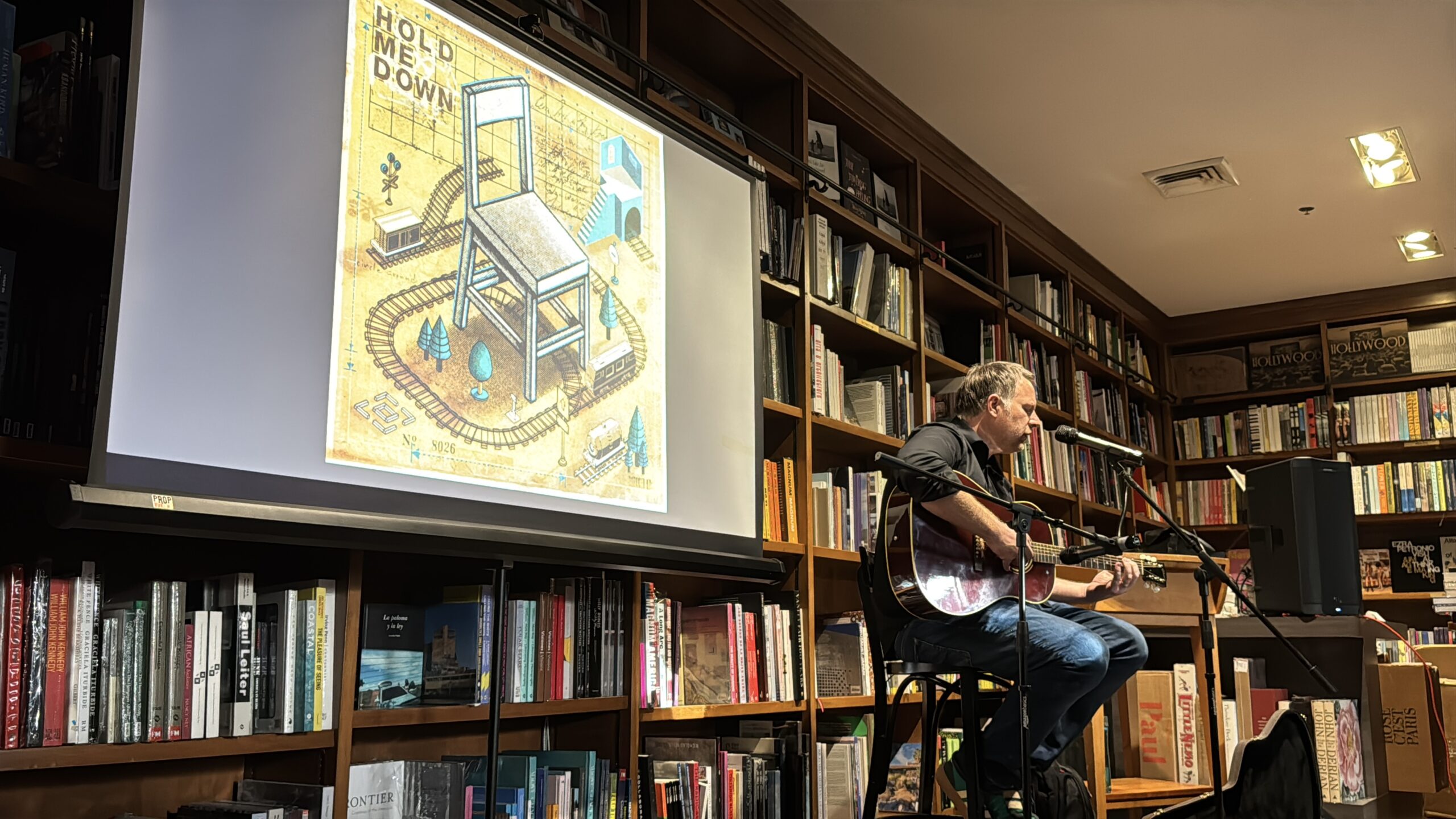
Ben Lauren playing live at Books and Books in Coral Gables, FL in 2025 (Photo courtesy of Ben Lauren).
Alexandra Hidalgo: And that’s something universities are trying to do, right? They want our work to go beyond the Ivory Tower, so if you figure out a way to argue that that’s the case, it helps them see what you do as valuable to one of their overarching goals.
Luhui Whitebear: I totally agree with this. Creative works don’t get stuck behind paywalls as well. Sometimes I think about this and wonder how my work will reach the people too. Thankfully more things are becoming open access, yet sometimes the academic language becomes a barrier. And, there is also the part where creative works are sometimes not viewed as scholarly work, which is also frustrating at times.
Alexandra Hidalgo: Academic language can definitely be a barrier. Thank you for bringing that up, Luhui. It’s about paywalls but also about how we express ourselves. Luckily art asks (demands sometimes) that we speak to the heart as well as the intellect.
Can/does art challenge dominant cultural and societal narratives more effectively than traditional textual/rhetorical work, and if so, how?
Alexandra Hidalgo: I think art challenges dominant culture differently than scholarship. As Luhui and I were discussing in the previous question, scholarship tends to have barriers around the level of language used and the assumptions about what people already know when they read it. This intellectual form is generative and desperately needed because it allows us to think deeply and to do so while citing others who have also thought deeply. There are some ideas and discoveries that can only be expressed through scholarship. However, the way in which scholarly work is written limits the number of people who can (and want to) engage with it. On the other hand, much of our audience for scholarship are current and future academics, many of whom will teach thousands of students over their careers, so there’s an indirect reach there too.
For art, you have a much wider direct audience. As I mentioned above, my online videos have reached hundreds of thousands of views and that’s during one year of work. Some of my content shows a hybrid Latinx/American family (my own) going through life in funny, loving, and adventurous ways. That doesn’t carry the weight of my video book’s analysis of the intersections between feminist filmmaking and rhetoric and composition, but it delivers the unstated (yet clearly visible) message that Latinx people are not simply tragic and/or criminal figures. I think that message matters particularly under the current administration, and I think YouTube is better suited to delivering it to a large number of people than scholarship—at least for me.
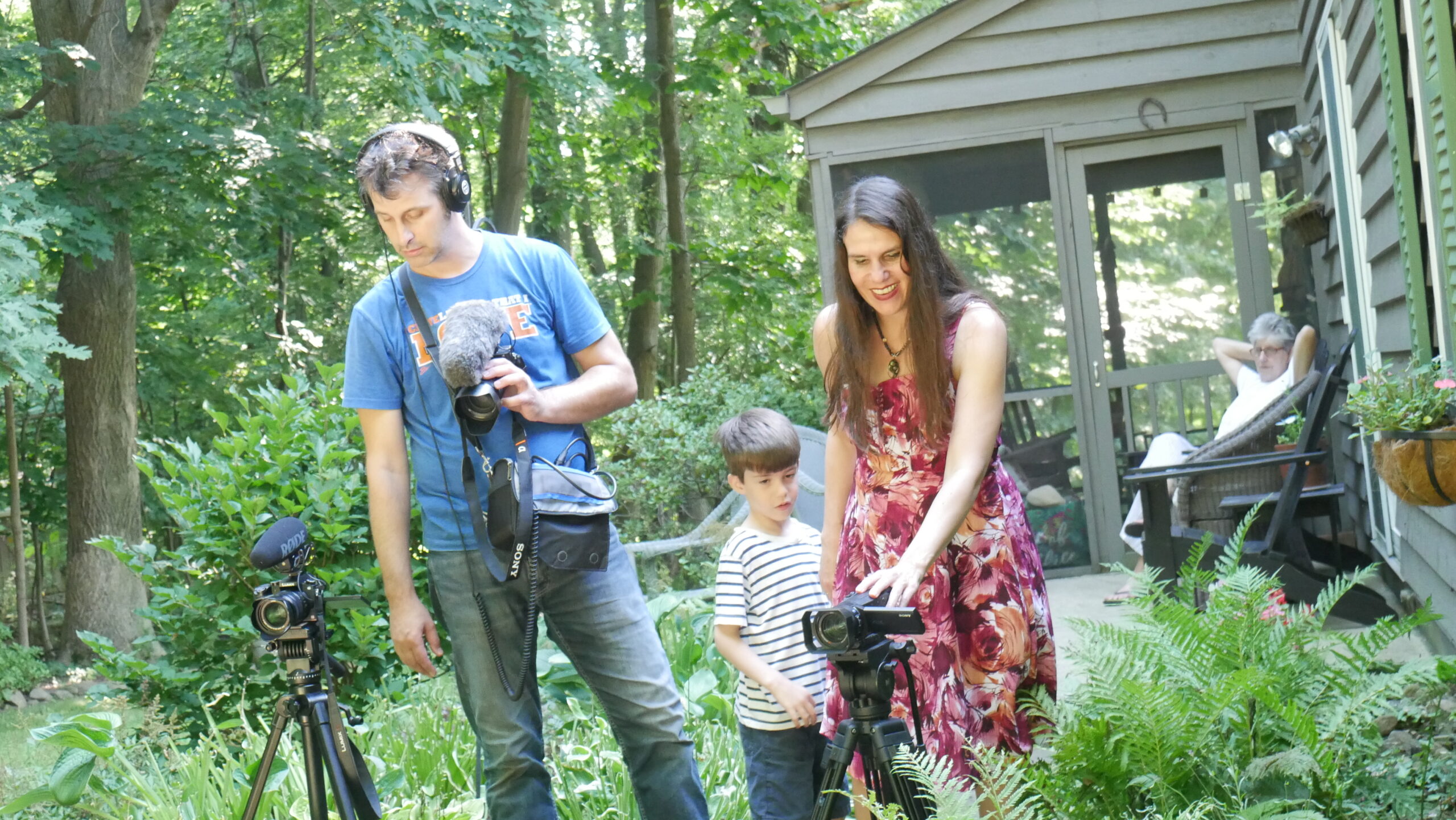
Alexandra Hidalgo and her husband Nathaniel Bowler fiddle with the equipment before filming while their son Santiago Hidalgo-Bowler looks on (Photo by William Hidalgo-Bowler).
Ben Lauren: Yes, the far-reaching impact of YouTube is a great example of how narratives get shaped. With so many people turning to social media and streaming, art shaping those environments feels essential.
Luhui Whitebear: Hasn’t it always done that across time? Art, song, dance, storytelling, etc. are all older than what we view as textual work now. Indigenous rhetorical methods have always used arts, and likely always will. In current times, it feels like it is working alongside traditional textual/rhetorical work. I think there should be caution in keeping them separate rather than as part of. There is a lot of power in bringing them together to me.
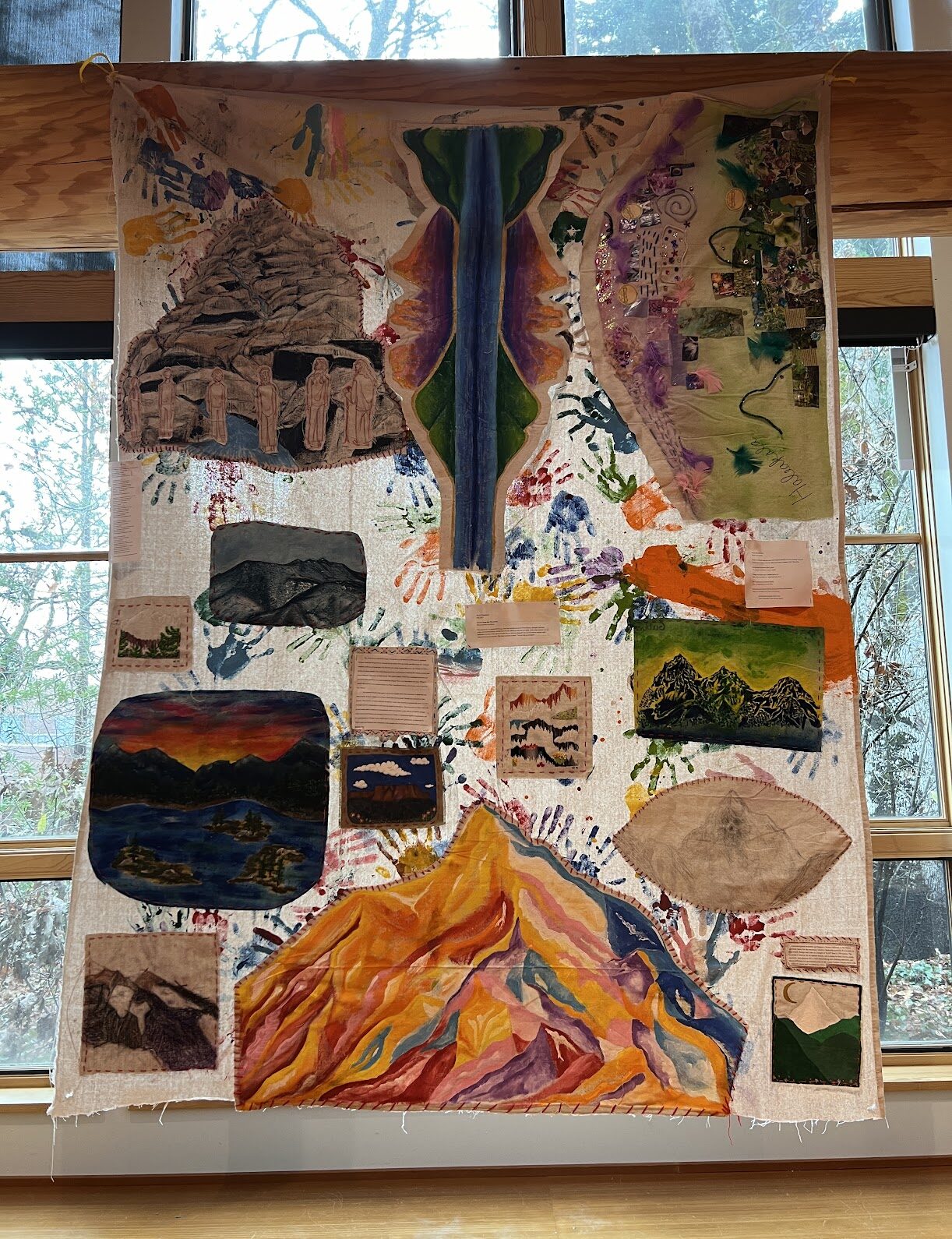
Mountain mural from Luhui Whitebear’s Arts and Social Justice class (Photo courtesy of Luhui Whitebear).
Ben Lauren: I totally agree, Luhui. I find that separating the arts from textual or rhetorical work is not something we should or have to feel compelled to do. That was one of the hardest realizations for me to personally overcome as I somehow felt my songwriting was not professional or valid. It took a long time for me to reframe songwriting as a professional practice, even though I readily accepted other forms of the arts as essential, such as poetry or painting.
Luhui Whitebear: Exactly, it is hard to overcome the barriers. I look at creative works as a form of translation to the people as well. Not everyone has to use or learn academic language to think critically, and I feel like creative works are a way to help people engage with this.
Alexandra Hidalgo: Thank you for the exquisite reminder, Luhui, that art is older than scholarship. Much, much older. Human beings remember and learn through emotion because we’ve done so for millenia. In a way, what we’re doing as artist scholars is delivering our insight in a format people enjoy and connect with. And songs, Ben, are one of our oldest art forms. What a genre to be engaging in!
Ben Lauren: For me, this is one of the most important parts of songs and songwriting. I feel deeply that songs can and have changed the world because in order to change the world, we often have to change hearts and minds, and songs (and art) are some of the best ways to do that. I could offer a coherent argument that is well reasoned, sourced, and written, but in the end, if someone is dug into their point of view, my argument may only reinforce what they already think. But a song has the power to move people in other ways. And I think it is because it taps into the universal—to truth. And when someone feels the truth, it really shakes them to their core. Their mind and body knows what they’ve encountered is truth, even if it is inconvenient or doesn’t align with what they want to believe. Some songwriters are so gifted at showing us truth that they change us forever and end up being an important part of how we see the world. I can sing every word to the songs that have done that for me.
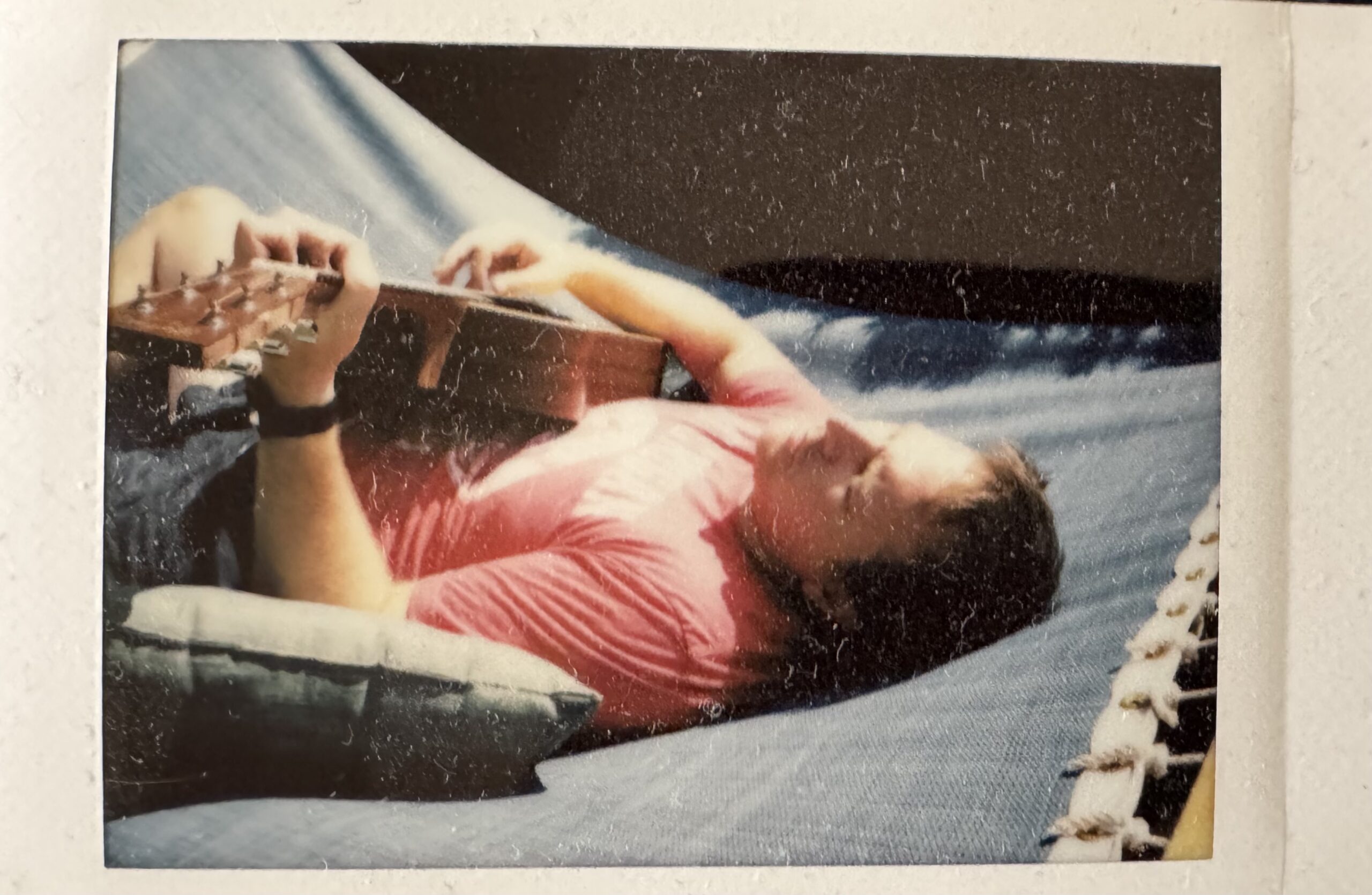
Ben Lauren writing a song on a hammock in 2019 (Photo courtesy of Luhui Whitebear).
What advice do you have for anyone (faculty, graduate, and undergraduate students) looking to work creatively while balancing other responsibilities, such as family and an academic career?
Ben Lauren: The best advice I ever got is that if it is important to you, you’ll make time for it without having to try. I don’t say that to dissuade you from trying to do the work, but to encourage you to pay attention to what you make time for. When I find myself least happy, unbalanced, or struggling to find purpose, it is often because I’ve stopped making time for the things that really do matter to me. Songwriting is one of those things. So, sometimes I just pick up the guitar for 10 minutes to see what will happen. I wonder if today is going to be the day where a new song decides to come out. It’s okay if no songs emerge or I don’t have anything to say because I invited the opportunity to see what would happen. I showed up, even just for 10 minutes.
The other piece of advice I’d offer is simply to work the material incrementally. Create a timeline that works with your life. It took me three years to write Hold Me Down and some of the songs were 20 years old. That was the timeline for that project and that was entirely fine by me. Of course, I had the luxury of tenure, so there was privilege associated with my timeline. But, I did the work in small bursts, focusing on making progress little by little, and eventually it worked out. Sometimes I put the work down for a while, but that was okay because that was my timeline.
Alexandra Hidalgo: Yes! Making art makes us happy. Like having a stomach that growls, our body and mood remind us when we haven’t made art for too long that it’s time to be creative so we can heal and feel good again. In that respect, it’s vital and keeps us going. To answer the question, as I mentioned above, my suggestion is to publish peer-reviewed scholarship about the process of making art, and to articulate the value of your art to the university very clearly. If it’s numbers, it’s numbers. If it’s international reach, then go with that. If you had a poetry reading and five people showed up, but they all then shared their own stories in the Q&A, talk about that. Art is foreign to most academics in English, rhetoric, writing, and composition. Not foreign as something they consume and analyze but as something they produce and articulate as valuable to the university. So you have to do that work for them and do it in smart and creative ways. You’re creative. Otherwise you wouldn’t be an artist, so use that creativity to argue for the value of what you do.
In terms of finding time for everything, that’s an ongoing struggle. I think everyone has to navigate it in their own way. For me with filmmaking, I make a lot of work that’s personal, and thus, it involves my husband Nate and our boys William and Santiago. A lot of my filming time is also family time. We make films together. A caveat is that I don’t do it very often. By which I mean, we live first and foremost, then once a week or once a month I film us. Our boys love watching the films and videos I made years ago, so this practice helps me develop a history of our love and lives as a family. That’s the path that has worked for me. Everyone needs to find their own path, though.
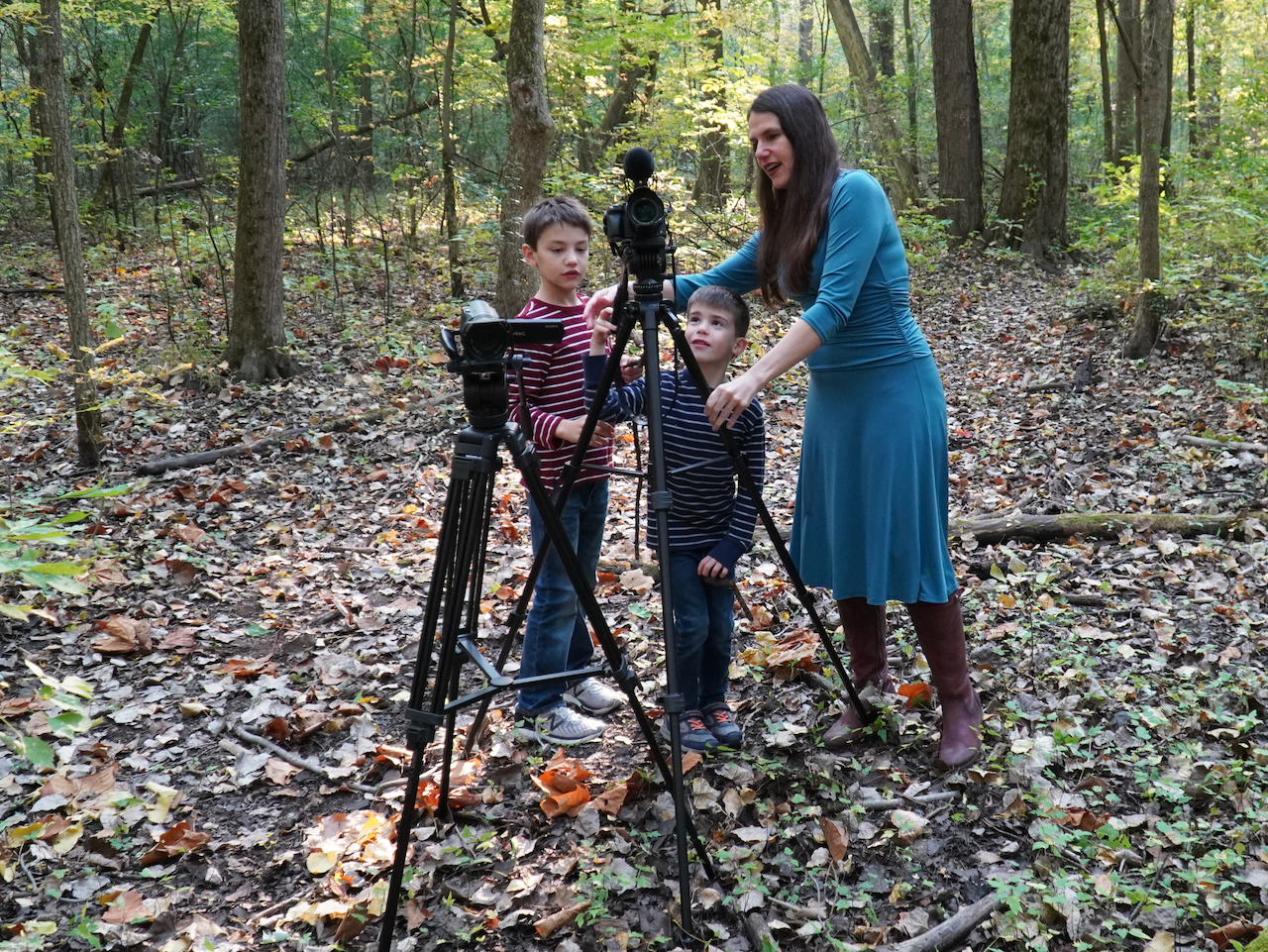
Alexandra Hidalgo showing her sons William and Santiago Hidalgo-Bowler how tripods work while they were filming a scene together in 2020 (Photo by Nathaniel Bowler).
Luhui Whitebear: Yes, bring your family into the arts with you! That is part of my advice. It’s not just about the students we teach and the people who engage with our scholarship. Bring the people in your lives in as well. I would also say to not be afraid of trying new things, and learn along the way. Sometimes getting through the barriers we place on ourselves becomes one of the biggest lessons on what we are capable of.
Alexandra Hidalgo: I agree we should stay nimble in terms of what we try. It’s fun and it keeps us excited and, at least for me, it also leads to new ways of thinking about scholarship.
Ben Lauren: It’s tough to offer advice about how to find time for everything, I agree! Luhui’s idea to bring your family into the arts with you, and your approach for working with your family is a great idea. On my next album, both of my kids are performing on the recording. Addie will sing and Austen will play viola. When they were younger, it was harder for us to play music together, but sometimes when I’d be working on a song, they’d be right there singing along! Having seen many of the videos you’ve created with your family, Alex, I can only imagine how much they will treasure those memories as they age and look back at their childhood. I just really love the idea of inviting even more people in your life into making art. It is such a great idea!
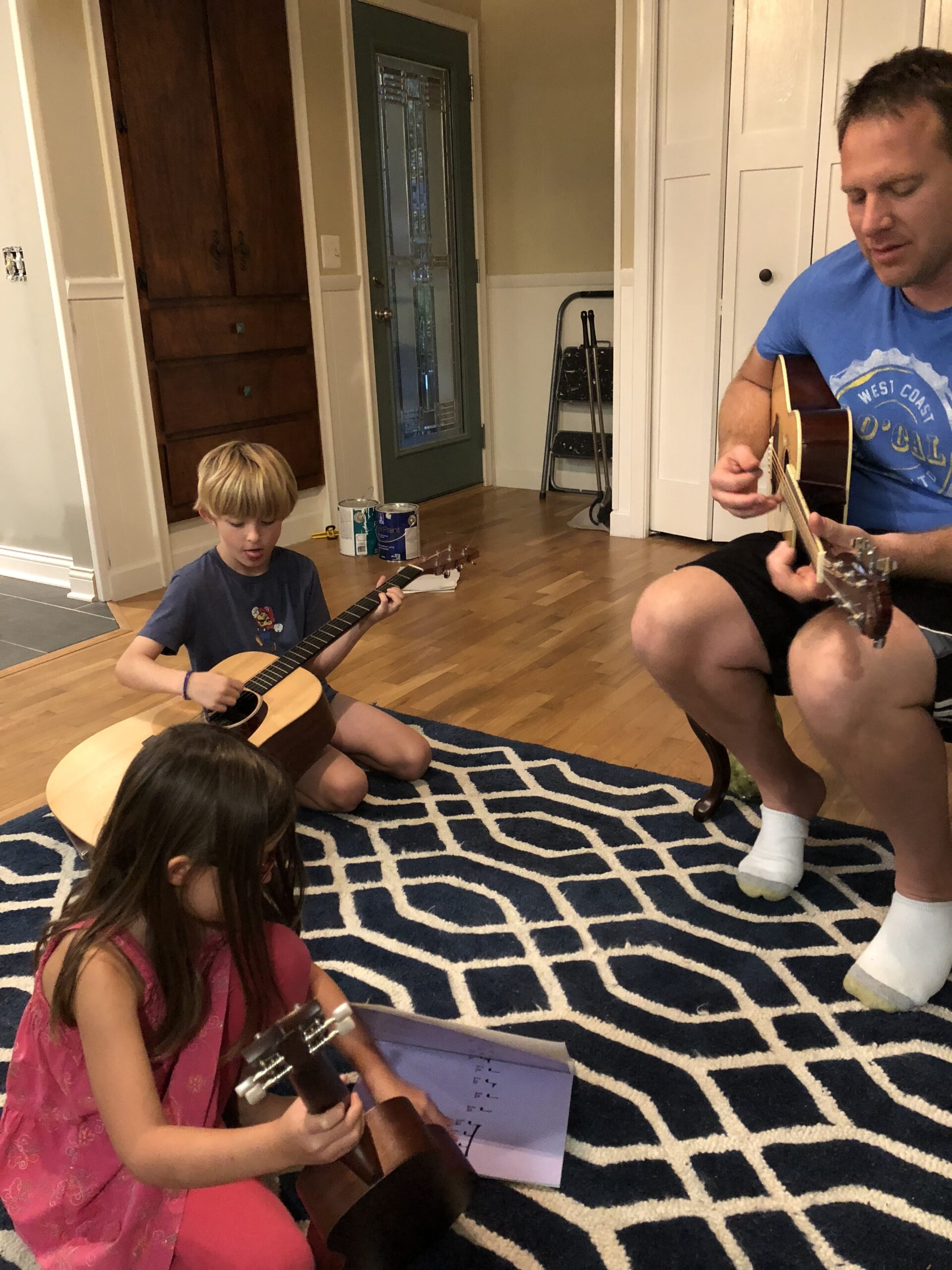
Ben Lauren jamming with his children in 2017 (Photo courtesy of Ben Lauren).
How do you see your work taking shape in the future, and do you have any projects you’re working on you’d like to tell us about?
Luhui Whitebear: I am actually looking to publish a pedagogy book on how I use arts in my classrooms and bringing in student work as examples, with their permission, of course. This is a really early stage idea that I am exploring and determined to make a reality. People always ask me about my poetry as well so I am thinking of where I can publish some of that work. Interestingly, outside of my own articles and chapters, my poetry is only published in science-based academic books, which I think is also pretty awesome. My poem titled “Song of the Salmon” is an example of bringing together Indigenous knowledge, poetry, and science to help educate the public.
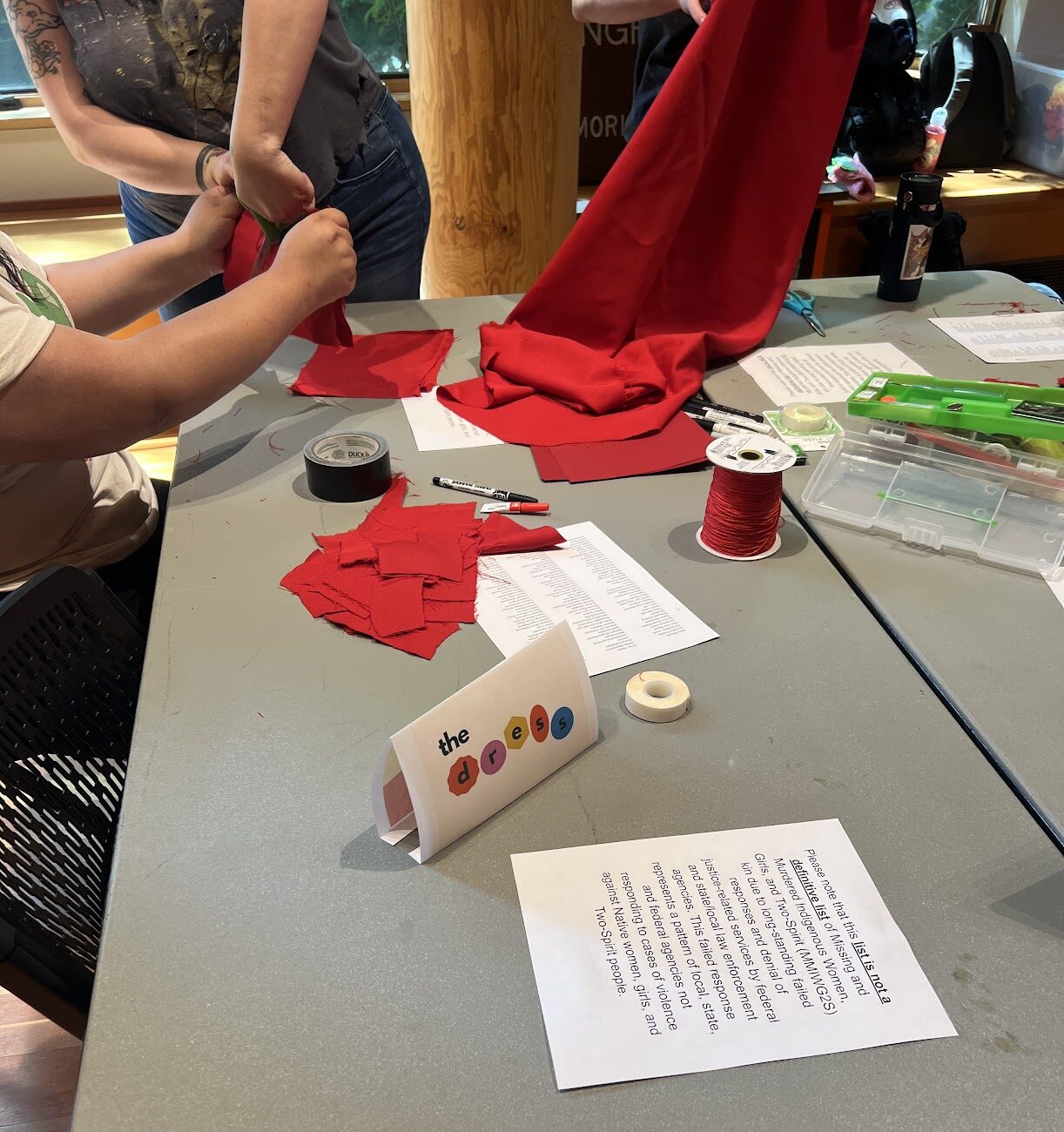
In-progress dress from Luhui Whitebear’s Indigenous Feminisms class (Photo courtesy of Luhui Whitebear).
Alexandra Hidalgo: Yes! Poetry in science books. That is awesome indeed, and I’m thrilled you’re writing about your pedagogy that brings art into the classroom. In that way, you can invite hundreds if not thousands of teachers to do the same and they in turn will touch thousands of students.
Ben Lauren: I really think this kind of book is needed, Luhui. I would be so excited to have a resource like this to consult and work with in my own classes!
Luhui Whitebear: I really appreciate the encouragement on this, you all! We are talking it into existence now.
Alexandra Hidalgo: I am about to start a novel (literally next week, it’s outlined and everything) tentatively titled Ori and Rima. The pitch is: “Ori, a 20-year-old aspiring writer raised in an idyllic small town in the Venezuelan Amazon, sets off on a quest when her mother hands her a letter from her deathbed. Ori arrives in Pittsburgh to deliver the letter to her estranged grandmother only to realize she had no idea Ori existed.” I’m over the moon about spending the academic summer with this granddaughter and grandmother and helping them find each other and themselves as they unveil the family secrets that kept them apart.
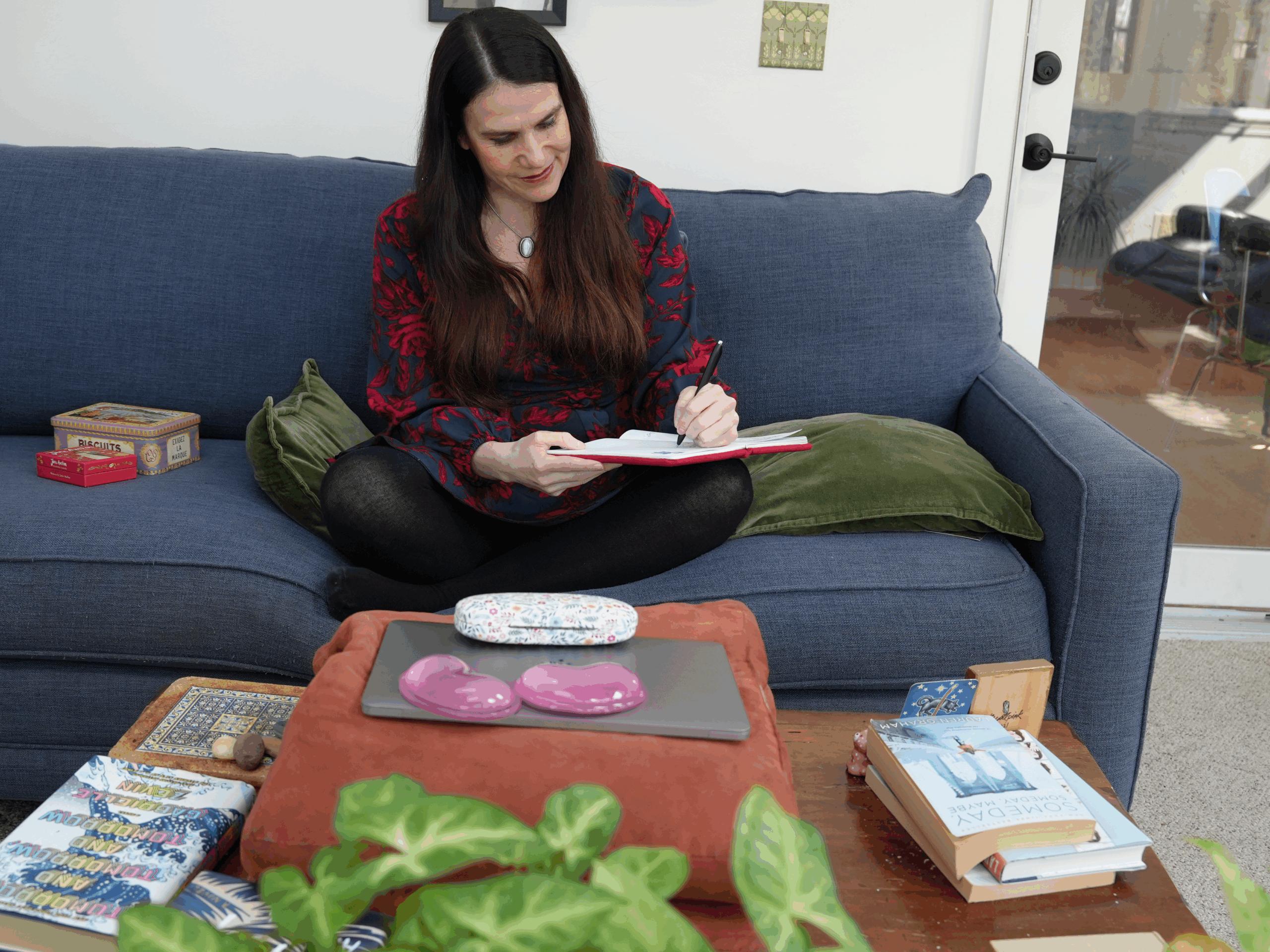
Alexandra Hidalgo drafting her new novel Ori and Rima in one of her many notebooks in 2025 (Photo by Nathaniel Bowler).
Besides the novel, I’m excited to see how my YouTube channel and my Substack evolve. Novels take forever to write and even longer to publish. They’re my favorite art form, but they require a lot of patience. YouTube and Substack are immediate. You make something, you publish it, and you get to see how people relate to it through their comments, and that has a magic of its own. I look forward to exploring all three of these ventures in the years to come and learning more about what they each have to offer me and my audience.
Luhui Whitebear: Your novel sounds awesome! It reminds me of intergenerational healing.
Alexandra Hidalgo: That’s a perfect way to put it, and it’s the throughline of my creative and academic work.
Ben Lauren: These sound fantastic, Alex. I’m so glad to learn more about the novel you are writing! It sounds like such a fascinating story. You are also motivating me to add something—anything—to my Substack haha. I created an account and never added anything. I need to get on that and take a cue from you.
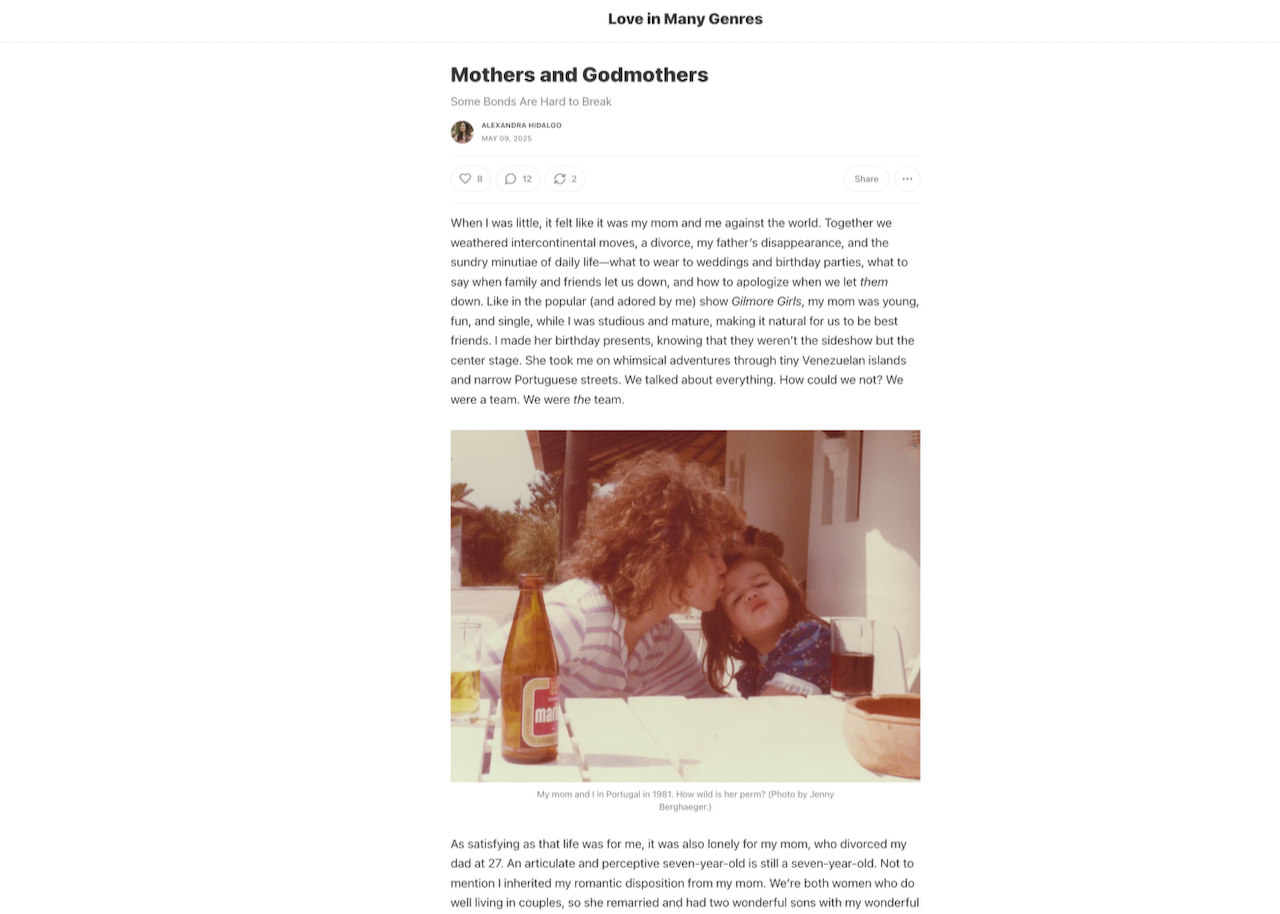
Alexandra Hidalgo’s latest Substack post “Mothers and Godmothers.” (Screenshot courtesy of Alexandra Hidalgo).
Alexandra Hidalgo: You can even have your songs there now. There’s a podcast feature too.
Ben Lauren: I have three projects upcoming. The first is the follow-up album to Hold Me Down. The next record is called Miami, the Album. It’s a continuation of the first album’s story, in a sense, except it focuses entirely on love and healing old wounds. It’s the happiest music I’ve ever made. I’m also writing liner notes to go along with it that further discusses rhetorical feel and memory. The second project is a creative-critical edited collection with Kyle Stedman called “Can I Ask A Question?” A Dialogue About Sonic Rhetorics, Professional Writing, and Creative-Critical Scholarship. That’s coming out in 2025 on Intermezzo and is an edited collection and also a kind of experiment in creative-critical scholarship. The final project is a more traditional book project about what songwriters teach us about innovation. So much of music recording focused on innovating approaches and creating technologies to capture new sounds, and I want to spend time with some of those stories to see what we can learn about creativity and innovation, especially given the near ubiquitous adoption of AI and its impact on creative work.
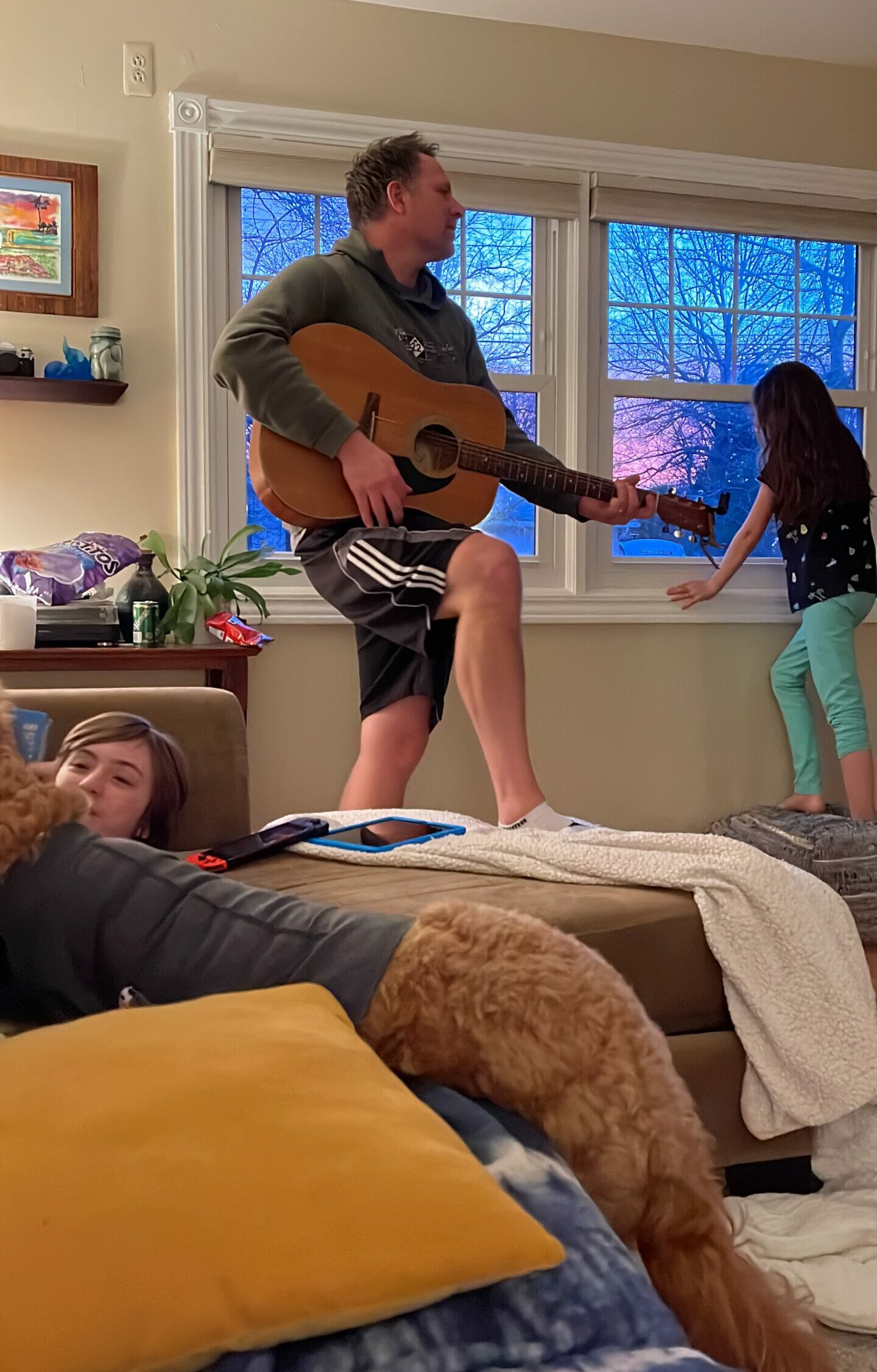
Ben Lauren jamming with his kids in 2022 (Photo courtesy of Ben Lauren).
Luhui Whitebear: I really love that your project centers what songwriters teach us about innovation. Sounds like bringing joy to scholarship to me.
Alexandra Hidalgo: You’re making peer-reviewed scholarship about your art. Yes! And you’re writing happy songs, which is great. I think we need happy. That’s another thing I think art can bring to academia. Joy and happiness. I find it harder to do joyful scholarship. I sure try, but it’s uphill. Joyful art, though? That’s a natural thing to do.
Ben Lauren: Yes!
About the Authors
Alexandra Hidalgo is a Venezuelan writer, filmmaker, theorist, memoirist, and editor whose documentaries have been official selections for film festivals in 15 countries and been screened at universities around the United States. She is the recipient of From the Heart Productions’ inaugural “Carole Joyce Award for Excellence in Documentary Storytelling.” Her videos and writing have been featured in The Hollywood Reporter, IndieWire, NPR, The Criterion Collection, and Women and Hollywood. She writes about relationships and the creative life in her Love in Many Genres Substack, and her All the Love! YouTube channel, which features “Stories About Family, Books, Movies, and TV” content, garners 25,000+ views a month. She has a PhD in English from Purdue University and an MFA in Creative Writing from Naropa University and is associate professor and Crow Chair of English at the University of Pittsburgh. Her video book Cámara Retórica: A Feminist Filmmaking Methodology for Rhetoric and Composition received the Computers and Composition Distinguished Book Award. Her scholarship has been published in Kairos, Composition Studies, Enculturation, and Peitho, among others. Her video essay, “Motherhood on the Screen,” received the Kairos Best Webtext Award. She is co-founder and editor-in-chief of the peer-reviewed journal constellations: a cultural rhetorics publishing space.
Ben Lauren is a songwriter and researcher who focuses on creativity, innovation, design, and rhetoric. He is currently an associate professor at the University of Miami. His most recent monograph Hold Me Down: Toward a Rhetoric of Feel was published by the University of Michigan Press.
Luhui Whitebear is an enrolled member of the Coastal Band of the Chumash Nation with Huastec and Cochimi ancestry. She is an assistant professor in the School of Language, Culture, and Society for Indigenous Studies at Oregon State University. She is also a mother, poet, and activist.
About the Moderators
Catheryn (Cat) Jennings is an Assistant Professor in the Department of English and Communication studies, Co-Director of Writing, and affiliated faculty in Environmental Studies at Hamline University in St. Paul, MN. Catheryn’s research and teaching paths included work in First Year Writing, Writing across the curriculum, Indigenous Rhetorics, Land Rhetorics, and composition pedagogy. She is a managing editor for constellations: a cultural rhetorics publishing space.
Megan Simmermeyer is approaching her third year as a PhD student in Rhetoric and Composition at the University of Pittsburgh. Her research interests revolve around building student voice, particularly in first-year composition when students are learning to find their footing with collegiate writing, and she seeks to trace the ways their voices can persist across genres. Megan holds an MA in English from Northern Kentucky University, and BA in English from Mount St. Joseph University. Her work has appeared in constellations: a cultural rhetorics publishing space and Writing Spaces (forthcoming).
Production Credits
Copy Editors: Natalie Cohen and Alexandra Hidalgo
Posted by: Natalie Cohen
Editorial Assistant: Natalie Cohen
Social Media Manager: Evelynn Pugh
Editor-in-Chief: Alexandra Hidalgo
Related posts:
 Recovering What’s “Swept Under the Rug”: Embodied Academic Experiences as Cultural Rhetorics
 Deep Feelings and Intentional Communities: Honoring Patricia Sullivan’s Legacy
 Teach and Write for Justice: Intergenerational Networks, Equity, and Community in the CCCC Caucuses
 Constellating Jewish Rhetorics: A Call for New Directions from an Iraqi Jew
 Gatekeeping Reviewer 2
 Negotiating Impossibilities: An Introduction to Issue 8 of constellations