
By: Emily Winderman, University of Minnesota, Twin Cities
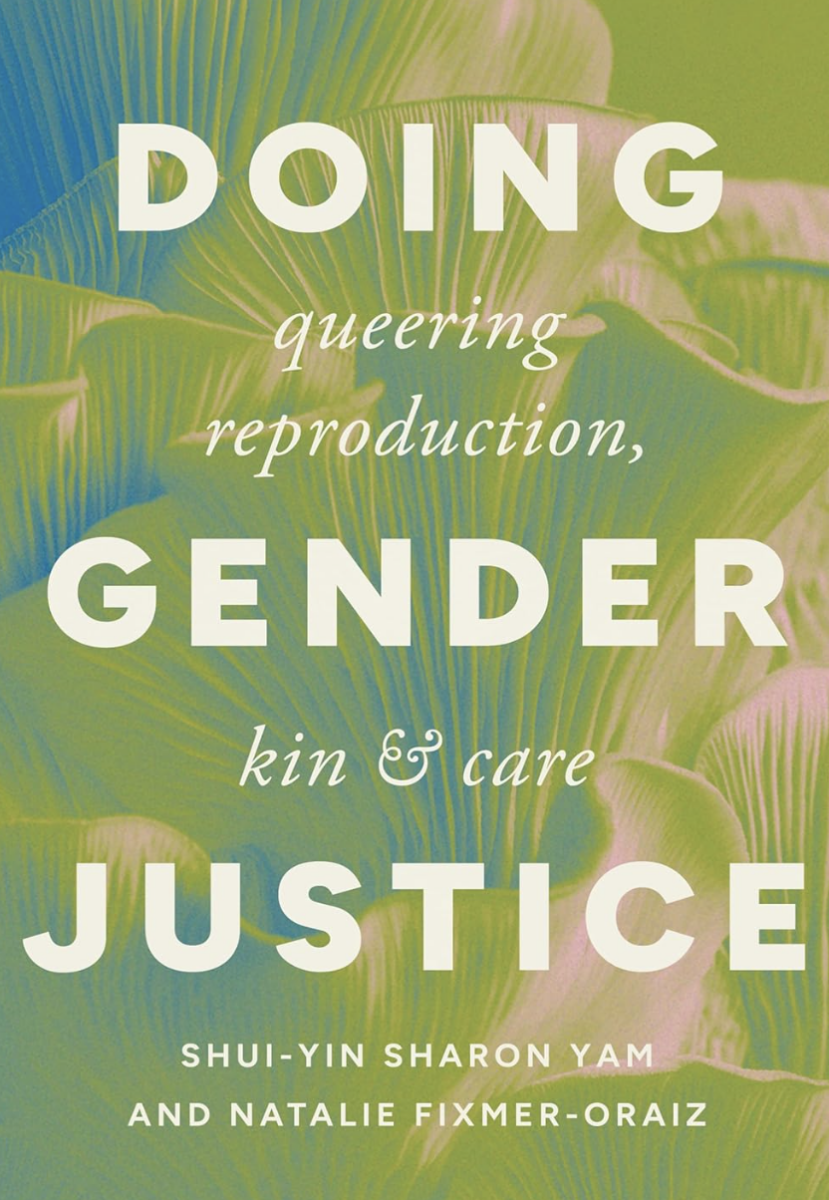
Fixmer-Oraiz, Natalie and Shui-yin Sharon Yam. Doing Gender Justice: Queering Reproduction, Kin, and Care. Johns Hopkins University Press, 2025.
Amid the amplified criminalization of reproductive healthcare and the dehumanizing systematic attacks on the lives of trans and gender nonconforming (TGNC) people, Shui-yin Sharon Yam and Natalie Fixmer-Oraiz have crafted Doing Gender Justice: Queering Reproduction, Kin and Care. A book that is both a sobering reflection of current reproductive injustices and a salve of hope for crafting better worlds, the authors make the compelling case that anti-trans discourses, laws, and practices that limit the boundaries of families to a white cisgender heterosexual configuration must be understood as reproductive injustice. Noting that this injustice often manifests through language debates surrounding gender specificity and gender neutrality in the context of reproductive discourses, Yam and Fixmer-Oraiz argue that relying upon a logic of inclusion to dismantle gender normativities is insufficient “to challenge the interconnected system of cisness and whiteness and the myth of sex/gender dimorphism” (3). Because the gender-binary supports the interconnected system of white supremacy, coloniality, and anti-Blackness, dismantling the gender binary is necessary to abolish these brutal systems of oppression. Notably, while this book engages in incisive historically grounded critique, the authors amplify ameliorative practices that birthworkers and TGNC people do to engage in worldmaking practices “towards a world in which racialized binary gender does not fundamentally shape the conditions and possibilities of one’s life” (5). Drawing upon analyses of public discourses, fieldwork, interviews, and media texts, Doing Gender Justice offers a framework for thinking about producing radically affirming spaces in reproductive contexts while simultaneously rejecting simple practices of “including” TGNC people in a cisgender-centric system.
Interdisciplinary in nature, the authors carefully identify moments of overlap and disjuncture in how queer studies, women’s studies, and trans* studies conceptualize the relationship between sex and gender. With deep investment in reproductive justice (RJ) as an analytic tool and framework for collective organizing, the authors differentiate their intervention from other scholars who aim to queer RJ by refusing to rely upon a logic of inclusion. Rather, challenging a systematic gender binary requires, in their words, a “decolonial trans feminist reproductive justice framework that considers the different experiences of gender identity and trans embodiment” (16). The authors demonstrate a compassionate understanding of the relational assumptions that undergird each of these literature bases. For example, they address tensions among some activists and scholars in the RJ movement who prefer to use gendered language to name the specificities of oppression and avoid erasing historically situated lived experiences. However, they insist that, in naming these lived experiences, we not lose sight of how the gender binary perpetuates white supremacy and colonialism. Black trans* feminist theory offers a powerful framework for holding this complexity because its critique of gender provides a rooted explanation of how Black women are not seen as women because of their lack of proximity to whiteness. Abolishing the gender binary does not minimize lived experience, it provides a sharper tool for critique and recognition.
The three content chapters are thoughtfully arranged in what could be described as a reverse cone: they begin with a focus on larger transnationally networked public arguments, move to a meso level where birthworkers challenge these logics as they manifest in healthcare settings, and end with personally narrated experiences of TGNC birthing people.
In chapter one, the authors take a transnational view of cisheteronormative family formation in public discourse, highlighting a disturbing coalition of people invested in viewing human reproduction through the lens of biological essentialism that conflates dimorphic sex and gender. Demonstrating how Evangelical Christians and conservative healthcare providers find coalitional affinities with trans-exclusionary feminists, the authors investigate the arguments undergirding the anti-gender movement. With pseudoscientific claims that find purchase in both religious and scientific circles, the anti-gender movement deftly mobilizes public emotions of anger and fear to maintain established power hierarchies under the guise of “protecting” (cisgender) women and children. The anti-gender movement has frightening resonance with some healthcare providers and birthworkers, who weaponize social justice language and fail to account for the elasticity of language over time. In essence, anti-gender activists wrongly argue that gender neutral language is to blame for reproductive health inequities and see rights as a zero-sum game that mean rights for some remove the rights of others. However, the authors close the chapter by showing how birthworkers’ trans-inclusive approaches to language in reproductive discourse take an additive approach that can nurture alliances across marginalized communities and recognize that gender does not align with dimorphic biological sex. The authors’ focus on resistive practices at the end of this chapter anticipate many of the rhetorical tactics of gender justice that will emerge in chapters two and three.
In chapter two, the authors argue that birthworkers such as midwives and doulas function as the connective tissue between oppressive transnationally networked anti-gender arguments in public discourses and the lived experiences of TGNC parents. Therefore, doulas and radical reproductive justice-oriented birthworkers serve as an ideal locus to navigate transantagonistic practices in birthing spaces. This chapter builds a robust archive of birthworker rhetorics. The authors attended two mainstream doula trainings; conducted fifteen semi-structured interviews with avowed RJ-oriented doulas and four interviews with queer birthworkers; and analyzed educational materials that queer-affirming birth workers created in response to cisgender and heteronormative-centric training materials. Following a historical and more contemporary contextualization of how woman-centered language was seen as a cudgel against patriarchal technocratic birth frameworks, the authors demonstrate gender essentialist language as one rhetorical response to a longstanding problem but argue that true birth liberation requires a move away from this language.
This chapter’s analysis distills three strategies of worldmaking that radical birthworkers employ to affirm transmasculine and nonbinary birthing people: advocacy, radical inclusion and nonjudgmental care, and self-reflexivity. In contrast to mainstream doula trainings that do not promote advocacy in birthing spaces, radical RJ doulas recognize their work as inherently political and explicitly advocate for the birthing person’s self-determination. Radical RJ birthworkers engage in advocacy at several levels. For example, in preparation for hospital births, radical RJ doulas will also prepare TGNC clients for possible microaggressions and will advocate for birthing peoples’ wellbeing by resisting hospital practices that assume cisgender and heteronormative identities. Radical RJ birthworkers’ second strategy represents one of radical inclusion and nonjudgmental care where they actively edit educational material to normalize TGNC birthing experiences. They also follow clients’ leads in how they refer to their own bodies. The third strategy of self-reflexivity reflects a birthworker’s willingness to sit with their own discomfort and encourage trainees to reflect upon their “positionality, beliefs, and biases” (104). By encouraging trainees to know the limits of their own cultural competencies, radical birthworkers teach trainees to put their egos aside if they have not yet developed the skills to adequately support multiply marginalized clients. Ultimately, this chapter reveals the ingenuity in how radical RJ birthworkers recognize the interstitial role they play in mediating lived experiences and oppressively hostile medical structures.
In chapter three, the authors invoke the robust tradition of storytelling in the RJ framework. They analyze the “everyday lived experiences of TGNC parents,” attuning to public storytelling that can re-imagine kinship and family structures beyond a compulsory heterosexual cisgender configuration. Following a content warning, the authors contextualize the structural harms and reproductive injustices that transgender and queer people experience in pursuing family building. These include repressive knowledge systems, healthcare structures, and legal doctrine.
The unique contribution in this chapter is found in the articulation of two critical frameworks for unpacking stories: deliberative empathy and counterstory. Shui-yin Sharon Yam’s theory of deliberative empathy tracks how people existing on the margins craft political solidarity with people in a more mainstream, dominant position. Aja Martinez’s contribution to the counterstory genre draws upon the affordances of critical race theory to make a radical intervention into dominant discourse in the context of rhetoric and composition. The authors thereby extend the reach of Martinez’s formulation of counterstory beyond academic settings to capacitate an intervention into discourses that circulate more widely in public. While these frameworks attend to different registers and purposes of storytelling, together they attend to a range of stories that TGNC and queer people use when narrating their experiences.
The TGNC stories the authors analyze range from strategically crafting identification with dominant audiences in mainstream outlets to more radical re-imaginings of kinship, embodiment, and birth in enclaved circles. They find that deliberative empathy often fosters identification through assimilatory means–namely pro-natalist ideology that is sometimes laden with politically regressive assumptions. For example, the authors note how Thomas Beatie’s discussion of his pregnancy in his memoir Labor of Love: The Story of One Man’s Extraordinary Pregnancy “appeals to mythic norms of gender, race, reproduction, and family….through Beatie’s adherence to reproductive homo-and heteronormativity in his adult life” (137). While Beatie discusses medical discrimination he faces, he also emphasizes how “normal” his family is by referencing trips to Costco and “white picket fence” dreams that place his family firmly within the boundaries of being white, American, and middle class. Despite their critique, Yam and Fixmer-Oraiz are careful not to police marginalized peoples’ counterstories. Rather, they read these politically limiting appeals as a symptom of the harmful constraints and unjust systems these TGNC parents are operating within. Indeed, I was struck by how carefully they eschewed purity politics, or an all-or-nothing approach to liberatory praxis, noting that the arc of justice is rarely linear. The authors’ critiques modeled a care for these narrators that we would hope to see in a more just world.
Some of the more exciting and radical aspects of this chapter emerge from counterstories that delinked gender from childbearing. Some of the storytellers offered new vocabularies for childbearing, for instance, opting to use the term “germination” rather than “pregnancy” (159). Within more enclaved media spaces, queer reproduction and parenting were delinked from white supremacist nation-building and framed as a liberation project–especially among Black transgender birthing people. For example, LaSaia Wade’s pregnancy journey’s reflected on how having a child and parenting was “the pinnacle of a child being liberated from all types of chains” because the practice resisted ideas that “trans people cannot give birth or have kids” (160).
I was also struck by the nuance of Yam and Fixmer-Oraiz’s analyses: while many counterstories reimagined kinship structures, they also noticed moments when members of a “chosen family” were not fully present during postpartum, when multiply marginalized birthing people can be quite vulnerable to depression, anxiety, and physical complications from birth. Ultimately, this chapter demonstrates that stories—which methodologically undergird the reproductive justice framework—reflect the complicated lives of the people telling them. The authors navigate the complexities with admirable sensitivity and respect for these stories to exist on their own terms.
The conclusion offers takeaways for a wide array of readers: rhetorical scholars, reproductive justice activist-scholars, and healthcare providers. First, in a move that is quite welcome among cultural rhetorical scholars, the authors encourage decentering persuasion in favor of elevating “marginalized ways of knowing” (168). True to the book’s nuance, the authors exhort scholars to avoid uncritically celebrating or condemning TGNC birthing people’s assimilatory tactics. They instead suggest critiques identify the political limitations of assimilatory rhetorical tactics while providing deep contextualization to avoid blaming and shaming marginalized individuals. This method is undoubtedly one worthy of replication for all areas of critical rhetorical study.
Second, the study invites reproductive justice scholars to recognize that trans justice and gender justice is reproductive justice because “the gender binary is racist all the way down” and RJ is fundamentally committed to abolishing white supremacy (170). They also maintain that RJ would benefit by adopting progressive “rhetorical templates,” or commonplaces that RJ activists can return to and adapt with an inventive eye towards the most pressing exigencies of the moment. Importantly, though, they caution that the politics of inclusion, visibility, and recognition cannot defeat the durable network of colonialism and white supremacy. With a friendly hand, they encourage the RJ movement to “grow and expand” with the leadership of Black and Indigenous TGNC leaders.
Third, the authors call for healthcare workers to become active accomplices in reproductive settings by recognizing how gender violence operates from the structural level to personal experiences. Laudably, the authors provide examples of grounded changes like performing audits to determine whether language practices, intake forms, and organizational cultures are minimizing harm. Healthcare workers should hire TGNC consultants and staff to ensure that the environment can be one that offers safety to birthing people. Language adaptation, such as asking open-ended questions and following birthing people’s lead with naming themselves (rather than default to mom or dad) can reduce dysphoria, which has a material impact in reducing stress and improving healthcare outcomes.
Doing Gender Justice offers a highly sophisticated, yet accessible, theory with an analytic eye towards building more equitable worlds for TGNC birthing people and their kin. Anyone who is invested in the project of pinpointing rhetoric’s role in building a liberatory praxis will find valuable the authors’ expansive methods, incisive critique, and the telos to offering practices for a future where a racialized gender binary no longer has sway in a person’s reproductive experiences. While this book is valuable for those already committed to a radical praxis, it will also be transformative for readers who may still be capacity-building in their approaches to gender, parenthood, and birth cultures.
About the Author:
Emily Winderman is an Assistant Professor at the University of Minnesota, Twin Cities. Her scholarship works at the nexus of rhetorical studies of abortion, reproductive health, justice, and affect theory. She is the author of Back-Alley Abortion: A Rhetorical History (Johns Hopkins University Press, 2025) and co-editor of Covid And…How to do Rhetoric in a Pandemic (Michigan State University Press, 2023), which won the Association for the Rhetoric of Science, Technology, and Medicine 2024 Book Award. Emily is also co-director of the Healthcare Under Crisis Oral History Project which critically interrogates Minnesota’s “safe haven” status by interviewing abortion and gender affirming care providers and activists.
Production Credits
Book Review Editor: Ana Milena Ribero
Editorial Assistant: Gissell Del Castillo
Posted by: Gissell Del Castillo
Social Media Manager: Sasha Jason
Editor-in-chief: Alexandra Hidalgo
Related posts:
 Cultivating Solidarity through Radical Subjectivity: A Review of Noor Ghazal Aswad’s Searching for Solidarity: Revolutionary Dreams and Radical Social Movements
 Truth Beyond Reason: Speculative Fictions and the Mad Imagination
 The Impermanence of Motherhood: Infertilities: A Curation
 Constellating Stories and Counterstories: Cultural Rhetorics Scholarship Principles
 Countering Racial Enthymemes: What We Can Learn About Race from Donald J. Trump
 What We Did the Year Everything Blew Up: An Introduction to Our Third Issue