
By Alexandra Hidalgo, editor-in-chief
Introduction
I descend from three generations of writers of various styles and varying amounts of success. My great-grandmother Mercedes Ochoa de Briceño wrote children’s stories on the back of phone books and brown paper bags from the corner bakery. According to her daughter, my grandmother Olga Briceño, Mercedes rarely finished and never published these stories, but they floated around the house and filled many children’s imaginations with lively tales of big-hearted animals on quests they never completed (because Mercedes would move on to the next story before they reached their happily ever after).
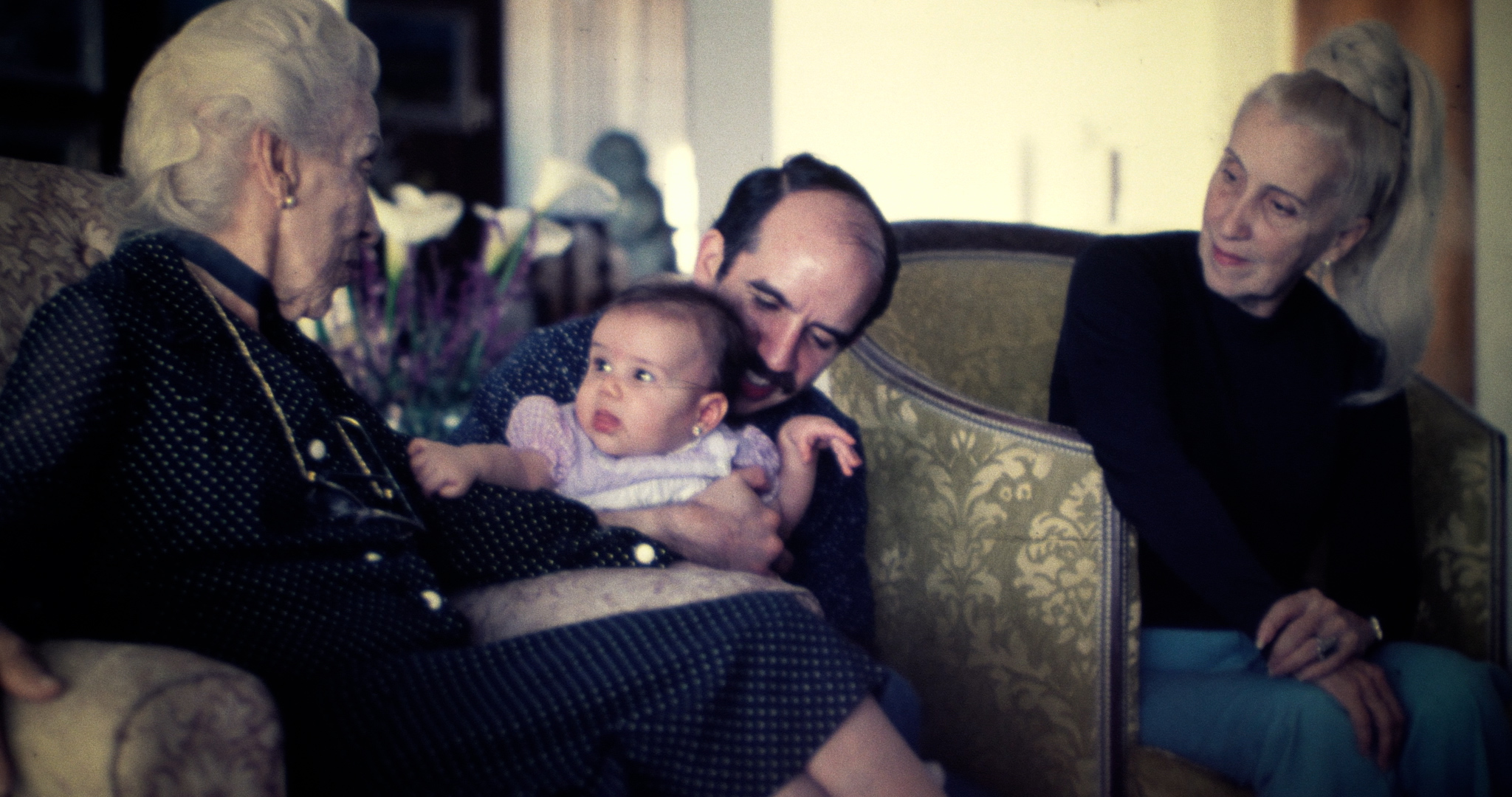
Mercedes, Alexandra, Miguel, and Olga. Four generations. One infatuation with the written word. (Photo by Antonieta Aagaard).
My grandmother grew up fascinated—and a tad frustrated—by her mother’s chronically incomplete storytelling. In response, she spent six decades starting (and often publishing) historical fiction and memoir books, as well as sundry journalistic endeavors in Spanish, English, and French. My father, Miguel Hidalgo, was awed by his mother’s uncanny ability to make a living through whatever writing style was profitable in whatever country she called home during each stage of her life. Dad also wanted to make his living through words, but he lacked his mother’s protean ability to adapt to the whims of editors and audiences. His writing took the shape of abstract philosophical treatises on Greek mythology and the kinds of big quests that humans (men, really) undertake to understand their own mortality. Unlike Mercedes’s quirky, incomplete journeys, Dad wrote about serious (except for a smattering of intellectual puns) quests toward defeating time, death, and other undefeatable things. He published a book, stories, and poems, but none of them set the literary world on fire. They did, however, set my imagination ablaze.
Having grown up hearing tales of my ancestors’ writing and literary triumphs (only Olga enjoyed the latter, but that was enough for me), I had no choice but to want to become a writer. Okay, that’s not true. I had many choices, but I liked the writing choice best, so it’s the one I went with. From the time I was six until two years into my PhD at Purdue, I saw myself as a writer. Then at 33, I decided I’d become a filmmaker and a scholar instead. The decision hurt. Oh wow, did it hurt. I was turning my back on Mercedes, Olga, and Miguel. Not to mention on the girl who’d longed to continue their legacy.
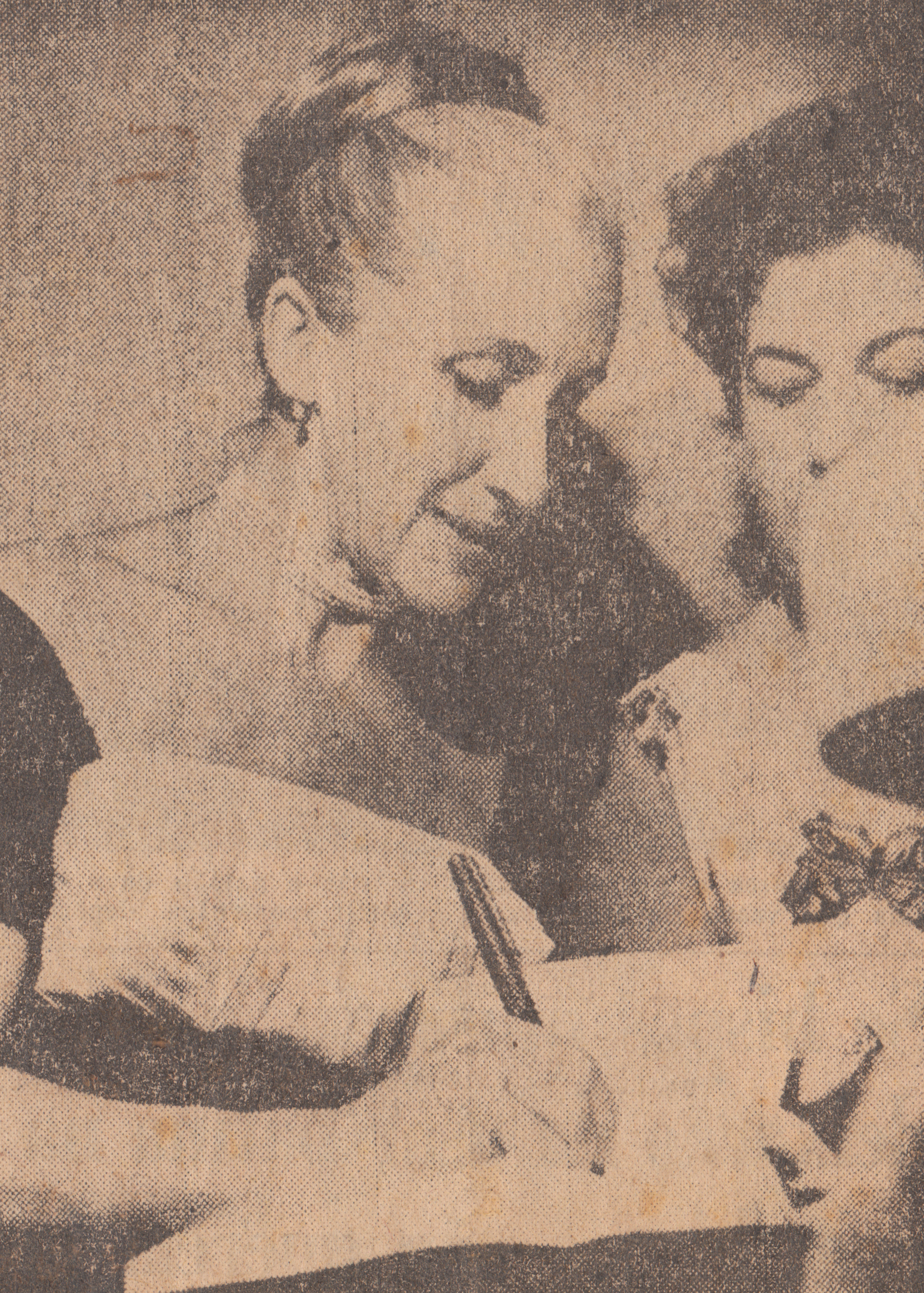
A photo from a 1959 Jornal do Brasil article about my grandmother Olga Briceño, where we see her autographing one of her books at a PEN Club event in Rio de Janeiro.
I told myself that filmmaking was storytelling and academic publishing was writing. I told myself I wasn’t walking away but breaking new ground. And it worked. For years. Ten to be exact. Then on April 15, 2021—when I was 43—I was dancing in my kitchen (as I do most nights to get the blood, emotions, and ideas flowing) when a story materialized in my head and demanded to be told. It was originally (and may someday become) a TV show, but the more I mulled it over with my entertainment industry friends, the clearer it became that it was a novel. Fiction, the craft I’d left behind, was beckoning me again. There was a delicious circularity to the whole thing. The kind of denouement Mercedes might have written on a paper bag if she’d ever finished her stories.
So here we are three years later, and last week I submitted my query and the requisite selection of pages from my Grand Gestures manuscript to a few dreamy agents. I’ve spent endless hours over most of the last three years writing and rewriting the novel. But that’s only part of it. Like Olga, I’m good at the dance. I learned the hustle from her and know how to adapt to ever-changing tastes and demands. Writers write, sure, but these days, we must also perform our writerly identities in the capricious digital spaces most people now inhabit.
I’ve been fortunate to collaborate with tireless and inventive Pitt student Sambhavi Bhayana on figuring out the rules of the social media game in its (too) many iterations: Twitter, Facebook, Instagram, YouTube, LinkedIn, and perhaps TikTok—if we ever get to it. But social media, pervasive as it is, is only part of the writerly hustle. I also redesigned my professional website with fantastic Pitt students Pujal Gandhi and Emily Vaiz. You can learn more about our process on “The Grand Digital Reinvention” post from my (new, of course) Love in Many Genres Substack. Are you tired yet? Because I sure am, and it’s not close to being over. The hustle of performance is ongoing. Ironically, I’d done such a good job at branding myself as a filmmaker and academic that it took quite a bit of backpedaling and re-reinventing to perform being the thing I’d always been. Or at least what I’d always wanted to be—a writer.
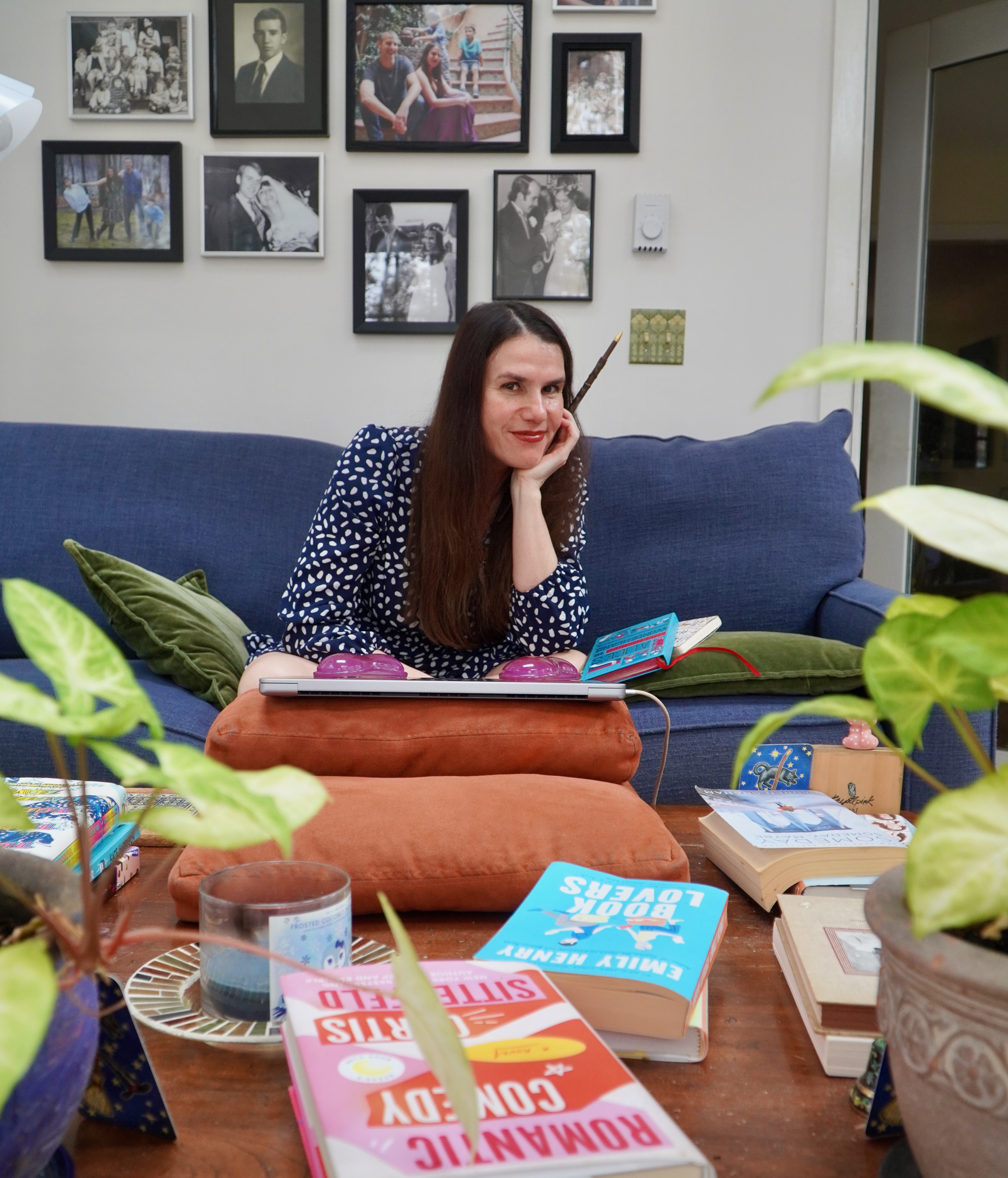
The portrait we used for the writer page on my redesigned website. (Photo by Nathaniel Bowler).
Cameras, mics, film posters, and working with crewmembers are all inherently visual. Writing, though, is a word game, and writers’ tools don’t have the most show-stopping of aesthetics. Pen and paper have their charms, laptops do not. I don’t use typewriters, so they (cool and vintage as they are) are out for me. It’s not just the photos but the need to rebrand from something I’ve completed (films and scholarship) to something that’s just a manuscript and a dream. And yet, if you can project it, you can become it. Right? That’s the hope. That’s the theme of the fantastic pieces you’re about to encounter in this issue: The laborious (and we hope rewarding) art of performing the change we want to see in the world. Or at least in our lives. Our authors analyze, theorize, and (of course) perform various personas and transformational acts—kneeling during the national anthem, embodying our heritage through bilingual poetry and tattoos, writing and performing feminist hip hop, going out to protest neoliberal and hegemonic policies in the US and around the globe. The hustle never seems to end. Maybe Mercedes had it right. Our quests are unfinished and ongoing—and perhaps they’re more valuable for it.
Thank you to the unstoppable, creative, and compassionate team that makes constellations happen. The pieces in this issue span the work of our former editorial assistant Yasmine Anderson and our current editorial assistant Alex Jennings. They kept all the intricate pieces of our journal working with admirable grace and patience while balancing the grueling hustle of grad school. Pitt undergrad Evelynn Pugh, our social media manager, is a true innovator who has pioneered gorgeous and cool Instagram reels and TikTok videos introducing the work we publish to new audiences, and who, alongside fellow undergrad Natalie Cohen, helped launch our journal’s brand new Substack, which you can subscribe to in order to stay up to date with the exciting work our publication is doing.
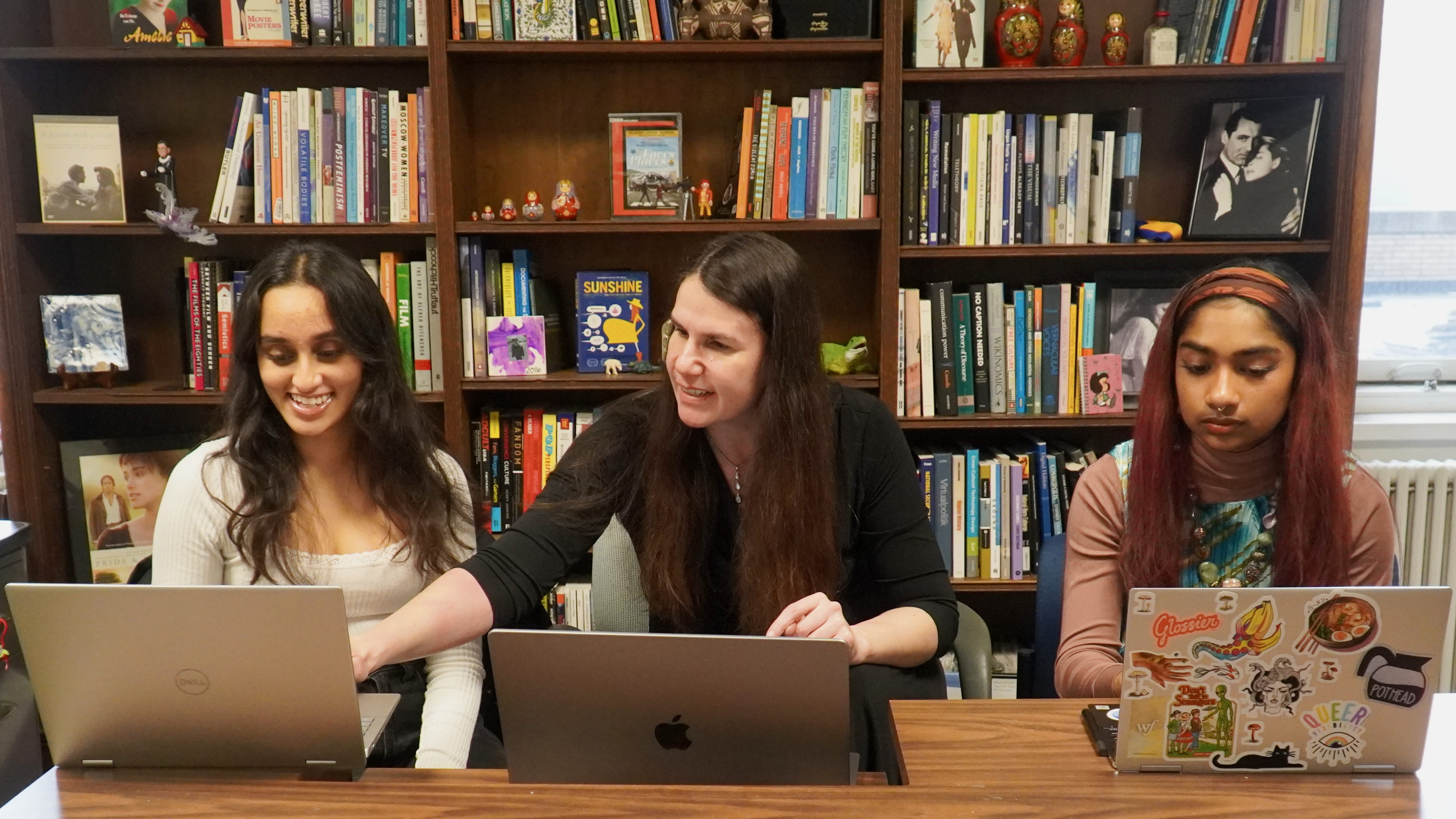
Working on my website with Pujal Gandhi and Emily Vaiz. (Photo by Brooke McEvoy).
Thank you to the undaunted and always-fun-at-meetings managing editors who worked on this issue: Lauren Brentnell, José Luis Cano Jr., Brandon M. Erby, Catheryn Jennings, Daisy Levy, Andrés C. López, Alexis McGee, Xiqiao Wang, and Kimberly Weiser. Our review editor, Ana Milena Ribero, continues to help us shine a light on cultural rhetorics scholarship by working with reviewers to produce excellent analyses of recent publications. Then, of course, there’s you, our readers. Whether you can’t wait for our latest issue or you’re here because it was assigned to you in class, we thank you for sharing your finite and ever-so-valuable time with us. Now let me introduce the magnificent meditations on performance and personas we have collected in this issue.
In “Articulating and Interrogating Black Embodied Resistance: Using Performative Symbolic Resistance as a Tactical, Analytical Tool,” Alicia K. Hatcher develops an analytic system to describe and interpret the work of Black activists. Performance Symbolic Resistance (PSR) involves a physical act (the body performing a gesture or movement) that unfolds within a public space and delivers a message of resistance to those who witness it. Hatcher analyzes NFL (National Football League) quarterback Colin Kaepernick’s act of kneeling during the national anthem to protest systemic oppression of Black people in the US through PSR categories—Who, What, How, When, Where, and Why. Using her adaptable model, Hatcher breaks down Kaepernick’s actions and pinpoints why they had such a significant impact on our culture. She invites readers to use the model to analyze other protests as well as to develop and organize protests of their own. Understanding how these acts work can help us not only parse out the resistance we have already witnessed but articulate our own resistance in ways that are impactful and have long-lasting effects on our culture and discourse.
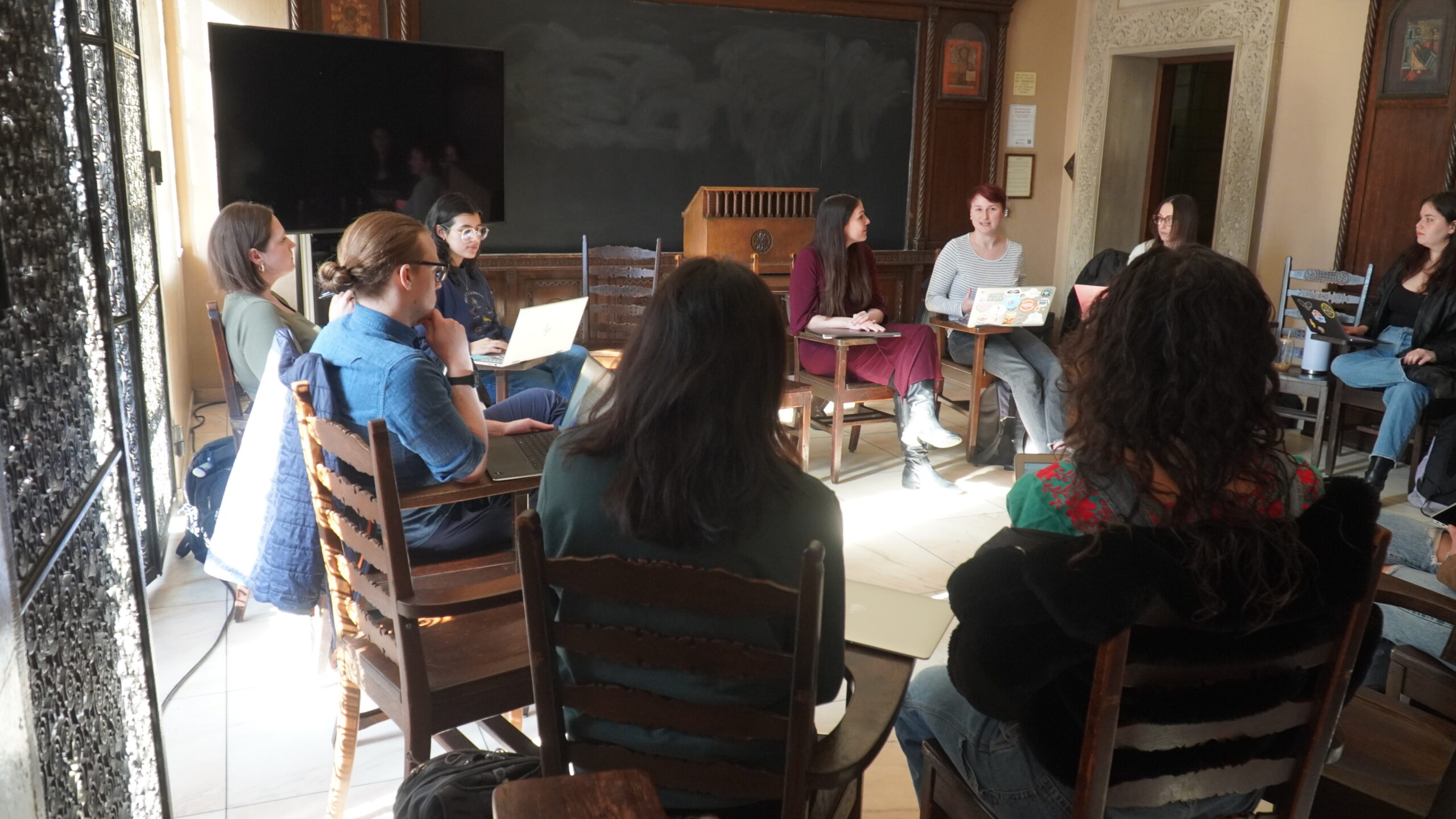
Discussing performance and personas with the students at my Cultural Rhetorics seminar at Pitt this spring. (Photo by Nathaniel Bowler).
Clarice A. Blanco follows in the footsteps of Gloria Anzaldúa in “My Name is /KLA-ris/: The Bordered Name of an American Latina,” utilizing poetry, scholarship, and memoir to bring to life the experiences of a Latina living in the US caught between cultures and identities. She argues for her right to be unapologetic and hybrid as she makes her life in a culture that doesn’t always understand and appreciate what she has to offer. Her article blends Spanish with English, personal experience with theoretical thinking, and lyrical language with photography, performing its hybridity as its form and content mirror each other. Blanco invites readers to inhabit her story, her body, and her life experiences while engaging with the text.
In “Rapsody’s Rhetorical Interventions: Black Women & the Hip-Hop Imaginary,” Eric House analyzes the wit and craft in hip hop artist Rapsody’s song and videos while exploring how the genre’s pervasive sexism makes it difficult for women artists to get the sort of recognition and audiences they deserve. House draws from Michelle Wright’s “Epiphenomenal Intervention,” a theoretical concept that examines the multiplicity and intersectionality of our identities, in order to break down how Rapsody changes her performances to adapt to the particular locations and contexts she finds herself in. House showcases the beauty and bravado of her lyrics as well as her fashion style, which Rapsody terms “tomboy femininity,” to portray an artist who is not only standing up for her own talent and dreams but for those of Black women around the world—whether they’re behind the mic or listening in on their AirPods.
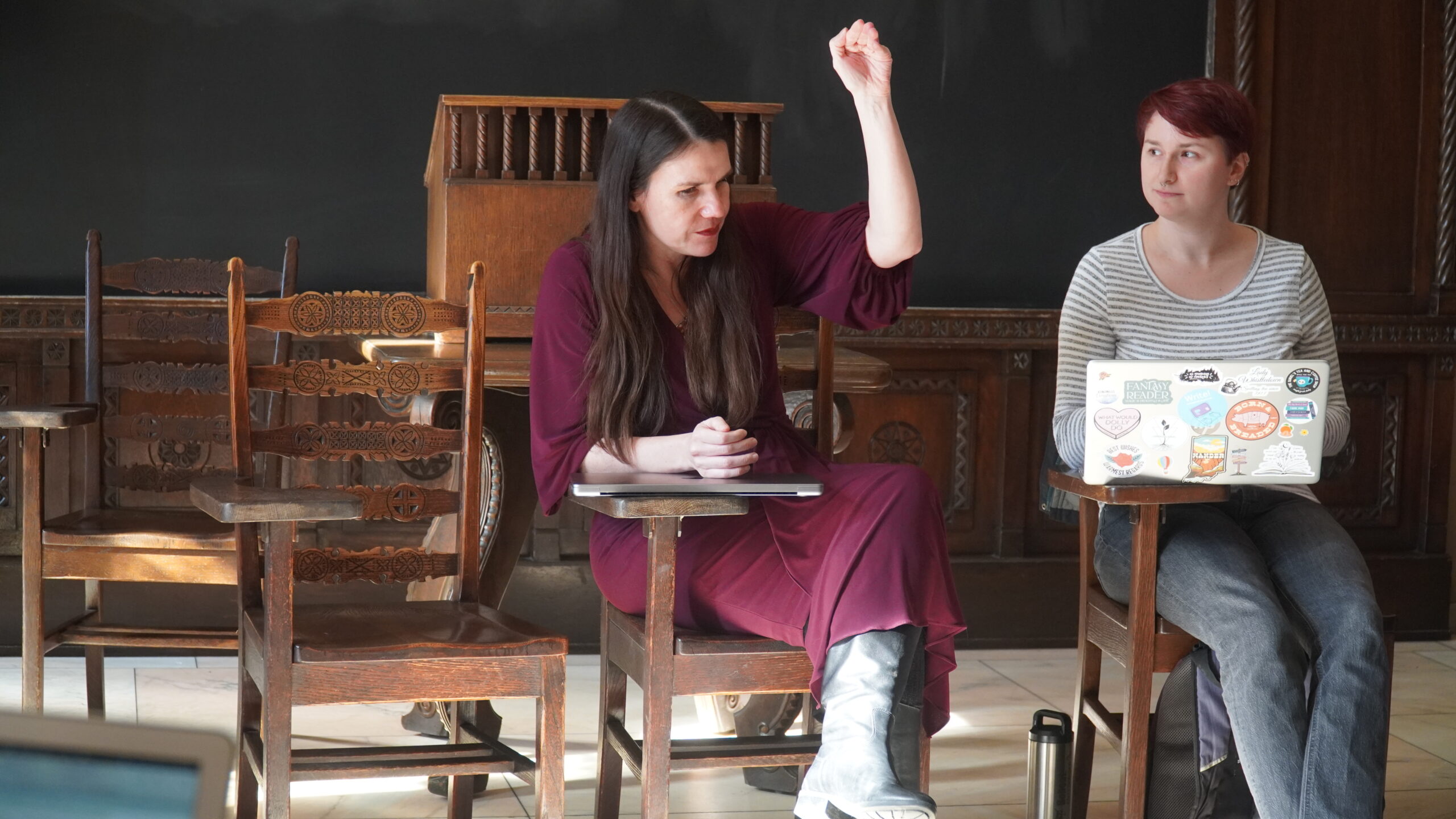
Who knows what this gesture signifies? But it seems pretty performative. I thank Pitt PhD student Megan Simmermeyer for taking it all in stride. (Photo by Nathaniel Bowler).
José Luis Cano Jr. and Daisy Levy moderate our “Stories that Lead to Action: An Exploration of US Political Rhetorics” conversation. This enlivening and layered discussion between Carlee A. Baker, Amber Buck, Angela D. Mack, James Chase Sanchez, and Jennifer Wingard addresses how rhetoricians study and participate in political activism around the US. From Roe v. Wade to gun violence to gerrymandering to trans rights to the anti-CRT movement, this conversation provides a thoughtful and generative map to issues currently dominating our headlines and our national conscience. Not only do we get personal accounts of participants’ engagement with these issues, but we find a (tempered) sense of hope in terms of how we can intervene as human beings, artists, activists, and scholars in the matters that mean the most to us.
Moderated by Andrés C. López and Xiqiao Wang, our “Transnational Fissures and Solidarities: International Political Rhetorics Across Borders” features Stephen Dadugblor, Gale Franklin, Hazel Elif Guler, and Sharon Yam. They discuss the counterintuitive take that pro-democracy Hong Kong activists have on #BlackLivesMatter, Western influences on Ghanan national identity, settler colonialism and the ripples of the far-right “Freedom” Convoy in Canada, and how art amplifies minoritized voices in Turkey and the Middle East. The participants argue that global politics, like so much in our current world, are interconnected and that what happens in one country is often replicated in others. As they show, as much as harmful ideas and practices spread internationally, so does activism, as people across borders come together to help each other make change.
In “Who is Worthy of Childhood?,” Joselyne Tellez-Cardenas reviews Wendy S. Hesford’s Violent Exceptions: Children’s Human Rights and Humanitarian Rhetorics. Tellez-Cardenas reports on Hesford’s account of how the Trump Administration’s 2018 “zero-tolerance” policy separated nearly 3,000 migrant children from their families and housed them in detention centers. The collection goes beyond the US to feature media stories about children around the world—child soldiers, war refugees, transgender children, and girls hampered by rampant sexism. As Tellez-Cardenas explains, Hesford argues that children in crisis are often weaponized by the media and used to forward Western ideas of exceptionalism and who is and isn’t deserving of basic rights.
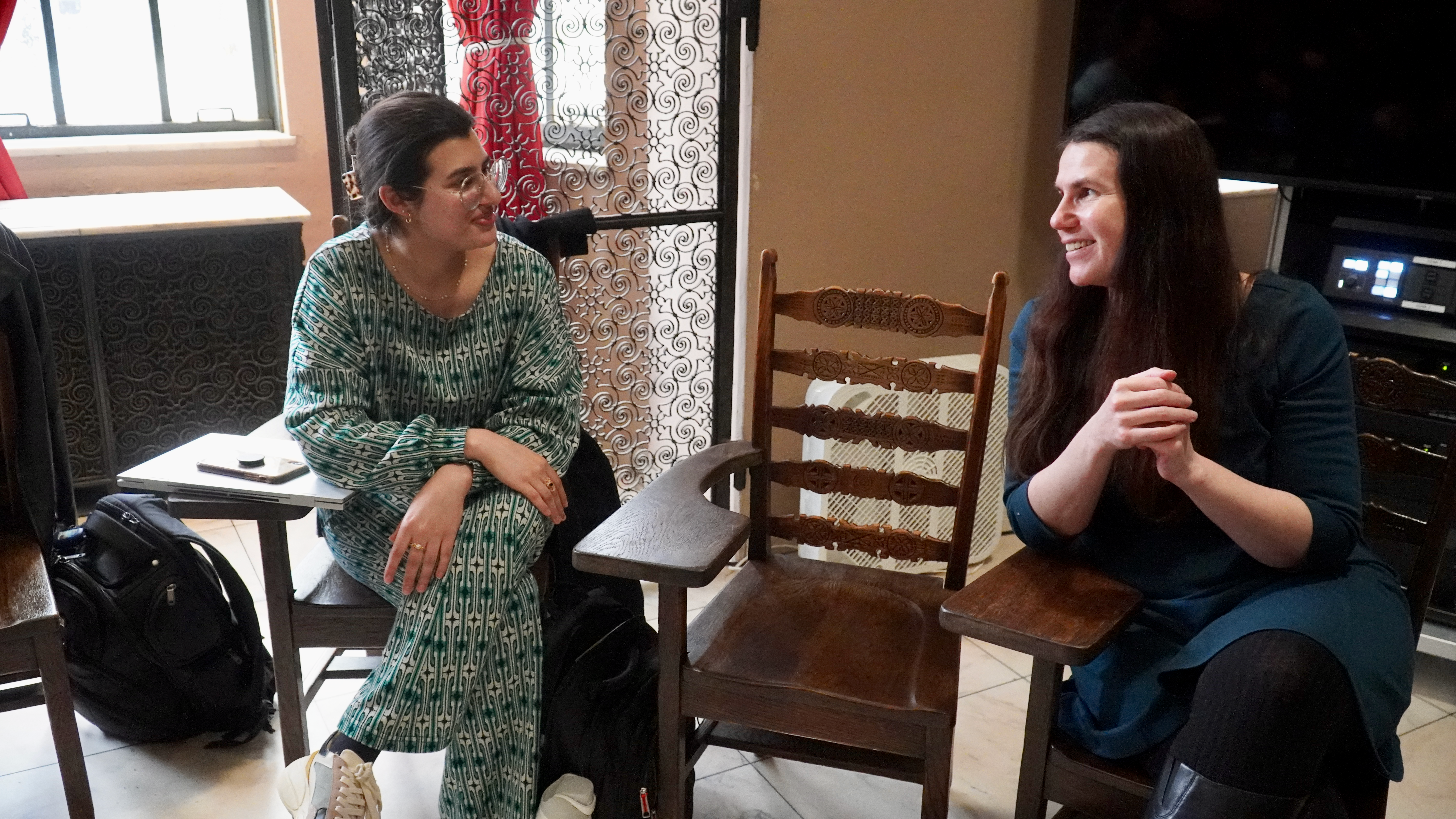
Sharing a moment of lightness with Pitt PhD student Sidra Arshad as we continue to make sense of the art of performance at our Cultural Rhetorics Seminar. (Photo by Helena Mazzarella).
Carlee A. Baker’s “How to Spot a Fascist: A Review of the Rhetoric of Fascism, Edited by Nathan Crick,” claims this edited collection not only provides a history of fascism but traces its development across various nations, including Mexico, Italy, and the US. As Baker argues, the book presents fascism in the US more generally, partnering it with more international case studies focused on particular countries. From the power of spectacle and tropes to the way World War II fascist practices still loom large to the complex layers of meaning that come with labeling someone a fascist today, Baker provides illuminating examples from the collection’s wide-ranging probe into one of the most devastating political movements in history.
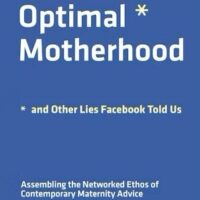
Alexandria Hanson’s “Review of Jessica Clements and Kari Nixon’s Optimal Motherhood and Other Lies Facebook Told Us: Assembling Networked Ethos of Contemporary Maternity Advice,” showcases Clements and Nixon’s examination of choices mothers are asked to make around what are considered good and bad motherhood practices. Covering topics like alcohol consumption, breastfeeding versus formula, and whether to use food pouches, the book traces these practices to the Victorian cult of seeking “true motherhood” and “maternal perfection.” Hanson concludes the book makes a significant and moving argument for mothers to go beyond the binaries that have been forced upon them and to instead build empathetic communities with other mothers, whether or not those mothers’ choices are different from their own.
About the Author
Alexandra Hidalgo is a Venezuelan writer, filmmaker, theorist, memoirist, and editor whose documentaries have been official selections for film festivals in 15 countries and been screened at universities around the United States. She is the recipient of From the Heart Productions’ inaugural “Carole Joyce Award for Excellence in Documentary Storytelling.” Her videos and writing have been featured in The Hollywood Reporter, IndieWire, NPR, The Criterion Collection, and Women and Hollywood. She has a PhD in English from Purdue University and an MFA in Creative Writing from Naropa University and is associate professor and Crow Chair of English at the University of Pittsburgh. Her video book Cámara Retórica: A Feminist Filmmaking Methodology for Rhetoric and Composition received the Computers and Composition Distinguished Book Award. Her scholarship has been published in Kairos, Composition Studies, Enculturation, and Peitho, among others. Her video essay, “Motherhood on the Screen,” received the Kairos Best Webtext Award. She is co-founder and editor-in-chief of the peer-reviewed journal constellations: a cultural rhetorics publishing space.
Production Credits
Copy Editors: Nathaniel Bowler and Alex Jennings
Posted by: Alex Jennings
Editorial Assistant: Alex Jennings
Social Media Manager: Evelynn Pugh
Editor-in-Chief: Alexandra Hidalgo
Related posts:
 My Name is /KLA-ris/: The Bordered Name of an American Latina
 Articulating and Interrogating Black Embodied Resistance: Using Performative Symbolic Resistance as a Tactical, Analytical Tool
 Stories that Lead to Action: An Exploration of US Political Rhetorics
 “Who is Worthy of Childhood?”: A Review of Wendy Hesford’s Violent Exceptions: Children’s Human Rights and Humanitarian Rhetorics
 Building a Better Future for Mothers: A Review of Jessica Clements and Kari Nixon’s Optimal Motherhood and Other Lies Facebook Told Us: Assembling Networked Ethos of Contemporary Maternity Advice
 How to Spot a Fascist: A Review of The Rhetoric of Fascism, Edited by Nathan Crick