

Joselyne Tellez-Cardenas, Oregon State University
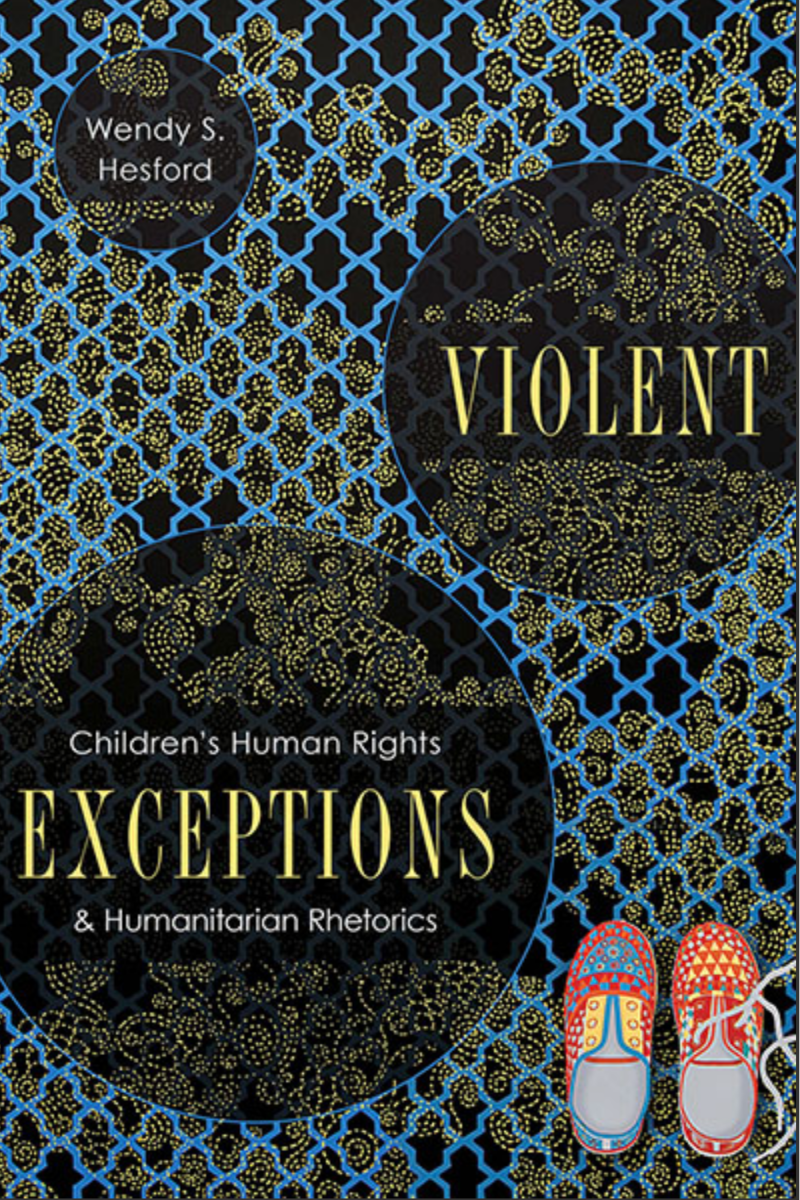
Hesford, Wendy S. Violent Exceptions: Children’s Human Rights and Humanitarian Rhetorics. The Ohio State University Press, 2021.
Following the implementation of the Trump Administration’s “zero-tolerance” policy on April 6th, 2018, approximately 3,000 migrant children were immediately separated from their families and placed into detention centers along various US border states. Although the “zero-tolerance” policy was not the first institutional effort to criminalize migrant families and children, Wendy S. Hesford explores how the mass outcry at the separation of children from their families is a reinforcement of violent humanitarian rhetoric.
In Violent Exceptions: Children’s Human Rights and Humanitarian Rhetorics, Hesford identifies and examines various international children’s humanitarian cases, in order to inspect how visual and political rhetorics are employed to mark children as “exceptional,” a process that has violent repercussions for those not considered worthy of exceptionalism. Specifically, Hesford analyzes how media coverage and photographs of children-in-peril are often used to produce narratives that fulfill Western political goals. Hesford begins her work on the intersection between children’s human rights rhetoric and political discourse with the 2019 hearing of the US House Subcommittee of Civil Rights and Liberties titled “Kids in Cages: Inhumane Treatment at the Border,” which featured testimony from Guatemalan asylum-seeker Yazmin Juárez (ix). During her testimony Juárez spoke on the violence and loss experienced by migrant families and their children at the detention facilities across the US-Mexico border. In using Juárez’s testimony and image, which work to evoke empathy and political change, Hesford begins her work on how the “child-in-crisis” is a rhetorical and political weapon. Ultimately, the author dissects the rhetorical and political image of the “child-in-peril” to analyze how American exceptionalism contradicts and endangers the children it claims to protect.
While Violent Exceptions begins and ends with the US-Mexico border, Hesford utilizes a global perspective in her framework to expose the contradictions and violence of exceptionalism in children’s human rights rhetoric. To accomplish this, Hesford dedicates each chapter of her book to different children, each who gained international media coverage and political attention. With this goal in mind, Violent Exceptions is structured and divided among five chapters and major children’s humanitarian crises: child refugees and humanitarian recognition; global girlhoods and humanitarian celebrity; disability exceptionalism and African child soldiers; transgender children’s human rights and humanitarian rights; and a final analysis of migrant children along the US-Mexico border. Throughout each chapter, Hesford provides a historical and political background for the individual child’s humanitarian causes, which includes media coverage, political tensions/conflicts, and even covering what (if any) changes occurred as a result of the attention. It is through the usage of interdisciplinary methodologies, such as the inclusion of visual and political rhetoric along with social commentary, that Hesford investigates how the notion of exceptionalism is inherently violent and counter-productive to the exact humanitarian causes it aims to remedy.
Though the analysis of children’s human rights and humanitarian rhetorics in Violent Exceptions is divided among five distinctive chapters, Hesford’s principal argument is clearly weaved throughout her book. Hesford’s work in Violent Exceptions centers the way in which “the humanitarian figure of the child-in-peril often stands in for the state and as a cover for political and state violence” (16). Hesford problematizes the state’s role in the conceptualization of “childhood” and “humanitarian” responses, which often value the discourse surrounding children’s human rights while actively policing and devaluing the actual children. It is critical to Hesford’s principal argument to understand the distinction between the figurative child-in-peril, often situated as a martyr, like the image of child refugees studied in Chapter 1, and the literal child, like the many children continuously being detained and separated from their families at the US-Mexico border.
Hesford makes the distinction between the figurative and literal child clear through the inclusion of various case studies, which contrast how humanitarian rhetorics are influenced by media and political coverage. More specifically, Hesford illustrates how dominant forms of media transform larger humanitarian crises into one digestible case by selecting a child to represent an entire cause, hindering the opportunity for legitimate political or social change. For instance, in Chapter 1 “No Tears Here,” Hesford directs our attention to the mass coverage of a wounded Syrian child, Omran Daqneesh, and his eventual tokenization. She writes, “The video of Omran pulled from the rubble of the August 17, 2016, airstrike elicited metonymic readings of Omran as a symbol of the endangered children of Syria and of the struggles of refugees of war” (39). Though Omran’s wounded image was circulated and sparked political discourse internationally, his image was used to perpetuate state violence. As Hesford points out, politicians like Barack Obama called for political and humanitarian aid for children like Omran while remaining complicit in the war-torn status of Syria; “Euro-American media mobilized the video of Omran as evidence of the inhumanity of President Bashar al-Assad’s regime and its allies and as justification for the ongoing proxy war on terror” (47). Through this dissonance, Hesford exemplifies both the distinction between the figurative and literal child-in-peril and Omran as a symbol that contrasts the hundreds of thousands of Syrian children impacted by the US “war on terror.” This also is an example of the ways in which children’s humanitarian rhetorics often perpetuate violent exceptions.
Overall, it seems that Hesford’s purpose in publishing Violent Exceptions is not only to evaluate the political and dominating rhetorical attitudes towards children’s humanitarian crises, but to also examine how US exceptionalism is counterproductive and produces violent repercussions for marginalized children. By using real life examples of “exceptional” children, in contrast to the “non-exceptional” child, Hesford effectively and persuasively displays the way in which children-in-peril are selected, not based on their worthiness, but based on their distance from the US. For instance, Hesford contrasts the martyrdom of African child soldiers to the criminalization of Black children in America to unravel the violence of US exceptionalism. Hesford’s theoretical work pushes back against dominant humanitarian rhetorics, which rely on empathy and “tears” to weaponize a cause that impacts the children they promise to protect. Ultimately, by comparing how humanitarian rhetorics and exceptionalism work for or against the child-in-peril, and the methods in which they operate, Hesford successfully evaluates how political and visual rhetorics determine the worthiness of children-in-crisis, and how US exceptionalism produces violent consequences for the “unworthy” child.
Violent Exceptions takes contemporary political and humanitarian issues, such as the US-Mexico border crisis and transgender student rights and evaluates how the notion of exceptionalism produces contradictory effects for children’s lives. Reproducing the imagery of the weeping mother, embodied by Juárez’s testimony and loss, Hesford returns to the US-Mexico border in the concluding portion of her work to remind us of the very real and very violent consequences of US exceptionalism. Now more than ever, the rhetorical and political work shown in Violent Exceptions is crucial in understanding how we, not just as scholars but as community members, are succumbing to notions that tell us who is deserving of our empathy and compassion, and who is not. Hesford’s work will diversify not just the study of immigration rhetoric and rhetorics of race, but will also pave the way for this novel field of study: children’s human rights rhetoric.
About the Author
Joselyne Tellez is a second-year master’s student in the School of Writing, Literature, and Film at Oregon State University, where she studies rhetoric and composition. Her research centers on the rhetorics of politics, visuality, migranthood, and the border. Joselyne’s current project, her master’s thesis, examines how migrant identity is shaped by political and visual rhetorics. Upon receiving her master’s degree from OSU, Joselyne aspires to continue to work on bringing multiculturalism at the forefront of higher education, either through the writing classroom or through administrative work.
Acknowledgments
I offer gratitude to Dr. Wendy Hesford and other humanitarian and immigrant scholars for doing such critical work for our fields and world. I want to thank Dr. Ana Ribero, who has not only provided critical feedback and support at different stages of development for this review, but for different stages of my master’s degree. Thank you to the constellations editors who worked with me to achieve my first academic publication. To my family and all those who are not named but nonetheless supported me: thank you for always listening and believing in me, I offer my gratitude.
Production Credits
Book review editor: Ana Milena Ribero
Copyedited and posted by: Alex Jennings
Social Media Manager: Evelynn Pugh
Editor-in-chief: Alexandra Hidalgo
Related posts:
 Building a Better Future for Mothers: A Review of Jessica Clements and Kari Nixon’s Optimal Motherhood and Other Lies Facebook Told Us: Assembling Networked Ethos of Contemporary Maternity Advice
 How to Spot a Fascist: A Review of The Rhetoric of Fascism, Edited by Nathan Crick
 Send My Love to the Family: A Review of Glasby, Gradin, and Ryerson’s Storytelling in Queer Appalachia: Imagining and Writing the Unspeakable Other
 “Theory With No Practice Ain’t Shit”: A Review of Aja Y. Martinez’s Counterstory: The Rhetoric and Writing of Critical Race Theory
 “You Know, Anger Can Be Righteous”: A Review of James Chase Sanchez’s Salt of the Earth and Joel Fendelman’s Man on Fire
 Black Tech Matters: A Review of Charlton McIlwain’s Black Software