
Carlee A. Baker, University of Texas

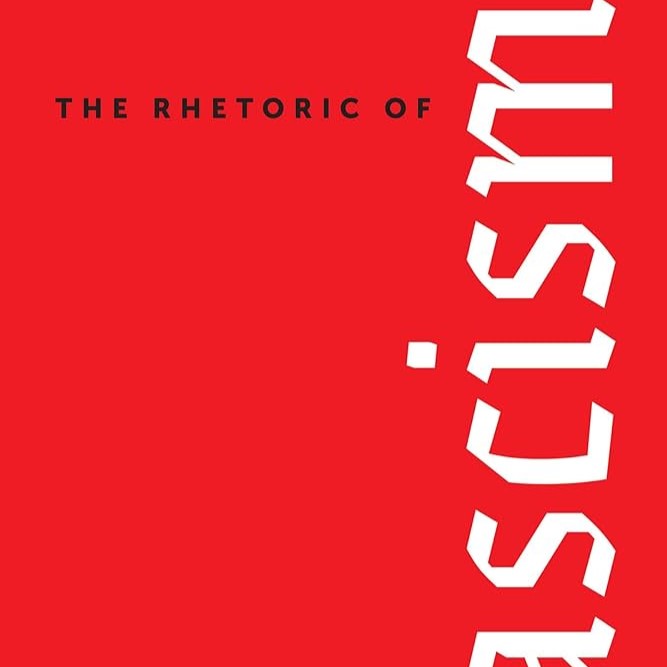
Crick, Nathan. The Rhetoric of Fascism. Tuscaloosa, the University of Alabama Press, first edition, 2022.
The Rhetoric of Fascism, a collection edited by Nathan Crick, offers a comprehensive past-to-present inventory of key moments in the rhetoric of fascism. Crucially, as opposed to a more focused text that might isolate a particular region or historical moment to focus on the fascistic rhetoric that defined it, Crick’s collection paints a broad historical and social picture, featuring in-depth analyses of the rhetoric of fascism from several countries, including the U.S., China, Italy, Mexico, Russia, and Germany. In this way, the collection of essays, taken together, provides a nuanced picture of the contours and features of fascist rhetoric via the analysis of a series of case studies. The text serves as something of a manual in the identification of fascist rhetoric, particularly in the face of the popular usage of “fascist” as an absent referent.
In the introduction to the collection, Crick emphasizes that the purpose driving the compilation of these diverse essays is to employ a broad analysis of the ways the rhetoric of fascism uses calculated maneuvers to stoke broad social fears. He writes, “This book was written to advance our understanding of how fascist politics preys on human frailty by exploiting common rhetorical devices to constitute motives and attitudes” (4; emphasis added). Elaborating on this point, he argues that the study of the rhetoric of fascism uncovers “ordinary devices that find their uniquely persuasive power and violent character in historical moments that allow for the conglomeration of a grand united front of prejudices” (6). This introduction foregrounds the essays within, which elucidate the rise and power of fascistic rhetoric that is outrageous to some and affirming to others. In other words, the chapters take rhetorical devices used by fascist leaders and rhetors, analyze their use to fascist ends, and expose them for the work they do “behind the scenes.” In this way, Crick’s curatorial effort, and the intricate thought of the contributing authors, lay bare the ways in which fascistic rhetoric employs entirely commonplace means to advance dangerous patterns of thought.
While the collection is not separated into official sections, there is a fairly clear delineation between the essays that focus on rhetorical case studies based in U.S. political culture and case studies focused outside of the U.S. Between the two unofficial sections, however, each of the essays within are connected to each other in many of the same ways that Crick outlines in his introduction – primarily, in highlighting the ways the rhetoric of fascism, utilizing quotidian rhetorical maneuvers and choices, works to make dominant fascistic ideals more palatable and, in some cases, celebrated political and social truths.
A common theme exhibited throughout the collection, and particularly in essays dealing with the rhetoric of fascism in the U.S., is the role that spectacle plays in the use of fascistic rhetoric in public political settings. Crick begins the collection with an essay on the 21st century US rhetoric of fascism, demonstrating how the rhetorical move of “Remaking Shit” employs the fascist theme of rebirth after labeling as shit “all that it hates and opposes but then remak[ing] that very same material into something glorious once it is invested with spiritual qualities and transformed into an ideal that serves the revival and redemption of some chosen people” (15). Having identified this rhetorical device in Trump’s rhetoric, Crick focuses specifically on Trump’s mythmaking in the proliferation of the “Make America Great Again” slogan as a case study. He elaborates on the efficiency of the slogan to mythologize the past and create an urgency to recapture lost glory, explaining that part of the slogan’s appeal is that “the specific details are lost within the intentionally vague and mystical sense of lost greatness communicated by the device of Remaking Shit” (29). From this analysis, he concludes that a critical and harsh look at the efficiencies and myths that empower the slogan is one step to delegitimizing them and imparts upon the audience their responsibility to call out “shit” in all forms.
Continuing the focus on the public spectacle inherent to the Trump brand of US fascistic rhetoric, Stephen J. Hartnett takes a stark look at a series of narrative tropes utilized within Trumpian rhetoric that emerge from the rhetoric of Mussolini: “the trope of carnage”; “the trope of betrayal”; “the trope of ‘manly consciousness’”; and “the trope of ‘specious nomenclature” (38, italics original). Harnett highlights how each of these tropes came to appear within Trumpian rhetoric. The “trope of carnage” and the resultant evocation of the “trope of manly consciousness” play upon many of the same assumptions that “Make America Great Again” does, where Trump presents the current state of the U.S. in terms of catastrophe and disaster, calling upon fears of societal decline felt among the Alt-Right and legitimizing the threat of violence and intimidation. The “trope of betrayal” appears most clearly in Trump’s open anti-intellectualism and disdain for “the elites.” His utilization of the “trope of specious nomenclature” works as an exclusionary rhetorical tactic intended to mark the Other as definitionally excluded from the meaning of “American.” Hartnett explains that these two tropes involve a subtle but persistent degradation of Others that works to “‘[deliver] the poison of prejudice in small but increasing doses” (48). At the heart of the use of each of these tropes in public political rhetoric is an appeal to fear, strong enough to motivate threats of violence at the behest of the former President.
Trump, of course, calls upon more than fear to reach his followers. Ryan Skinnell takes up the concept of truth in the Trump era, discussing how, even when his followers know he is lying, Trump’s charisma and sincerity make him appear honest and trustworthy. Skinnell coins this maneuver “Deceiving Sincerely” and situates this device squarely within Trump’s fascist era of truth: “In the fascist version of truth, truth is felt, it is authentic, it is sincere. Whether or not it’s also factual is beside the (fascist) point” (223, italics original). Instead of falling into many of the familiar pitfalls of responding to the Trump-caused “post-truth” era, Skinnell highlights that the inclination toward “more education, more science, more objectivity, more logical argumentation, less emotion in politics” is misguided because it assumes that fascists are irrational, poorly educated, and anti-intellectual (224). This leads to a misunderstanding of the revival of fascist politics in the 21st century “not just among the irrational and uneducated” and of fascists’ relationship to the truth (224). Skinnell suggests that for fascists, “factual truth is subordinated to a shared, intuitive sense of truth as it relates to their overarching political aims” (225). He then directs the conversation outward, issuing a warning about the global rise of fascism by suggesting that this fascist version of truth is observable in political contexts beyond the U.S.
The other significant portion of this edited collection takes up this issue of analyzing fascism and fascist rhetoric outside of the U.S. Jacob A. Miller-Klugesherz takes a close look at the rhetorical appeals of “blood and soil” rhetoric, observed in rural Germany in the WWII era. Drawing loose parallels between Germany and the U.S., he identifies the ways in which fascism’s success depends on its stronghold in rural communities. In this way, he argues that “Defining rural identity is central to bolstering the idea of a nation’s historical and homogenous identity, as any nationalistic heartbeat starts in the heartlands” (90). Miller-Klugesherz demonstrates the implications of “blood and soil” rhetoric in Germany for the U.S., marking the connection between the use of the rhetoric in the WWII era and how it presents and changes in the modern US context, “Those who chant ‘blood and soil’ are not rural farmers committed to protecting land but are, rather, people mobilized by racialized hatred and conspiracy theory” (89). The explicit connection between the origination of the term and its current conative use in the U.S. makes the phrase’s fascist underpinnings that much clearer and provides insight into the proliferation of alt-Right political affiliations among rural US Americans.
In continuing the study of exclusionary in-group identity performance in the rhetoric of fascism, Rya Butterfield conducts an analysis of the rhetoric of “Calling Out” as present in China’s Great Proletarian Cultural Revolution (GPCR). In a nuanced use of personal anecdote and first-hand interviews, Butterfield analyzes how Calling Out as a rhetorical device is “turned to support fascist attitudes when it violently channels deep-seated resentments against a class of scapegoats in the name of a righteous campaign for national purity… [when it] is personal, political, and compulsory” (131). In the context of the GPCR, Calling Out (which resembles other rhetorical tools of Othering used within fascist regimes) was predicated on a sense of righteousness in completing the act of social ousting and reinforced a sense of unity that comes with having pushed out the so-called “bad eggs.” Butterfield argues that Calling Out is an overtly political act “because it targets structures of authority, person by person” and that it is characteristically violent because “the group bonds together through acts of joint physical violence against their targets. The oneness increases the feeling of moral vindication” (131). This is reminiscent of several of the previously discussed rhetorical devices working to violently exclusionary ends. Making the connections between the past and present and from the local to the global, Butterfield highlights how the culture of Calling Out has remained to the present day, appearing largely within social media spaces, where there is vindication in collective action against those understood as blocking the path toward greater progress.
The collection wraps up with an afterword written by Patricia Roberts-Miller, where she discusses the importance of the accurate label of “fascist” and explores the implications of the flippant use of “fascist” to describe “out-group political figures and forces, often on the part of people who themselves have been plausibly labeled fascist” (241). She continues: “To label someone or something as fascist is to perform three rhetorical functions. First, the label ‘fascist’ functions as a strategy of scapegoating, of placing certain groups or ideas under suspicion … Second, the label ‘fascist’ identifies how public discourse is handled, namely by highlighting attempts to exterminate any opposition arguments or even mild dissent. Lastly, the label ‘fascist’ categorizes the politics pursued and promoted by certain groups as having a specific characteristic reflective of movements in the twentieth century that provide us a way of sizing up movements in the present through the models of the past” (244). This addresses the common use of the word “fascist” as a scapegoating measure but reinforces Crick’s contention that exposing the label – and all of its implications – under harsh critical light is the key to understanding and dismantling it.
This collection provides a nuanced and complex understanding of fascist rhetoric and its associated devices, thus deconstructing the buzzword into recognizable features. While the organization of the text–particularly the order in which the essays appear–is slightly unclear, the connections between each essay are clear and represent an important link between related, but different, fascistic rhetorical devices. Each of the perspectives provided within are crucial to Crick’s project, as they span cultural and national contexts and highlight features that may otherwise escape the criticism necessary to subdue their negative effects. This text will be of particular interest to those working at the juncture of politics and rhetoric or communications, but may also be of interest to those studying cultural rhetorics, rhetorical historiography, and the rhetoric of social movements. The collection represents one among many emerging pieces of scholarship dealing with the rhetoric of fascism post-Trump and is remarkable for its measured tone and careful analysis, as the history and precedent of fascist rhetorics is foregrounded and accounted for throughout the analyses presented therein. In this way, it makes a significant contribution to the field as a piece of well thought-out and extensively researched political rhetorical analysis of fascism from the Trump and post-Trump eras. Considering the large focus on US fascistic political rhetoric, the balance between the scholarship focusing on fascistic rhetoric in other regions and areas perhaps could have been teased out to a larger extent. Recognizing the space limitations, however, Crick has completed a satisfactory curation of essays analyzing fascist rhetorical devices relevant to the modern age.
About the Author
Carlee A. Baker is a Ph.D. student at the University of Texas at Austin studying rhetoric and writing. She is also a senior research fellow at Labor Lab, the only nonprofit watchdog organization in the country that tracks and investigates corporate spending on union-busting. Her research interests include the rhetorics of labor and class, political and public rhetorics, and design of communication and information. Her work has appeared in Technical Communication Quarterly. Prior to attending UT, Carlee worked as a communications specialist for the Montana Federation of Public Employees, the state’s largest labor union.
Acknowledgments
I’d like to thank Dr. Ana Milena Ribero for her thoughtful comments on several early drafts of this review.
Production Credits
Book review editor: Ana Milena Ribero
Copyedited and posted by: Alex Jennings
Social Media Manager: Evelynn Pugh
Editor-in-chief: Alexandra Hidalgo
Related posts:
 “Who is Worthy of Childhood?”: A Review of Wendy Hesford’s Violent Exceptions: Children’s Human Rights and Humanitarian Rhetorics
 Building a Better Future for Mothers: A Review of Jessica Clements and Kari Nixon’s Optimal Motherhood and Other Lies Facebook Told Us: Assembling Networked Ethos of Contemporary Maternity Advice
 Send My Love to the Family: A Review of Glasby, Gradin, and Ryerson’s Storytelling in Queer Appalachia: Imagining and Writing the Unspeakable Other
 “Theory With No Practice Ain’t Shit”: A Review of Aja Y. Martinez’s Counterstory: The Rhetoric and Writing of Critical Race Theory
 “You Know, Anger Can Be Righteous”: A Review of James Chase Sanchez’s Salt of the Earth and Joel Fendelman’s Man on Fire
 Black Tech Matters: A Review of Charlton McIlwain’s Black Software