
Prakash Paudel, Washington State University
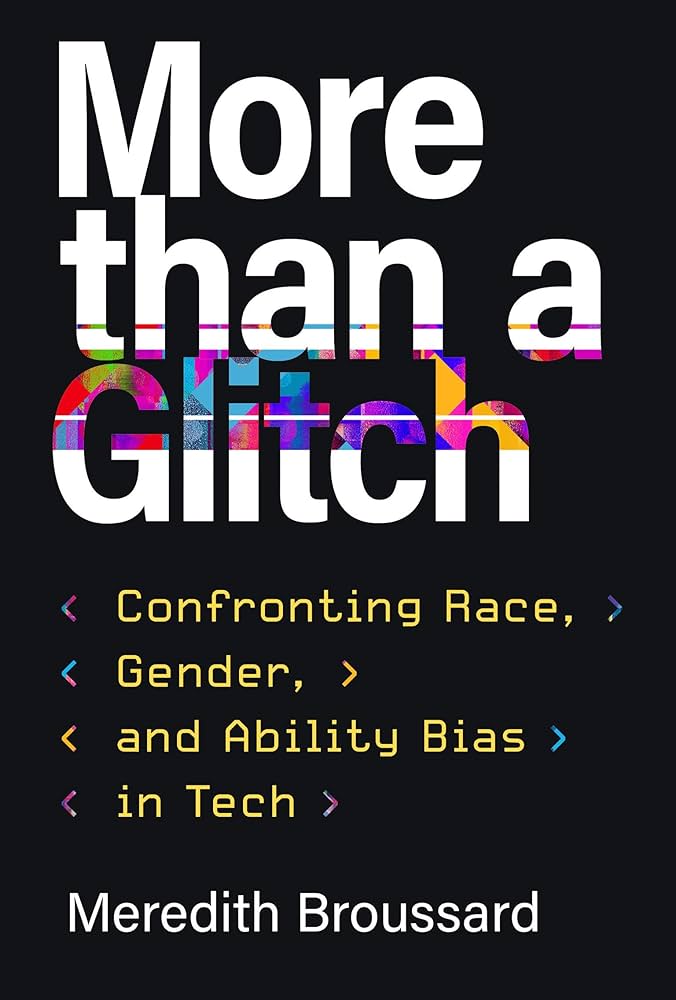
More than a Glitch: Confronting Race, Gender, and Ability Bias in Tech by Meredith Broussard makes an optimistic call for justice in the tech world. Injustices and biases in tech are not mere errors as they are culturally and socially mediated in algorithmic forms. Broussard’s cardinal concern in the monograph is about “more equitable technology” and the fairness of its use. She interrogates absolutist and ableist perceptions that are prevalent in the tech universe. For her, to solely consider technology as objective and fair – more mathematical than social – is to invite the technochauvinism that her monograph rhetorically interrogates.
Machines that follow algorithms based on set mathematical formulae can, to a certain degree, ensure fairness, known as mathematical fairness. However, such mathematical formulae-based precise and calculative predictions underestimate social fairness. Using case studies, Broussard examines bias resulting from artificial intelligence adopted in academia, the justice system, the tech industry, law enforcement, and health care to reveal to her readers the scary realities of tech-based discrimination. Broussard illustrates the dark side of the uncritical incorporation of algorithm-based tech practices. She takes on the role of a critical observer and advocates for fair and just treatment in using recent tech innovations.
In the book’s introduction, Broussard follows prominent scholars who are advocating for justice in the tech industry and digital world, including Sofiya Umoja Noble and Ruha Benjamin, to argue that “social fairness and mathematical fairness are different. Computers can only calculate mathematical fairness” (2). While identifying the dominant rhetorics of technological superiority over human performance and of the brilliance of technicians over the common populace, she critically interrogates the “technochauvinist optimism” that “led to companies spending millions of dollars on technology and platforms that marketers promised would ‘revolutionize’ and digitize everything from rug-buying to interstellar travel” (3). This technochauvinism–the idea that technology is superior to human beings–forwards the notion that “algorithms are unbiased or computers make neutral decisions because their decisions are based on math” (3). However, Broussard contends that such rhetoric is like “selling snake oil and pretending that technology is the solution to every social problem” (3). She proposes that “[d]igital technology is wonderful and world-changing; it is also racist, sexist, and ableist” (4). While relishing the positive sides of technology, users have overlooked the serious problems residing in tech, merely taking them as “glitches.” Broussard argues that these are not mere glitches; they are rather serious structural biases that have crept into the system in a more nuanced way. Thus, these biases, unlike the glitches that can be quick-fixed, demand a critical and systematic approach to be ended.
In the second chapter, “Understanding Machine Bias,” Broussard makes a case for “algorithmic accountability,” exposing the algorithmic bias in financial institutions that rely on credit scores, which are discriminatory against people of color and minorities. The supposed black box of algorithmic performance is mathematical in its operation, and it has become a veneer to cloak the racism that mysteriously works behind the digital walls. The third chapter, entitled “Recognizing Bias in Facial Recognition,” brings in the case of Robert Julian-Borchak Williams who was erroneously arrested in January 2020 when “facial recognition technology (FRT) had wrongly identified him as a suspect in a robbery that happened over a year earlier” (30). Many government agencies have collected pools of facial identifiers like photographs, and these photographs have been fed into algorithm-based software programs, which are finally adopted by different government agencies like police departments. These programs have problems that are more than a glitch. They often treat “all Asians as looking alike” and “all Black people as looking alike” (32). Therefore, algorithm-based programs fail to accurately represent an individual’s identity and can lead to stereotyping and discrimination.
In the succeeding chapter, “Machine Fairness and the Justice System,” the author exposes algorithmic fault lines that exist in AI-based programs adopted in the justice system that often result in the victimization of BIPOC (Black, Indigenous, and people of color). Predictive policing, for example, is based on “crime prediction technology” which uses “promising statistical and machine learning methods that will predict where crime will happen and who will commit it, so that police can intervene before the bad things happen” (45). The instances of predictive policing show how “the technology is biased against Black people, Brown people, under-resourced people, and LGBTQIA+ people” (45). Broussard delineates the mathematical insufficiency and miscalculations of the programs adopted by law enforcement departments in the name of “data-driven initiatives” and “reform policing” (50). She outlines the case of Robert McDaniel from Chicago who was subject to continual police surveillance of his home since the computerized model repeatedly identified him as “someone at risk for being involved in a shooting” (46). In 2020 someone from his locality shot McDaniel mistaking him for a police informant. Instead of mitigating real risk, computerized model-based proactive patrolling created risk for McDaniel. Broussard proposes that predictive policing hinges on the unfulfilled promise of surveillance technology. Like the conditions resulting from the execution of the 1700s Lantern Law that required “Black or mixed-race people to carry a lantern if out at night unaccompanied by a white person” (52), predictive policing intensifies the risk of violence for BIPOC as it easily exposes this vulnerable populace. Moreover, the biometric data collected in different stages and at different agencies help create data for predictive policing that displays “digital supremacy,” practically becoming a synonym for “white supremacy” (62).
The chapter titled “Real Students, Imaginary Grades” presents how an AI-driven grading system, and by extension an education system, affects a learner’s whole life, situating them in a condition with complicated and compromised choices related to academic success and career prospects. During the aftermath of the COVID-19 pandemic, many academic institutions and programs like international diploma programs switched to software-based grading systems. Broussard presents the case study of Isabel Castaneda and asserts that calculating “grades in education is a social decision, not merely a mathematical decision” (69). Isabel, whose International Baccalaureate (IB) exam was unfairly graded by an algorithm-based software system, failed the Spanish IB exam even though she was doing well in her internal assessments. Because of her failing grade, she was denied all transferable credits. However, she appealed to the university and showed the absurdity of IB’s algorithm-based grading. Later, the university administrators agreed with her and transferred her credits. Obviously, each educational program adopts a defined set of requirements and outcomes, yet they are very nuanced and subjective in orientation. In the name of objective evaluation, adopting mathematical measures, mostly with mediated AI, overlooks the very human aspect of grading. AI-based grading may do mathematical fairness but completely lacks social fairness for “one person’s measure of good isn’t always the same as another’s” (71).
The sixth chapter, “Ability and Technology,” argues for equitable and just treatment in the tech world. Competitiveness, creativity, and productivity are the valued qualities in the tech world as it is driven by scientific innovation for capital gain, but the very defining values foreground segregation in the industry. Broussard exemplifies the case of Apple Inc.’s disabled worker Richard Dahan from Maryland, who was regularly denied accessible conditions so that he would rather resign despite his valid requests for accessible administrative features and services. Ableist tech companies in turn produce technologies that are exclusively guided by ableism and conspicuously lack universal design. Broussard cites Ruha Benjamin, who interprets the concept of ‘design’ as “a colonizing project” that “erases the insights and agency of those who are discounted because they are not designers” (93). Thus, she argues, the ableism in the tech industry must be corrected so that design can mitigate structural inequalities.
The seventh chapter, “Gender Rights and Databases,” reveals an inherent problem in databases around the globe. Demographic registration and other databases are designed based on normative gender divisions. Whenever a person decides to identify with another gender, these databases do not offer options to fill in, or they restrict the person’s change from their earlier assigned gender to a new one. Such confirmatory and constrained digital conditions replicate the biased social belief that gender is confirmative. It erases the gender-associated digital existence of the people who defy normative gendered identities. Such practices are a version of identity “erasures” (112) as they “superimpose human social values onto a mathematical system” (109).
The next chapter, entitled “Diagnosing Racism,” spotlights the biased health and medical practices in various stages of health examination and treatment. Most prominently, certain medical devices like oximeters are trained and tested on certain groups of people, and as a result, do not provide accurate information whenever used in other groups of people. Additionally, GFR (glomerular filtration rate) correction underscores the devaluation of BIPOC bodies in medical treatment. Broussard writes, “[B]lack patients were given a ‘GFR Correction’ score of ≥ 1.2 times the baseline, meaning that non-Hispanic white patients qualified for kidney transplants earlier than Black patients” (124). Finally, Broussard critiques the practice of “race correction”—the medical practice in which a patient’s race is taken into account to adjust or correct the results of diagnostic tests—because it upholds white supremacy.
In the ninth chapter called “An AI Told Me I Had Cancer,” Broussard narrates her personal experience of a cancer diagnosis process. This chapter portrays a clinical scenario in which the AI-enabled data sets become determining factors in recognizing certain body conditions like cancer. Software programs are fed into the earlier imaging and based on pre-diagnosed conditions; the programs ascertain and confirm the condition. Broussard becomes critical when she finds that medical practitioners rely on such programs to confirm the medical condition, illustrating the persistence of technochauvinism. She contends that medical treatments cannot be solely dependent on AI-assisted digital programs as these programs are not always quickly updated or as “flexible as human experts” (156).
In the final two chapters, “Creating Public Interest Technology” and “Potential Reboot,” Broussard upholds a very optimistic tone as she reckons that these “more than glitches” are the unconscious or conscious representations of social structural inequalities that cannot be easily fixed like glitches but can be certainly mitigated with conscious attempts like Noble’s Google search critique and the resulting improvements in the search algorithms. To make public interest technologies inclusive and unbiased, public auditing of the algorithms becomes crucial. Moreover, adequate legal provisions and scrutiny in the context of use can help in asserting justice in digital platforms. She offers some preventive processes like bug-bounty, whistleblowing, collective movements, and academic practices as a part of public engagement while she demonstrates the urgent promulgation of the AI regulatory act. Interestingly, when the book was just in the market, US President Biden signed an executive order for an AI Act on October 30, 2023. As Broussard calls for regulating policies, scrutiny, and fair use of AI, the executive order encourages ethical and responsible AI use, outlining potential legal provisions.
Throughout her book, Broussard echoes Ibrahim X Kendi’s call for being antiracist as she emphasizes that “it is necessary to be antiracist in order to effect change” (35). Broussard’s antiracist analysis illustratively elucidates the alarming incidents of discrimination that take place in the tech world. In many instances, such biases are swept under the rug as the rhetoric of technology influences the public with its penchant for objective approaches. Broussard, using examples, invites her readers and tech users to have critical observation, careful implementation, and responsible correction while contributing to the tech industry and adopting new AI-assisted technologies. Her work exposes the black box of AI and advocates for inclusive and just practices.
Works Cited
Broussard, Meredith. More than a Glitch: Confronting Race, Gender, and Ability Bias in Tech. MIT Press, 2023.
About the Author
Prakash Paudel (he/him/his) is a third-year PhD student at Washington State University. He went to Tribhuvan University for his BA and MA programs. He studied Economics and English in his B.A. and earned his M.A. in English studies. He completed his M.Phil. in English from the Central Department of English, Tribhuvan University, Kathmandu. His research interests include the rhetorics of health and medicine, rhetorics of technology, public rhetorics, medical and digital communication.
Acknowledgements
I offer my sincere gratitude to Professor Wendy Olson for her regular encouragement.
Production Credits
Book review editor: Ana Milena Ribero
Editorial Assistant: Megan Simmermeyer
Copyedited and posted by: Megan Simmermeyer and Natalie Cohen
Social Media Manager: Evelynn Pugh
Editor-in-chief: Alexandra Hidalgo
Related posts:
 Send My Love to the Family: A Review of Glasby, Gradin, and Ryerson’s Storytelling in Queer Appalachia: Imagining and Writing the Unspeakable Other
 “Theory With No Practice Ain’t Shit”: A Review of Aja Y. Martinez’s Counterstory: The Rhetoric and Writing of Critical Race Theory
 “You Know, Anger Can Be Righteous”: A Review of James Chase Sanchez’s Salt of the Earth and Joel Fendelman’s Man on Fire
 Black Tech Matters: A Review of Charlton McIlwain’s Black Software
 Leigh Gruwell’s Making Matters: Craft, Ethics, and New Materialist Rhetorics
 “Who is Worthy of Childhood?”: A Review of Wendy Hesford’s Violent Exceptions: Children’s Human Rights and Humanitarian Rhetorics