
Alexandria Hanson, Syracuse University
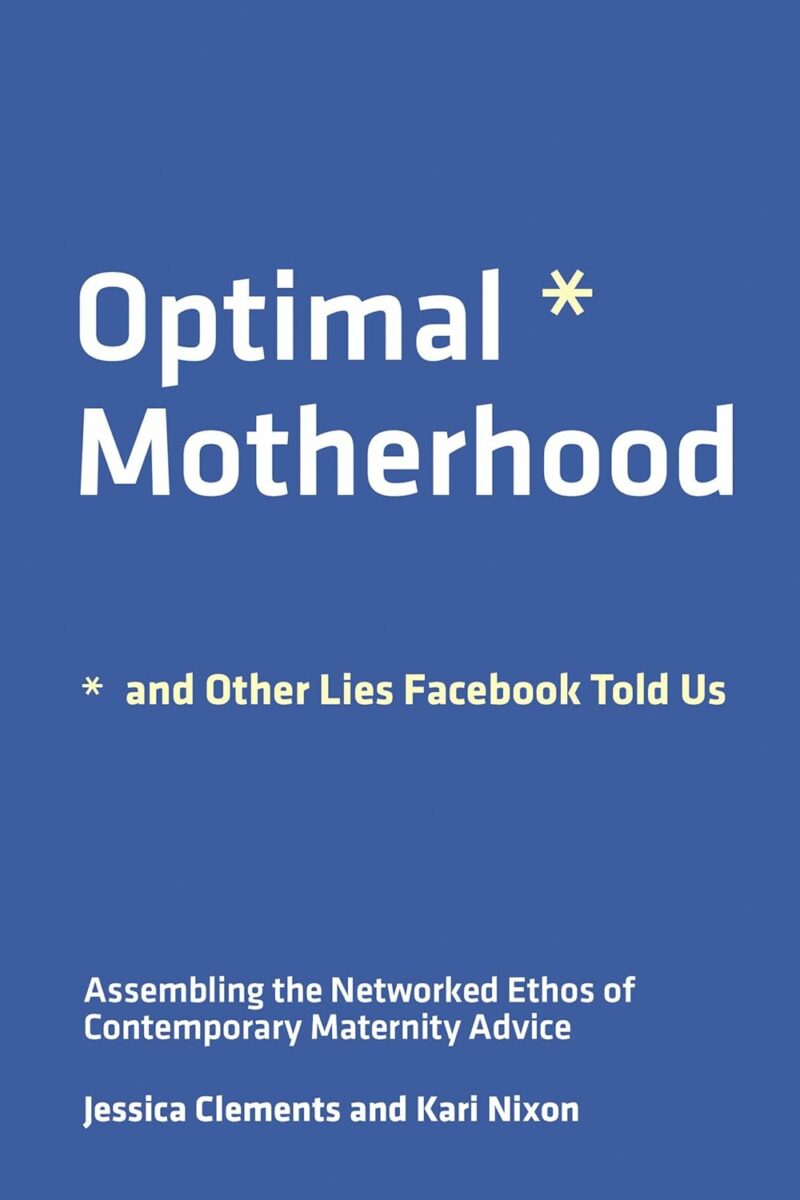
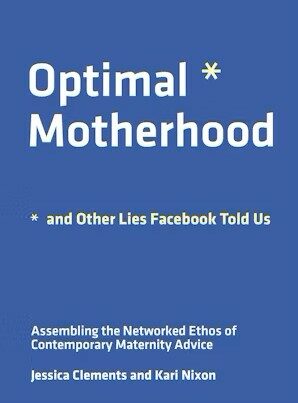
Clements, Jessica., and Karl Nixon. Optimal Motherhood and Other Lies Facebook Told Us: Assembling Networked Ethos of Contemporary Maternity Advice. The MIT Press, 2022.
In their book Optimal Motherhood and Other Lies Facebook Told Us: Assembling Networked Ethos of Contemporary Maternity Advice, Jessica Clements and Kari Nixon introduce “optimal motherhood,” a term that manifests itself in the revolving door of binary choices mothers make beginning before a child is born. Choices like whether to drink coffee, eat sushi, drink wine, or consume un-microwaved deli meat while pregnant. Choices like whether to give birth at home or in a hospital, breast or bottle feed your baby, stay at home with your baby or send them to daycare. As Clements and Nixon point out, these choices are not isolated or fleeting but tied up in social constructions of what constitutes “good” and “bad” mothers. Whether or not you are a parent, their book encourages reflection on cultural ideas about motherhood and the real life impacts these ideas have beyond the mothers and children who experience them most directly.
Throughout Optimal Motherhood, Clements and Nixon intertwine their parenting experiences with rhetorical analyses of digital media and multimethod research. Their research considers the experiences of mothers and alcohol consumption, labor and delivery, postpartum medical diagnoses, breast and bottle feeding, infant sleep, and interpreting at-home pregnancy tests. The book opens with Nixon standing in the grocery store deciding what food pouch—“half pint-sized vessels built from layers of laminated film that contain mashed-up vegetables laced with fruits” (1)—to buy for her daughter; through her narrative, Nixon reveals the mental gymnastics that happen for a seemingly mundane decision. Food pouches can be a shame-laden purchase, often blamed for picky eating, digestive issues, and as Nixon notes, decreased fine motor skills (the kind that enable someone to use a fork, for example). From there, Clements and Nixon shift into the origins of the book, and provide a thorough, foundational overview of optimal motherhood.
Clements and Nixon explain how the cult of true womanhood, a nineteenth century concept, is the foundation of optimal motherhood. At its heart, the Victorian era cult of true womanhood saw maternal perfection as something achieved through passivity—women remained pure and spread this purity to their families by example; this concept applied to “all aspects of women’s lives as daughters, wives, and mothers” (6). Optimal motherhood involves the same responsibilities as the cult of true womanhood, but with some slight modifications. Nixon and Clements break these down into three tenants: optimal motherhood focuses only on maternity issues; it prioritizes individualism rather than collective or communal support; and it doubles down on an increased and intense demand for perfectionism.
The introduction continues by explaining how neoliberalism and risk-aversion shape optimal motherhood. Neoliberalism, which the authors describe as “the way norms in modern, developed nations are enforced not by literal state force but more subtly through adding a moral value to behavior,” is especially reflected in the second tenant as women are viewed as responsible for understanding, researching, and meeting all their children’s needs (10). As Nixon and Clements explain, this is evident in a plethora of childrearing choices from what pajamas to put a child in, to what preschool to send them to. Meeting these needs is also tied to risk-aversion, which stems from the development of germ theory and bacteriology in the 1880s; it is the idea that if we can identify risks, we can also avoid them. In optimal motherhood, mothers are expected to be hypervigilant because if something happens to their child(ren) the mother is at fault—she wasn’t careful, attentive, or informed enough. In the context of optimal motherhood, neoliberalism is not only about understanding, researching, and meeting a child’s needs, it is also about repeating the choices that feel right and avoiding mistakes made by one’s own parents. To end the introduction, the authors mention postmodern theory as a tool for thinking critically about and dismantling optimal motherhood, and they also explore how ethos is tied to optimal motherhood, as an optimal mother proves her status by having ethos rooted in “scientific Truth claims” (22).
In the first chapter, Nixon and Clements discuss a case study from the Centers for Disease Control and Prevention’s (CDC) 2016 fetal alcohol syndrome (FAS) campaign. They explain that most data determining what is safe or unsafe for pregnant women is correlational, particularly related to what they eat or drink (35). This is problematic because of “confounding variables that could change the meaning of the data entirely” (36). This argument about data is central to understanding the CDC campaign, which relies on correlation data to posit no amount of alcohol is safe to drink while pregnant. While the chapter focuses primarily on the CDC FAS campaign, Nixon and Clements also include cultural ideas around mothers and alcohol consumption, specifically “mommy wine culture,” by incorporating memes as well as a social media post by an Olympic gymnast who is having a glass of wine postpartum. Throughout this first chapter, Nixon and Clements acknowledge a theme central to the book: the binary responses that occur in debates related to mothering. In this case, mothers who consume alcohol are bad and those who abstain are good.
Chapter two continues the focus on binary responses with birth plans and the #MeToo labor and delivery movement. The chapter begins by analyzing Facebook posts from members of new parent groups about birth plans—“a word-based, print-based genre meant to help women regain control in the labor and birthing process” (64). Focusing on linguistic and rhetorical features, Nixon and Clements describe how the posts reflect a right/wrong birth plan binary; they explain that having a plan is tied to agency while not having a plan implies no agency. “They then explain the history of birth plans before analyzing three different types (standardized, discussion, and birth partnerships), and then moving into how the negative or uncomfortable aspects of birthing, especially traumatic birthing experiences, are often silenced in social media spaces and popular culture. They connect this silencing to Samantha Wallace’s extension of the #MeToo movement, an extension that advocates for “using autobiographical experiences to raise awareness of ‘grey experiences’” (89). Nixon and Clements argue that making space to share complicated birth stories or “grey experiences”can benefit current and future mothers while challenging the binary that there is a right and wrong birthing experience.
The third chapter complicates the binary between post-partum depression (PPD) and baby blues; the latter is seen as a normal postpartum state, while the former is considered abnormal. In addition to considering postpartum screening tests, specifically “ well-designed web screening[s],” as actants that can “play an active part in dismantling the postpartum binary of ab/normal sadness,” chapter three includes analyses of Facebook posts related to PPD and baby blues (97). In their analysis, Nixon and Clements focus on the role of kairos and hedging, as well as how such posts and responses can reinforce feelings of guilt and shame. The authors also include interview data from mothers and health-care practitioners about their views on PPD. They divide this data into “The Moms” and “The Nurses,” using similar questions with slight modifications to center perspectives from parents versus healthcare providers.
Chapter four describes and defines the binary discourse around infant feeding decisions, specifically pro-formula feeding (PFF) versus pro-breastfeeding (PBF). They delve into Facebook posts related to PFF and PBF, noting patterns of defensiveness from PFF posters and PBF experiences of judgment. Within the chapter, the authors acknowledge the complexities tied to breast feeding, specifically complicating factors related to race and class, and they call for centering the lived experiences of mothers in maternal decision making citing mentoring within social media groups as a solution to dissolving the polarizing discourse around this topic (140-141).
Infant sleep is the focus of chapter five, and specifically, the choice of having an infant sleeping alone or with others. After opening with an anecdote about infant sleep challenges, the authors explain the lack of historical data and contemporary evidence on infant sleep. This acknowledgment sets the tone for the rest of the chapter, as it makes a case for why mothers turn to crowdsourcing information online to determine what is “best” (147). To make clear the limitations of the available scientific information for moms, Clements and Nixon analyze material from the National Institute of Health, the National Institute of Child Health, and the CDC. This section emphasizes the use of digital and visual rhetoric to enact hypervigilance and risk aversion in new mothers. The authors then analyze social media posts from moms on the topic, noting how mothers on both sides of the issue draw on scientific perspectives. Within this chapter, the authors offer an explicit breakdown of the rhetorical moves that happen in such exchanges, such as “dismissing evidence based on ethos of evidence creator” and “noting flaws in study design and applicability, and then presenting best practices from their own stance” (167). Ultimately, the authors emphasize how neoliberalism has created a lack of community for moms, which is at the heart of the problem—new parents need a community of support postpartum.
The sixth chapter shifts focus to how women trying to conceive develop community around the practice of tweaking pregnancy tests—using apps and filters to alter the color contrast and saturation of at-home pregnancy test images to discern a pregnancy line “at the earliest possible date” (175). Clements and Nixon theorize that in the absence of a fetus/infant, the central components of optimal motherhood are gone, creating the potential for reimaging motherhood as a “robust, supportive, and nonbinaristic community” (173). Clements and Nixon conduct an ethnographic study of digital spaces like message boards and the BabyCenter community where they analyze the linguistic practices of participants, and then describe a “corporately created alternative to tweaking communities”—a First Response Bluetooth-enabled pregnancy test (188). Rather than women helping one another through using apps and filters to discern pregnancy tests like they do in digital spaces, this alternative has women connect their pregnancy test to an app on their phone to decipher the results. Clements and Nixon don’t condone the app, and I couldn’t help but feel uneasy about the potential for digital surveillance with an app like this, particularly in our current post Roe v. Wade country.
In the conclusion, Clements and Nixon return to a point in the introduction and their sixth chapter: the importance of considering mothers intersectionally, and the limitations of optimal motherhood, which is deeply embedded in white, Anglo-American culture (173). They recognize that the primary demographic for their analytical observations is white, middle-class women from the United States and Canada, and they call for further research that considers how “women of color are forced to participate in a construction of Optimal motherhood that is not adequately captured in this book” (198).
Throughout the book, Nixon and Clements cover substantial ground related to visual, feminist, and digital rhetorics. They intertwine historical context with rhetorical theory and analysis, giving readers robust scholarly content and experiential perspectives. As a mother of a toddler and tween, I found myself relating to various parts of the book, and as an instructor, I could see Optimal Motherhood being a valuable resource for teaching visual rhetorical analysis, social media research, as well as feminist and digital rhetoric.
This book would work well in combination with Academic Mothers Building Online Communities: It Takes a Village edited by Sarah Trocchio et al., as well as Jenna Vinson’s Embodying the Problem: The Persuasive Power of the Teen Mother, and Kimberly Harper’s The Ethos of Black Motherhood in America: Only White Women Get Pregnant. I was reminded of Trocchio’s et al.’s edited collection as I read chapters two through five in Optimal Motherhood. Both texts consider aspects of building digital community with Trocchio et al.’s centering mother’s personal, lived experiences. Clements and Nixon’s visual rhetorical analysis of online memes as well as online campaigns and advertisements would be complimented well by the work Vinson does of the representations of teen mothers in anti-teen pregnancy campaigns, and the work Harper does of Black mothers in pregnancy books.
Optimal Motherhood recognizes the pervasiveness of binary thinking related to mothers, the importance of complicating this thinking, and the need for community building to eradicate polarization and develop a new conception of optimal motherhood.
Works Cited
Harper, Kimberly. The Ethos of Black Motherhood in America: Only White Women Get Pregnant. Lexington Books, United States, 2021.
Trocchio, Sarah, et al. Academic Mothers Building Online Communities: It Takes a Village. Palgrave Macmillan, Cham, Switzerland, 2023.
Vinson, Jenna. Embodying the Problem: The Persuasive Power of the Teen Mother. Rutgers University Press, United States, 2017, doi:10.36019/9780813591049.
About the Author
Alexandria Hanson is an assistant teaching professor of Writing Studies, Rhetoric, and Composition at Syracuse University. Her research interests include Feminist Rhetoric(s), institutional rhetorics, labor and policy, experiences of mothers in academe with a focus on single mothers, multilingual writers, translingualism, and writing program administration.
Acknowledgments
Thank you to Ana Milena Ribero and the Constellations editorial staff for patiently and generously offering feedback on the review; your comments helped make the writing clearer in a way I could not have accomplished on my own. I also appreciate the Constellations team who regularly bring issues to fruition, creating an invaluable space for cultural rhetorics scholarship. Finally, I am so grateful to Phelps Playschool for providing reliable, affordable, and high-quality childcare, so that I can do this work.
Production Credits
Book review editor: Ana Milena Ribero
Copyedited and posted by: Alex Jennings
Social Media Manager: Evelynn Pugh
Editor-in-chief: Alexandra Hidalgo
Related posts:
 “Who is Worthy of Childhood?”: A Review of Wendy Hesford’s Violent Exceptions: Children’s Human Rights and Humanitarian Rhetorics
 How to Spot a Fascist: A Review of The Rhetoric of Fascism, Edited by Nathan Crick
 Send My Love to the Family: A Review of Glasby, Gradin, and Ryerson’s Storytelling in Queer Appalachia: Imagining and Writing the Unspeakable Other
 “Theory With No Practice Ain’t Shit”: A Review of Aja Y. Martinez’s Counterstory: The Rhetoric and Writing of Critical Race Theory
 “You Know, Anger Can Be Righteous”: A Review of James Chase Sanchez’s Salt of the Earth and Joel Fendelman’s Man on Fire
 Black Tech Matters: A Review of Charlton McIlwain’s Black Software