
Sonia C. Arellano, Independent Scholar
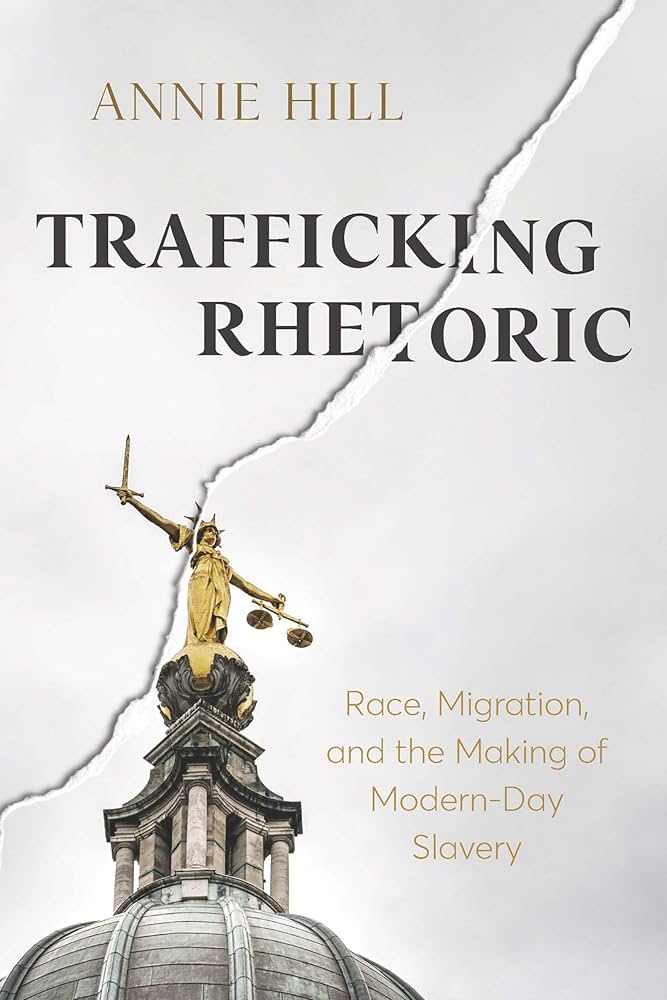
Hill, Annie. Trafficking Rhetoric: Race, Migration, and the Making of Modern-Day Slavery. The Ohio State University Press, 2024.
Could there possibly be a better time to discuss the cultural politics of immigration, race, and gender? As the recent 2024 election season has demonstrated, these issues are at the forefront of US American’s minds and the tips of politicians’ tongues. However, the movement of people, racialization of historically excluded groups, erasure of a country’s atrocious history, and criminalization of marginalized groups and their actions are not unique to the US. Annie Hill’s Trafficking Rhetoric: Race, Migration, and the Making of Modern-Day Slavery artfully critiques the rhetoric of trafficking, specifically in the United Kingdom, in relation to its imperialist past and its recent attempts to save victims of trafficking through aggressive immigration and criminalization policies. Hill does a great job of calling out the UK as a key perpetrator of slavery and imperialism—although they attempt to absolve themselves of their past by venerating their abolition of slavery—while carefully explicating how their attempts to protect and save victims of trafficking (read: white Eastern European women) actually negatively impact the very people they intend to save because (gasp!) migration, trafficking, and race are so much more complicated than the clearly demarcated terms established in the flawed UK policy.
Hill uses genealogical methods to trace the UK antitrafficking agenda from 2000-2022 and examines “material rhetorical texts” including faked reports, government action plans, public awareness campaigns, and relevant policy and program documents. Her analysis handles “trafficking texts as material rhetoric,” treating the material and discursive as co-constitutive not as separate elements (5). Hill’s method of analysis “starts from a premise that rhetoric is material,” meaning that the discourse in the examined texts matters because they produce the policies that dramatically and materially affect marginalized people’s lives (5). In the book this method appears as a textual rhetorical analysis with specific emphasis on how the texts rhetorically construct and then address trafficking, illustrating how trafficking rhetoric manifests materially in the world.
The true art of Hill’s work is the very clear contradictions she illuminates throughout each step the UK takes to fight human trafficking. Hill opens the book with an important contradiction: simultaneous state veneration and state violence. She argues that “the torque of state veneration and state violence is evinced—it is evidenced—when a state points to the supposed misdeeds of others as a way of celebrating itself and concealing its own aggression” (3). This argument is the thread that binds her book. Chapter One, “Speculative Figures,” details the effectiveness of flawed quantitative rhetoric used to make impactful policy decisions. Hill engages a rhetorical-material analysis of two important reports from the Home Office to demonstrate how the numbers of women trafficked for sexual exploitation were erroneously extrapolated and then affirmed as true. In explaining their methods, the researchers who published one report state that they first estimate the number of women who are of foreign origin and then from that number they assumed how many were trafficked, essentially equating foreign to forced. Hill traces these initial numbers from their creation to their circulation in the media to convince UK citizens and politicians of the existence of human trafficking. In analyzing such incredibly flawed reports, Hill elucidates how easily “bad numbers are created and circulated ostensibly for a good cause” (49).
Chapter Two, “Anti-Blackness by Analogy,” analyzes the UK Action Plan to Tackle Human Trafficking. Hill details how the UK invokes the memory of slavery in the Action Plan only as a reference point to absolve the UK of their past and to create a false equivalence to the current trafficking of white people. In the Action Plan the Home Office venerates the abolition of slavery by referencing the 1807 anniversary and including a commemorative coin while also making no connection to or acknowledgement of Britain’s history of the slave trade. The Action Plan incites moral panic about white people being trafficked and being victims of a modern-day slavery. Falsely tying slavery to trafficking disregards the structural factors shaping migration, therefore not allowing any kind of discursive opposition.
Importantly, framing white migrants as victims of trafficking serves to maintain Britain’s racial purity in two ways. It leaves no room for nonwhite migrants to be considered victims; they are seen as migrating out of choice, and therefore, subject to and deserving of the violent anti-immigration policies that Hill details in Chapter Four. Additionally, such framing does not consider the legacy of slavery on black UK citizens. Hill points to the UK’s quick action to implement antitrafficking measures, but inability to implement antiracist measures to address the state-sanctioned violence black UK citizens experience. Here is the contradiction Hill so beautifully connects us back to in the end of the chapter: the UK venerates its abolishing of slavery while perpetuating state-sanctioned violence against migrants and descendants of enslaved Africans through policy and practice.
In Chapter Three, “Glaring Whiteness,” Hill examines an antitrafficking campaign called Blue Blindfold focusing on how the campaign uses statistics and images to appeal to logos and ethos. The underlying argument of the campaign was to persuade the viewer (white UK citizens) to look out for trafficking victims and report when they think they see instances of trafficking. By claiming that human trafficking was happening everywhere, the campaign promoted a state of nationwide surveillance. Hill analyzes images from the campaign that mainly include white women (assumingly Eastern European) as the women being trafficked and images of white women, Britons, who are wearing blindfolds to symbolize the community’s ignorance to human trafficking. In this way, the campaign implores UK white women to take off the blindfold for their country to see and save trafficked white women. Insightfully, in her analysis, Hill mentions the ableist logic in using a blindfold in the campaign so that “disability thus becomes a prop and plot device for the dramatic action of removing the blindfold and restoring sight” (82). Hill extends her critique to the expansive use of the blindfold campaign in countries, all former British Colonies with primary white populations (Canada, Ireland, US), which portrays the UK as a leader in the global antitrafficking market, continuing to export its influence and facilitating extraterritorial governance with other countries to further its own antitrafficking agenda. Finally, she notes how the phrase “blindfold Brexit” emerged during the Brexit campaign in an effort to protect the UK from being “enslaved” by the EU. In doing so, she explains how the adoption of the Blue Blindfold in various campaigns “signals its overall success as an antitrafficking signifier, empty enough for use in different countries and contexts” (91).
Chapter Four, “‘A Really Hostile Environment for Illegal Migrants,’” is perhaps the most difficult to read, simply because it is heartbreaking. Hill begins with the title quote said by the 2012 Home Secretary as the goal for the UK to become. Hill then proceeds to trace how the Conservative Party did just that using the Hostile Environment Policy. Most of the chapter focuses on two elements of the Hostile Environment Policy: 1) the Statistical Assessment from the Operation Pentameter 2 (OP2) and 2) the National Referral Mechanism (NRM).
OP2 was the second iteration of a police-led campaign (Operation Pentameter) to target trafficking for sexual exploitation. Hill examines the language of the Statistical Assessment and discusses the very public shortcomings of the campaign. The report revealed that the imagined numbers of women being trafficked and the type of women being trafficked were all wrong. Officers were unsure how to categorize people, often categorizing a person as both a victim and a suspect, disrupting the idea that trafficker and trafficked are clearly different. Moreover, they had trouble identifying if a woman was being trafficked or a sex worker or both. Mostly women from China and Southeast Asia were being trafficked and charged with trafficking because of these difficult overlapping categories. Although this campaign was intended to protect migrant women (antitrafficking), it negatively affected migrant women (anti-immigrant) who, ultimately, bore the brunt of OP2 because in an effort to eliminate prostitution, many migrant women were criminalized and prosecuted.
Lastly, in Chapter Four, Hill discusses the National Referral Mechanism, a program for people to appeal for victim of trafficking status. One problem with this program was the definition of who counts as a victim. The narrative that trafficked women are forced to migrate and have no agency requires morally pure victims, which excludes women who choose to migrate and cannot be seen as helpless. Another problem Hill details is unqualified law enforcement and case managers who did not recognize people as victims of trafficking. For example, one woman was not categorized as a victim because time had passed and she had obtained a job, which according to the case manager was proof that the woman had overcome her trauma. Hill analyzes the Statistical Assessment and the NRM to demonstrate the material negative outcomes of such programs on people’s lives.
The conclusion begins discussing a recent scandal concerning a group of people known as the Windrush generation—people who immigrated to the UK from the commonwealth Caribbean between 1948-1971. In 2018, the government began to say that people of the Windrush generation had no right to remain in the UK, and officials were demanding documentation for each year they’d been in the UK. Of course, this documentation was difficult for many people to produce, and many were denied full rights as citizens and in some cases were even deported after living decades in the UK. Hill discusses this scandal because it shows how the Hostile Environment Policy targeted groups of people and materially affected their lives. The Windrush generation scandal is a noteworthy example of the contradiction of state veneration and state violence: the UK’s revered antitrafficking agenda is to monitor and control unwanted immigration, which resulted in the persecution of black migrants, while ignoring the British land and labor theft that allowed the Windrush generation to be in the UK in the first place (123).
In her conclusion, Hill carefully conveys the multiple contributions of her book. Her analysis shows how xenophobia and racism materialize (as) State agendas (125) and how race remains a moving target (126). She claims that her book shows the results of centering feminist and critical race theories, as well as gender and race in analyses of state agendas, and she hopes that her analysis of texts concerning quantitative rhetoric, law, and policy helps people study “how a state’s language materializes in and through people’s lives” (127). She also lays out three points to inform future work: 1) racism and colonialism are inextricably linked; 2) we need to build solidarity across struggles that recognize the common threads creating racist and anti-immigrant nationalism; and 3) white supremacy is expansive and explicitly transnational (127). Ultimately, she leaves readers with a very hopeful and positive note claiming that we need to continue doing the critical work of antiracism and commit to fighting the hard fight.
One thing that Hill does extraordinarily well is bring to bear the past and consider the future while being firmly situated in material content and material consequences of the present. The book is beautifully written with some incredibly delicious sentences. One point of difficulty for me was learning so many reference points and histories that I was unaware of. This is not the fault of the author or book but more of a point for reflection about my US-centric viewpoint. Overall, this book is timely, great to read, and important for our current political context. Hill makes us consider what happens when flawed logic and rhetoric inform state initiatives. In the current environment where we risk lies propagating policy change, we can learn so much from examining how such rhetoric has impacted policy previously and continues to do so.
About the Author
Sonia C. Arellano is an independent scholar and current Director of the Migrant Quilt Project. Her scholarship broadly engages social justice issues through textiles, tactile methods, Tactile rhetorics, and mentoring of BIPOC students and faculty. You can see her scholarship in journals such as Peitho, Rhetoric Review, Composition Studies, and College Composition and Communication. Sonia was awarded the 2022 CCCC Richard Braddock Award for her research quilt and article titled “Sexual Violences Traveling to El Norte: An Example of Quilting as Method.” Additionally, Sonia received the 2022 Theresa J. Enos Anniversary Award, which recognizes “Best Essay” published in Rhetoric Review, for her article “Quilting as a Qualitative, Feminist Research Method: Expanding Understandings of Migrant Deaths.”
Production Credits
Book review editor: Ana Milena Ribero
Copy Editors: Megan Simmermeyer and Alexandra Hidalgo
Posted by: Natalie Cohen
Editorial Assistants: Megan Simmermeyer and Alex Jennings
Social Media Manager: Evelynn Pugh
Special Issue Editors: Christina Cedillo, Ana Milena Ribero, and Kimberly Gail Wieser-Weryackwe
Editor-in-Chief: Alexandra Hidalgo
Related posts:
 Sovereignty, Lands and Rhetoric: A Review of Danielle Endres’ Nuclear Decolonization: Indigenous Resistance to High-Level Nuclear Waste Siting
 Creating Home through Narrative: A Review of V. Jo Hsu’s Constellating Home: Trans and Queer Asian American Rhetorics
 Send My Love to the Family: A Review of Glasby, Gradin, and Ryerson’s Storytelling in Queer Appalachia: Imagining and Writing the Unspeakable Other
 “Theory With No Practice Ain’t Shit”: A Review of Aja Y. Martinez’s Counterstory: The Rhetoric and Writing of Critical Race Theory
 “You Know, Anger Can Be Righteous”: A Review of James Chase Sanchez’s Salt of the Earth and Joel Fendelman’s Man on Fire
 Black Tech Matters: A Review of Charlton McIlwain’s Black Software