
by: Amanda Fields, Central Connecticut State University
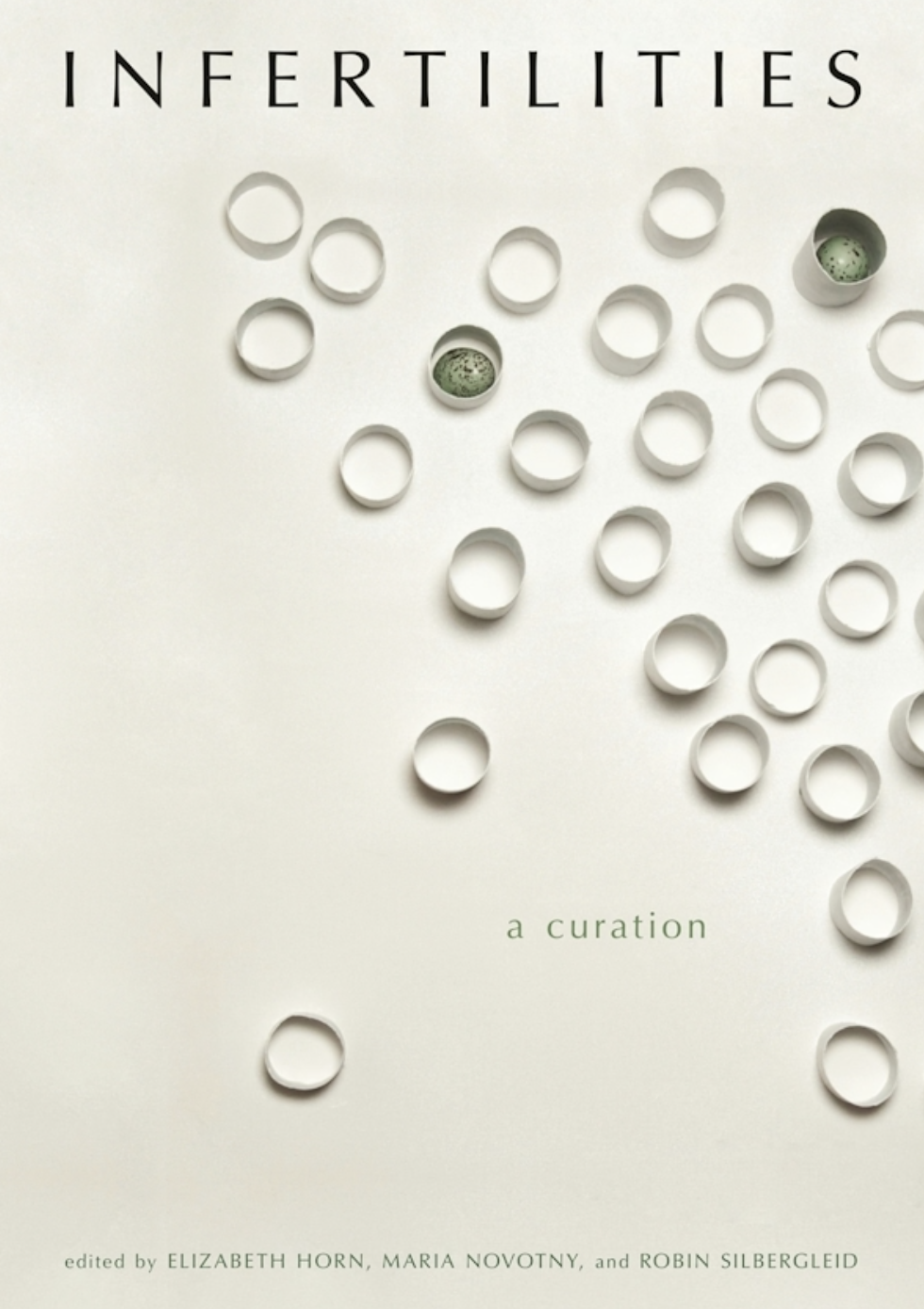
Infertilities, a Curation
Edited by Elizabeth Horn, Maria Novotny and Robin Silbergleid. Published by Wayne State University Press. 2023.
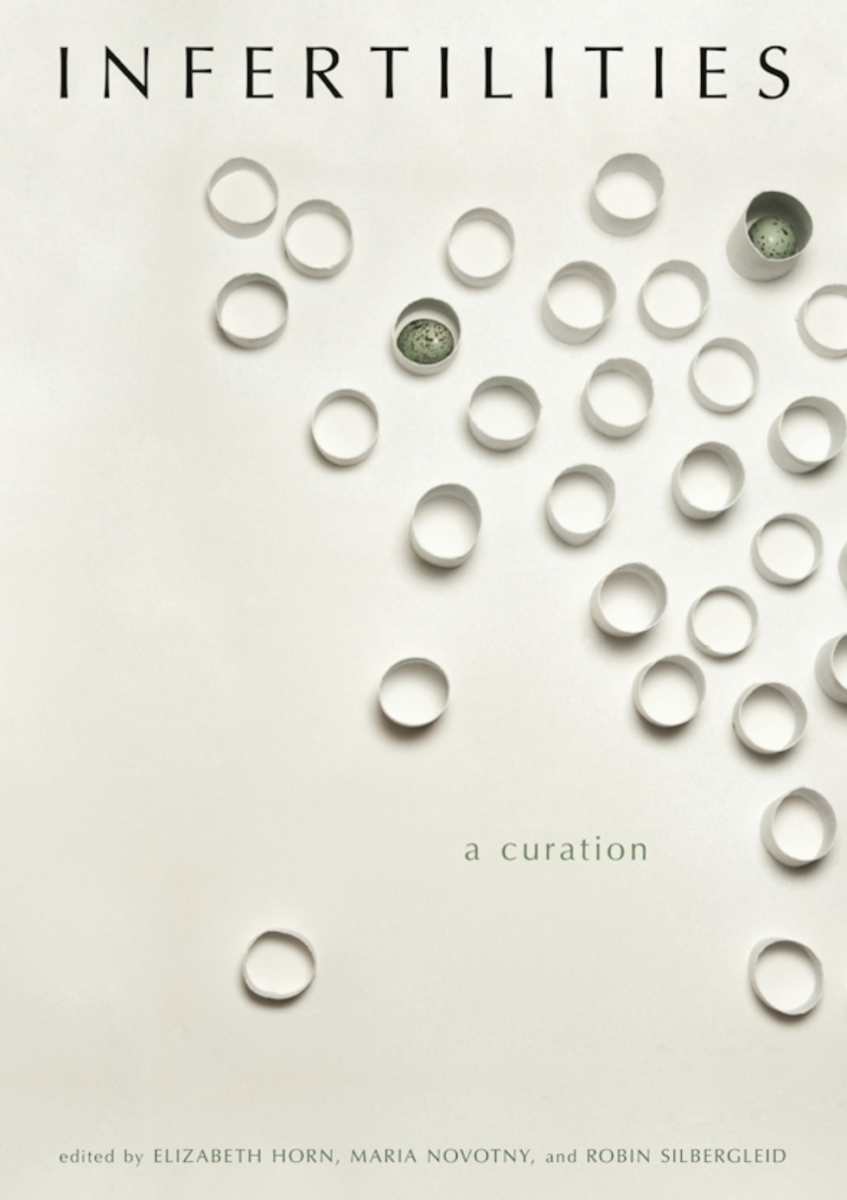
In Infertilities: A Curation, Elizabeth Horn, Maria Novotny, and Robin Silbergleid collect “a visual and textual performance of the experience of fertility” (3). The publishing industry tends to refer to such assemblages as “collections” or “anthologies.” Horn, Novotny, and Silbergleid, however, call this book a “curation,” which not only indicates selectivity and intentional arrangement but also honors collaborative conversation among writing and other forms of art, much like a gallery exhibition.
Infertilities grew from the editors’ work with fertility clinic patients and The ART of Infertility, a group dedicated to supporting multigenre expressions. Horn writes, “ART has a double meaning, referring both to the artwork created by individuals living with infertility and to assisted reproductive technologies” (xi). This group’s work eventually became part of an exhibition in Ann Arbor that led to this book. Indeed, the book’s arrangement calls up a museum that readers navigate with their own pace and movement, which offers space to apply sociocultural understandings of and experiences with infertility, parenting, and families.
As the editor-in-chief of Literary Mama and an academic, I’m often hit with the persistent evidence that parenthood (especially motherhood) stories aren’t offered due critical respect. This curation chafes against such silly notions, specifically in meditations about the medical establishment and the bodily tolls of infertility. Its written pieces include poetry and essays, and its artwork varies widely in genre, which contributes to an overall thread of resisting linear discourse and normative systems. At their core, these expressions address multifaceted ways in which people experiencing infertility can connect, reflect, and potentially advocate for understanding and action about infertility.
Infertilities is organized into what the editors refer to as “rough movements” that narrate the “beginnings, middles, and ends” of infertility (4), qualifying that “the experience of infertility is temporally linear and emotionally recursive” (4-5). Section 1 covers “the emotional beginnings” with diagnoses and family (9). Section 2 conveys “the murky middle” of “trying” to conceive and the questions that arise as a result (81). Section 3 reckons with the aftermath of infertility and the possible outcomes, with the editors asking: “What does infertility look like?” (153).
Many of the pieces describe medical approaches that can lead to not only misunderstanding but irreparable harm for those experiencing infertility. In the essay “Mother’s Day,” Carla Rachel Sameth questions how individuals decide to keep pursuing fertility treatments, writing, “I see it seems absurd – this blind adherence to a path that proved so destructive to my health and psyche” (37). Other artists describe their frustrations at medical conclusions that don’t consider individual and cultural needs. In the essay “Grief to the Bone,” Yomaira Figueroa-Vázquez describes a white primary care provider whose initial advice for infertility is to lose ten pounds. Later, the same PCP tells her that she is entering perimenopause and it is unlikely she will become pregnant. A week later, Figueroa-Vázquez’s ob-gyn tells her that she is “perfectly healthy” and “can have babies” (108-9). Figueroa-Vázquez layers this personal experience with data from Puerto Rico, “the most sterilized nation in the world,” writing, “I touch an empty womb. I rage against histories of corporeal dispossession” (109). Throughout the curation, medical providers – with lives, bodies, and health in their hands – often disappoint their patients.
The curation covers not only the dearth of respect for the complexities of parenting and infertility but also the lack of diverse understandings on identity. As the editors and a few of the contributors note, most statistics on infertility are based on heteronormative coupling and tend to omit single parents by choice as well as same sex parents. In the essay “She’s Not My Mother: Fertility, Queerness, and Invisibility,” Jennifer Berney writes, “As it turns out, there’s no place on anyone’s chart to write lesbians. Male factor infertility remains the standard diagnosis for all lesbian couples seeking intrauterine inseminations. It’s a term that inserts a man in the equation, when there is none” (53). In “Frozen Futures,” Krys Malcolm Belc describes being a “visibly queer teacher” whose status at work shifted with the pregnancy of their partner, Anna, “who has always, though it is not a role she chose or would have chosen, made me seem more normal” (186). Belc also reflects on the maintenance of a sperm bank after Anna has their child: “Everything we decided about the bank was a projection of a possible future we could barely imagine” (187). Choices about what to do with the sperm – whether to pay an annual fee or ditch it – indicate uncertainty and the pressure to plan ahead in a way that doesn’t often reflect material reality. In considering this question, Belc runs into an existential dilemma: “If we use the sperm, our sperm, if one of us becomes pregnant, we will have to access the selves we were…In our family, there is no way to move forward without looking back” (188). The pressures of capitalist discourse on these choices are evident in Belc’s essay, as even cited emails about the sperm collection demonstrate a sense of bloodless medical detachment. Berney, too, notes that, in spite of the ways the medical establishment could learn about how queer patients experience infertility, they are “treated like anomalies” (55). The indifference of the medical establishment evidenced in the curation is striking and could prompt work by cultural rhetorics scholars in expanding the possibilities of medical discourse.
The artists in this curation also offer powerful counters to the more lifeless aspects of contemporary medicine. Figueroa-Vázquez and others take note of providers who go above and beyond, such as the gynecologist who listened to Figueroa-Vázquez for an hour every two weeks for many months: “Even now, I don’t know where to place my gratitude for her care” (112). In an acrylic titled “El Camino,” Molina B. Dayal offers the perspective of a medical practitioner who has gone through infertility (124-5). And about a watercolor, “HSG,” Adi Hadar praises the doctor who took extra time to stay with her through three hysterosalpingograms (26).
Ashley MacLure’s “The Wound” brings these concerns to bear. The fiber piece features a woman lying on her back, hair splayed and palms flat to her sides, with red thread streaming from her uterus, a piece MacClure says is meant to be “used on a decorative throw pillow” (116). MacClure writes, “I’ve considered mailing it to the doctors who delivered my daughter as a reminder that mothers are human” (116).
Another theme in the book is the embodiment of infertility. As with the critiques of the medical establishment, contributors describe exterior violations and interior betrayals of the body. Many of the contributors make use of the discourses surrounding their experience, such as emails from doctors, and this focus on various texts clarifies how individuals absorb and carry the weight of language while experiencing infertility. For instance, Betty Doyle’s poem, “On Ovaries,” depicts the heaviness of science conversing with culture (86). Doyle meditates on facts about eggs in humans, birds, and clownfish, interspersing these facts with personal experiences – from lying in cramping pain on the floor of a public restroom to feeling pride at getting her period at age 11, “smug in my supposed womanhood” (86). For Doyle, scientific data along with cultural mythologies about fertility are heavy weights when one is infertile. This weight leads to uncertainty as Doyle considers options and treatments for infertility.
The weight and uncertainty are also evident in “Excision,” acrylic and thread on canvas by Jo C. about getting ovarian cysts removed, in which the artist reflects on the uncertainty of not knowing what will be found until the procedure is finished (88). Monica Wiesblott’s photopolymer etching, “The Seeds Were Sown,” shows a uterus “stuck together and twisted with scar tissue” from endometriosis and ovarian growth; the artist says of infertility treatment that “It started to feel like we were paying snake oil salespeople, who claimed that if I drank this or allowed the next procedure, I would instantly grow a baby with no problem” (94). And in “Mother’s Day,” Carla Rachel Sameth captures the psychological weight: the desire for a perfect trajectory prevented her eventual positive pregnancy result from feeling like the triumph she wanted it to be.
Toward the end of the curation, editor Robin Silbergleid asks, “What makes a mother?…Mothering is a verb, I think, more than it is a noun. Perhaps motherhood is not a permanent state of being. You can be a ‘genetic’ mother, a ‘biological’ mother, a ‘social’ mother. These qualifiers are not meant to be exclusionary; I just think they are different” (201). In the essay “Frozen,” Silbergleid, in true editor’s fashion, meditates on her journey of infertility as well as what it means to be a mother from journeys and stories not her own. Possibilities abound on the infertility journey, and some offer a false sense of control. So too, editor Elizabeth Horn meditates on the freezing of memories and archives as those who have experienced infertility try to make meaning of the journey. In “Crib with Medication Boxes” (mixed media), Horn presents a wooden crib and mattress that hold “the remnants of approximately $10,000 worth of medications, needles, and syringes” (218). Horn writes, “I wanted a historical record of my experience with infertility for the day it no longer plagued me. Now, I realize that infertility is always there” (218).
“Crib with Medication Boxes” is a powerful final piece in the curation because it solidifies the influence of art and storytelling for both creator and receiver: each time we immerse ourselves in expression, we respond differently based on where we perceive ourselves in time and space. An artist still looks this way and that at a piece that is “finished,” only to find something new each time. Infertility experiences – beginning, middle, and end – are all of a piece, and recursive. The editors’ insistence on infertility as an ongoing journey in this curation offers several lenses on the experience while emphasizing the many sorts of meaning that can be found along the way and beyond.
About the Author
Amanda Fields is an Associate Professor of English and the Writing Center director at Central Connecticut State University, the Editor-in-Chief of Literary Mama, and co-host of the podcast This Mama Is Lit!. Fields co-edited My Caesarean: Twenty-One Mothers on the C-Section Experience and After, a Silver winner of the 2019 Foreword INDIES. Fields has published in Brevity, Indiana Review, MUTHA Magazine, So to Speak, Nashville Review, Kairos: A Journal of Rhetoric, Technology, and Pedagogy, Children’s Literature Association Quarterly, Writing Program Administration, The Peer Review, Sexuality Research and Social Policy, Journal of Adolescent Research, Writing Center Journal, and others.
Production Credits
Book Review Editor: Ana Milena Ribero
Editorial Assistant: Gissell Del Castillo
Posted by: Gissell Del Castillo
Social Media Manager: Sasha Jason
Editor-in-chief: Alexandra Hidalgo
Related posts:
 Reproductive Liberation Requires Dismantling the Gender Binary: A Review of Doing Gender Justice: Queering Reproduction, Kin and Care by Shui-yin Sharon Yam and Natalie Fixmer- Oraiz
 “Theory With No Practice Ain’t Shit”: A Review of Aja Y. Martinez’s Counterstory: The Rhetoric and Writing of Critical Race Theory
 Cultivating Solidarity through Radical Subjectivity: A Review of Noor Ghazal Aswad’s Searching for Solidarity: Revolutionary Dreams and Radical Social Movements
 Constellating with our Foremothers: Stories of Mothers Making Space in Rhetoric and Composition
 Truth Beyond Reason: Speculative Fictions and the Mad Imagination
 How to Spot a Fascist: A Review of The Rhetoric of Fascism, Edited by Nathan Crick